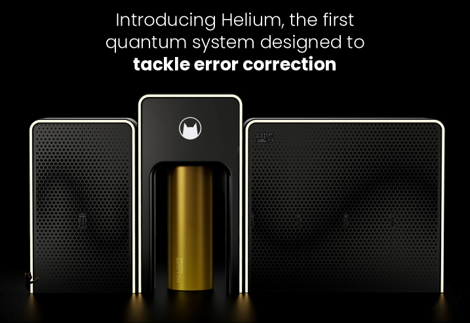
Fault-tolerant hardware developer Alice & Bob has unveiled the Helium Quantum System, transitioning the company from chip-level manufacturing into delivering full-stack, on-premise quantum computing platforms. However, in an industry accustomed to bold claims of record qubit counts and glossy commercial timelines, the company has explicitly stated that Helium “is not a product launch.” Instead, Alice & Bob is pitching the platform as the world’s first physical cat-qubit laboratory explicitly open to third-party organizations—a dedicated hardware environment built from first principles to move quantum error correction (QEC) out of theoretical debate and into raw experimental validation.
The Mathematical Paradigm of Asymmetric Cat-Qubits
Operating on a noise-biased cat-qubit architecture, the integrated machine is engineered to encode the company’s first logical qubit using an array of 18 physical cat-qubits. While standard transmon or neutral-atom architectures must combat bit-flip and phase-flip errors with equal frequency, Helium’s cat-qubits are physically engineered to suppress bit-flip errors exponentially at the hardware layer. On the Helium system, bit-flip protection times can exceed an hour before error correction software is even applied. By using hardware to eliminate one entire axis of the error equation, the platform fundamentally alters the mathematical structure of the QEC problem, allowing research partners, national laboratories, and high-performance computing (HPC) centers to focus entirely on mastering phase-flip accumulation at a fraction of the physical qubit overhead.
Hardware Topology, Co-Location Integration, and Operational Footprint
The Helium architecture is constructed as a modular, upgradeable system designed to structurally support Alice & Bob’s upcoming 48-cat-qubit chip generation without requiring complete infrastructure replacement. To facilitate deployment within legacy supercomputing nodes, the system incorporates full compatibility with major classical HPC workload managers, such as Slurm, utilizing the open-source QRMI (Quantum Resource Management Interface) library. For programmatic interfacing, users control the chip via Alice & Bob’s native Felis software framework, which compiles custom, noise-biased instruction sets while maintaining cross-compatibility with mainstream quantum programming languages. Mechanically, the hardware reduces typical deployment barriers by operating on a modest power footprint of approximately 40 kW while maintaining strict facility tolerances, including a 18–25°C ambient temperature range, a 60 dB maximum acoustic noise threshold, and a 45–65% humidity envelope.
The Starboard Interface and the Philosophy of “Co-Design”
Coupled with the hardware launch, Alice & Bob introduced Starboard, a proprietary, highly automated system monitoring interface that grants site administrators real-time control over the 18-cat-qubit processor. From a centralized dashboard, operators can track individual qubit coherence metrics, program and schedule workflows based on real-time chip utilization, and review deep instrument telemetry across the cryogenic dilution refrigerator rack. Rather than treating this stack as infrastructure to be rented remotely via the cloud, Alice & Bob is offering a deep “co-design” model. Partner organizations receive full-stack integration support, joint maintenance protocols, and shared authorship of scientific results, allowing external research teams to directly shape the error-correction discovery pipeline.
Platform Roadmap Projections Toward 2030
This structural diagnostic stack serves as the foundational validation testbed for the company’s long-term commercial roadmap. By leveraging the inherent phase-stabilization properties of cat-qubits—which mathematically cut physical hardware scaling requirements up to 200 times compared to standard topologies—the Helium system anchors a multi-generational development pipeline. The experimental protocols developed by researchers on Helium today are architected to carry forward natively into upcoming Lithium and Beryllium platforms, building the definitive accumulated experimental knowledge required to realize a universal, fault-tolerant quantum computer by 2030.
The official, technical syndication announcements detailing system architecture parameters can be reviewed directly via HPCwire here. For detailed operational guidelines, power-grid requirements, floor layouts, and multi-generational hardware specifications, check the Alice & Bob Platform Index here, and explore the complete executive manifest outlining the company’s “Anti-Launch” commercial methodology on the Alice & Bob Insights Journal here.
June 11, 2026/ Updated June 17, 2026