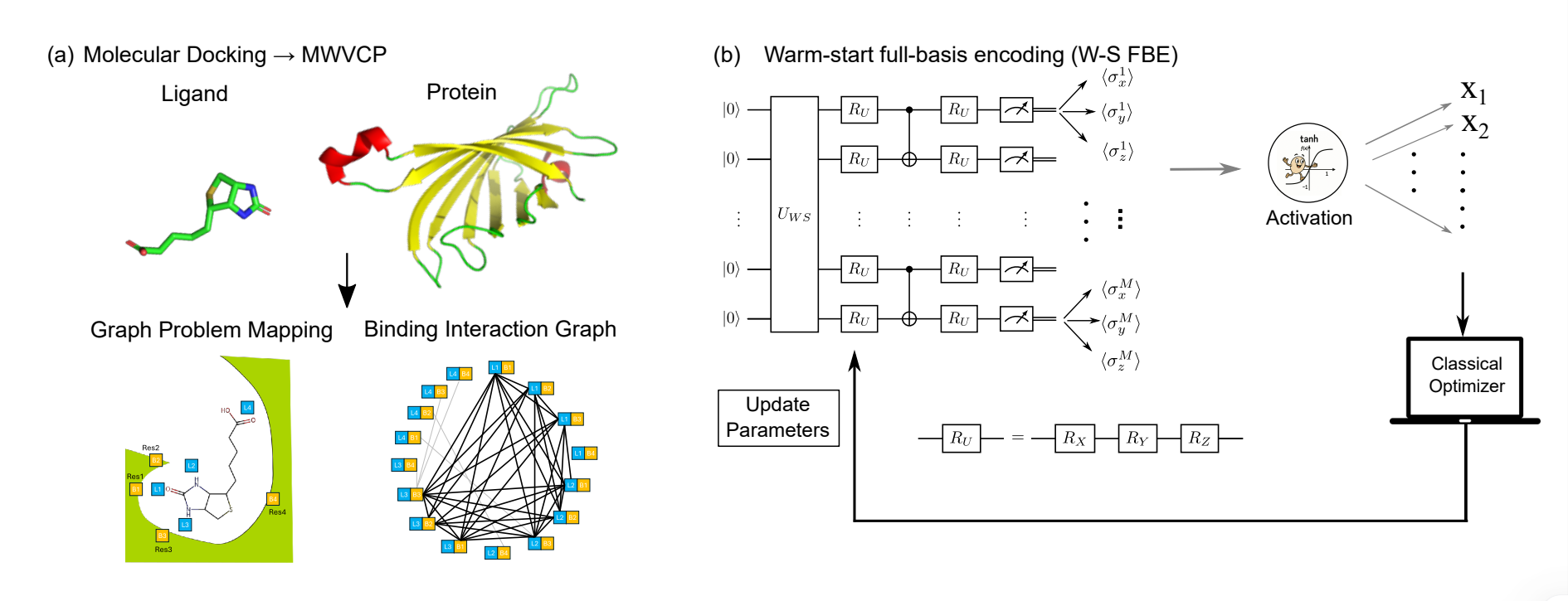
Researchers from Singapore’s Agency for Science, Technology and Research (A*STAR) and the National University of Singapore (NUS) have introduced a hybrid quantum-classical framework that compresses the qubit footprint required for structure-based drug discovery. Published on arXiv (arXiv:2608.19868), the study demonstrates resource-efficient bio-molecular docking—identifying optimal binding configurations between a ligand and a target protein—on digital NISQ hardware using IBM’s 156-qubit Heron r2 processor (ibm_kingston).
| [ Warm-Start Full-Basis Encoding (W-S FBE) Framework ] | ||
|---|---|---|
| Optimization Mapping | Quantum Qubit Encoding | Hardware & Verification |
| • Maximum Vertex-Weighted Clique (MVWCP) | • Full-Basis Encoding (3 Variables / Qubit) | • IBM Heron r2 Processor (ibm_kingston) |
| • Binding Interaction Graph (BIG) Construction | • ⌈N/3⌉ Physical Qubit Requirement | • 1stp (Biotin, N=18 Solved via 6 Qubits) |
| • QUBO / Ising Cost Hamiltonian Reduction | • qDRIFT-Inspired MPS Warm-Start | • 9aw2 (Benzamidine, N=14 Solved via 5 Qubits) |
Three-Variable Qubit Compression via Full-Basis Encoding
Molecular docking requires searching vast combinatorial spaces to find mutually compatible pharmacophore interaction sets. While classical approaches recast docking as a Maximum Vertex-Weighted Clique Problem (MVWCP) on a compatibility graph, traditional quantum mappings assign one binary variable per physical qubit, quickly exceeding near-term hardware limits:
- Full-Basis Encoding (FBE): Rather than reading out a single observable per qubit (⟨σz⟩), FBE assigns classical variables across all three orthogonal Bloch-sphere expectation values (⟨σx⟩, ⟨σy⟩, ⟨σz⟩). This allows up to three decision variables to be hosted on a single physical qubit, reducing an N-variable optimization problem to just ⌈N/3⌉ physical qubits.
- Mathematical Proof of Pure Product Ground States: The authors provide a rigorous proof establishing that at least one global minimizer of the continuous FBE objective can always be represented as a pure product state. This proves that complex multi-qubit entanglement is not required to represent the optimal discrete solution, justifying shallow unitary variational circuits.
- Stochastic Imaginary-Time Evolution Warm-Start: To bypass barren plateaus and accelerate training convergence, the optimization initializes via a Trotterized stochastic drift (qDRIFT) imaginary-time evolution step calculated classically using Matrix Product States (MPS).
Execution on IBM Heron QPU and Benchmark Systems
The team validated the framework on two biologically relevant protein-ligand complexes derived from the Protein Data Bank (PDB):
- Streptavidin–Biotin Complex (1stp): Mapped to an N=18 binding interaction graph and executed on the IBM Heron processor using 6 physical qubits.
- Trypsin–Benzamidine Complex (9aw2): Mapped to an N=14 binding interaction graph and executed on hardware using 5 physical qubits.
For both complex structures, the hardware measurements recovered the exact ground-truth clique assignments calculated by classical graph solvers under real gate infidelities and readout errors, outperforming standard two-basis (ZX) encodings under identical circuit-depth and training budgets.
The research was supported by the National Research Foundation, Singapore, and A*STAR’s Quantum Innovation Centre (Q.InC).
Review the complete open-access paper on arXiv:2608.19868 here.
August 27, 2026

