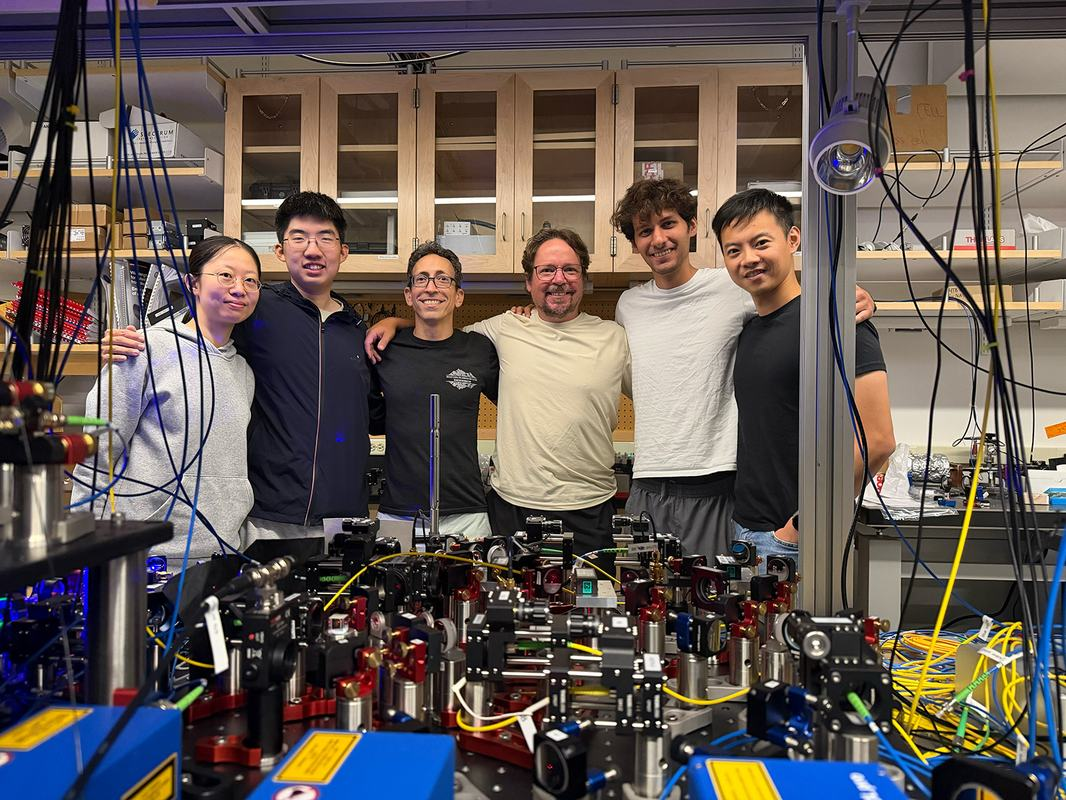
A physics collaboration led by Caltech—combining the experimental laboratory of Professor Manuel Endres and the theoretical group of Professor Jason Alicea, alongside theorists from Université Paris-Saclay and the Technical University of Munich—has performed the first direct experimental measurement of finite-size energy excitation spectra predicted by 2D Conformal Field Theories (CFTs). Detailed in Nature (“Observation of conformal field theory spectra in a quantum simulator“), the team used an analog neutral-atom quantum simulator to measure the low-energy level ratios (“rungs of the energy ladder”) predicted by John Cardy’s 40-year-old CFT framework at quantum phase transitions.
                 [ Caltech Neutral-Atom CFT Spectroscopy Architecture ]
                                           │
     ┌─────────────────────────────────────┼─────────────────────────────────────┐
     ▼                                     ▼                                     ▼
  Hardware Platform                     Spectroscopic Methodology               Observed Field Theories
  • Strontium Neutral Atom Chains.      • Many-Body Modulation Spectroscopy.    • Ising CFT (2D Criticality).
  • Laser Optical Tweezers (1D).        • Modulated Laser Drive Frequencies.    • Tricritical Ising (TCI) CFT.
  • Rydberg Blockade Interactions.      • Reflection Parity Symmetry Sorting.   • Edge Detuning & Boundary Transitions.
Many-Body Spectroscopy and CFT Spectra Verification
Conformal field theories describe universal behavior across statistical mechanics, condensed matter physics, and high-energy physics (such as the AdS/CFT correspondence). At zero-temperature quantum critical points, microscopic material details wash out, and low-energy excitation spectra follow universal scaling ratios governed by CFT operators:
- Experimental Setup: The researchers trapped 1D chains of up to 35 strontium atoms using optical tweezers, exciting them into strongly interacting Rydberg states (Vij ∝ ∣ri − rj∣−6) within the Rydberg blockade regime. Tuning laser Rabi frequencies (Ω) and detunings (Δ) placed the atomic chain precisely at quantum critical points.
- Many-Body Modulation Spectroscopy: The team introduced a diagnostic technique by gently modulating the global laser drive at specific frequencies and measuring the collective response. Sweeping through modulation frequencies resolved discrete energy levels, collapsing measured spectra onto single universal curves predicted by Ising and tricritical Ising CFTs.
- Local Boundary & Parity Control: Leveraging individual atom addressing, the team sorted excitation states by reflection parity symmetry and applied site-dependent detunings at the chain boundaries (δΔi). This induced transitions across three distinct fixed-point boundary conditions, directly altering the observable low-energy CFT spectrum as predicted by theory.
Supported by the U.S. Department of Energy (including the Quantum Systems Accelerator and Quantum Science Center), the National Science Foundation (IQIM at Caltech), DARPA, and the Air Force Office of Scientific Research, the spectroscopic technique provides a non-invasive diagnostic tool to characterize unknown quantum phase transitions and strongly correlated quantum matter beyond the reach of classical numerical simulations.
Review the open-access research in Nature here, and read the announcement on the Caltech Newsroom here.
August 20, 2026