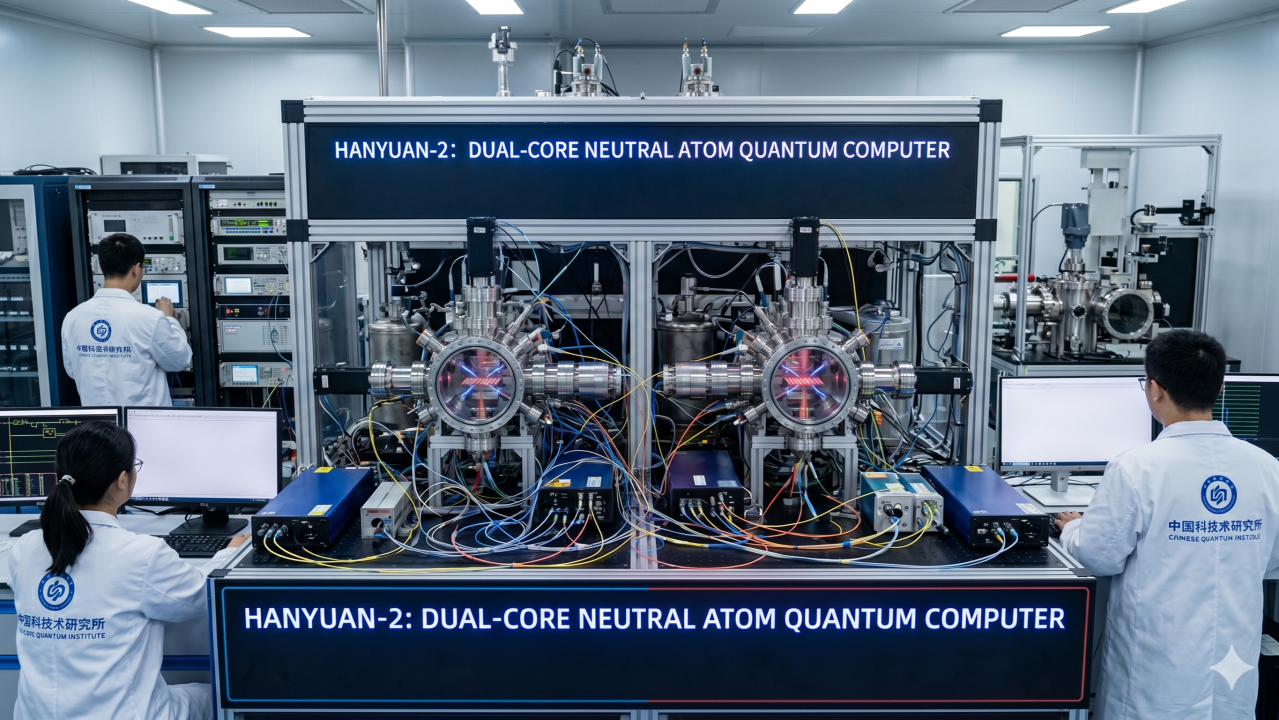
CAS Cold Atom Technology, a quantum hardware developer based in Wuhan and affiliated with the Chinese Academy of Sciences (CAS), has unveiled Hanyuan-2 (also referred to as HANYUAN 02), the world’s first dual-core neutral atom quantum computer. This 200-qubit system marks a transition from single-core architectures to a parallelized, dual-core design, enabling a “main core plus auxiliary core” operational mode. The dual-core framework is intended to address scalability limitations and interference challenges by allowing the two arrays to either compute different aspects of a problem simultaneously or perform error correction on one another.
Neutral Atom Architecture and Energy Efficiency
Unlike superconducting or trapped-ion systems that require massive dilution refrigerators to maintain temperatures near absolute zero, Hanyuan-2 utilizes neutral atoms (specifically Rubidium-85 and Rubidium-87). Because neutral atoms are uncharged and cooled directly via laser cooling, the system can operate at room temperature without extensive environmental shielding. This architecture results in a significant reduction in operational overhead:
- Power Consumption: The total system power draw is below 7 kW, comparable to standard IT server racks.
- Deployment: The machine uses a compact, cabinet-style integrated design, allowing for rapid deployment in ordinary indoor environments rather than specialized cryogenic laboratories.
- Qubit Configuration: The system integrates 100 atoms of Rubidium-85 and 100 atoms of Rubidium-87, forming two independent but collaborative 100-qubit arrays.
Parallel Computing and Stability Breakthroughs
The dual-core design is a significant architectural shift in the neutral atom platform, which is increasingly favored for its long coherence times and high control accuracy. By moving to a dual-core model, CAS Cold Atom Technology aims to facilitate parallel quantum computing, where complex algorithms are decomposed and executed across both cores to accelerate time-to-solution. This setup also provides a pathway toward more stable logical qubits, as the second core can be dedicated to real-time syndrome extraction and error correction tasks without disrupting the primary computation.
Strategic Context and Commercial Roadmap
Hanyuan-2 follows the successful commercial delivery of the company’s first-generation system, Hanyuan-1. General Manager Tang Biao noted that the modular design of neutral atom systems allows for significant future scaling, with the goal of expanding to thousands of qubits while maintaining a manageable energy footprint. As the first instance of a dual-core quantum processor, Hanyuan-2 is positioned as a critical step in lowering the technical and cost barriers for industrial quantum applications in sectors such as materials science, geological exploration, and cryptography.
You can find the official report on the Hanyuan-2 unveiling from the Science and Technology Daily here and the technical briefing on its 200-qubit dual-core architecture here.
May 9, 2026