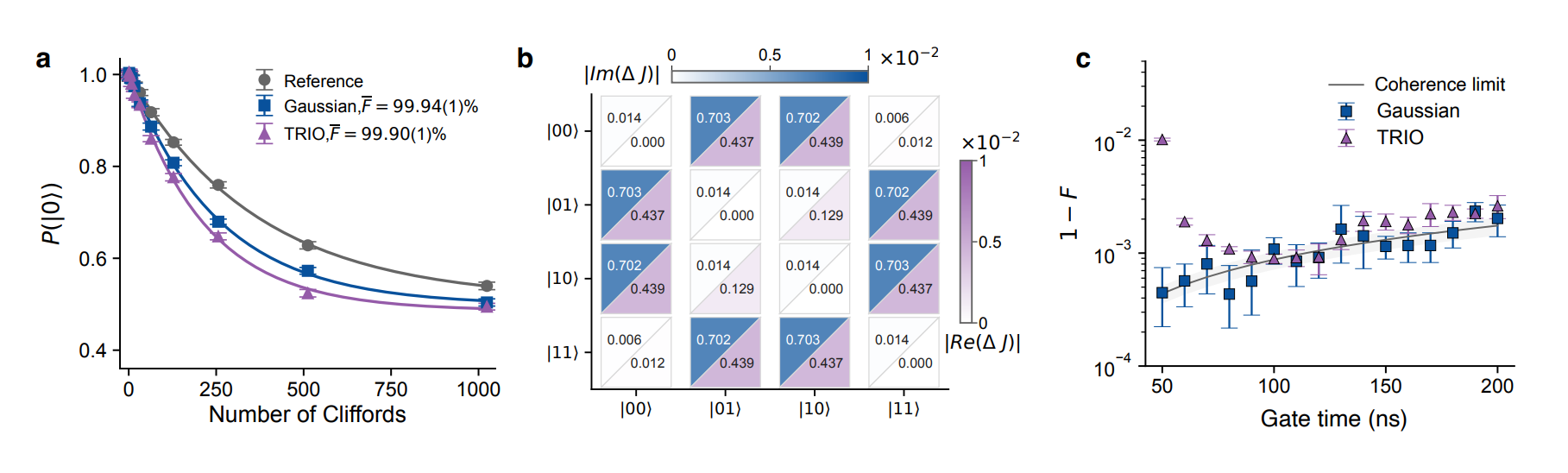
A research team led by the Wallenberg Centre for Quantum Technology (WACQT) at Chalmers University of Technology, in collaboration with Université Bourgogne Europe and Aalto University, has introduced and experimentally validated a quantum control framework termed Time-Rescaling Robust Inverse-Optimal (TRIO) pulses. Detailed in a research manuscript published on arXiv (“Optimal robust single-qubit gates in superconducting quantum processors“), the technique creates single-qubit gate envelopes that remain resilient against simultaneous control-amplitude miscalibrations and frequency detuning errors.
Tested on a superconducting transmon processor, a 90-nanosecond TRIO X-gate achieved an Interleaved Randomized Benchmarking (IRB) fidelity of 99.90%, while maintaining gate fidelities above 99.5% under simultaneous drive-amplitude variations of up to 20% and qubit detuning shifts of up to 4 MHz. Compared to standard Derivative Removal by Adiabatic Gate (DRAG) Gaussian pulses, TRIO pulses expand the parameter range for high-fidelity execution by an order of magnitude, offering a pathway to reduce periodic re-calibration overheads in large-scale quantum processors.
| [ TRIO vs. Conventional Gaussian Single-Qubit Gate Benchmarks ] | |||
|---|---|---|---|
| Control Envelope / Gate Type | Peak Gate Fidelity (90 ns) | Fidelity under 20% Amp & 4 MHz Detuning | Energy / Pulse Area Metrics |
| • Gaussian X-Gate (DRAG Calibrated) | • 99.94(1)% | • ~92.0% (Narrow, sensitive tolerance window) | • Baseline pulse area (π) |
| • TRIO X-Gate (Robust Inverse-Optimal) | • 99.90(1)% | • > 99.5% (Order-of-magnitude wider tolerance) | • EXopt = 3.461π (Pulse Area = 3.093π) |
| • Gaussian H-Type Gate (Hadamard) | • 99.92(1)% | • Standard decay under drive distortion | • VZ(π) Y-π/2 construction |
| • TRIO H-Type Universal Set (Xπ/2, Y-π/2) | • 99.60% – 99.69% | • Maintained robust plateau across parameter sweeps | • EHopt = 5.633π (Pulse Area = 3.395π) |
Time-Rescaling Inverse Optimization and DRAG Integration
Classical Robust Inverse-Optimal (RIO) pulse designs rely on inverse trajectory engineering in two-level systems, which often yields sharp, square-like waveform features that suffer distortion in finite-bandwidth microwave hardware and induce leakage into upper transmon states. The TRIO protocol overcomes this limitation by applying a time-rescaling function g(τ) to map energy-optimal Bloch-sphere trajectories onto smooth, hyper-Gaussian envelopes (ΩTR(τ)). This retains the underlying trajectory geometry while eliminating high-frequency spectral components.
The smooth TRIO pulse is further integrated with first-order DRAG corrections to mitigate higher-level transmon leakage and AC Stark shifts. The resulting complex envelope is synthesized via in-phase and quadrature (IQ) microwave phase modulation, allowing the Rabi frequency and detuning to continuously compensate accumulated errors across the trajectory.
The research team extended the TRIO framework beyond single π-rotations to create a universal single-qubit gate set (including Xπ/2 and Y-π/2 Hadamard-type operations), demonstrating average fidelities of 99.69% for Y-π/2 and 99.62% for Xπ/2. Numerical simulations indicate that applying TRIO control to physical systems with higher anharmonicity (such as 1 GHz fluxonium qubits) yields gate errors below 10-6.
Inspect the preprint on arXiv here and review the research announcement on Giovanna Tancredi’s LinkedIn post here.
October 22, 2026