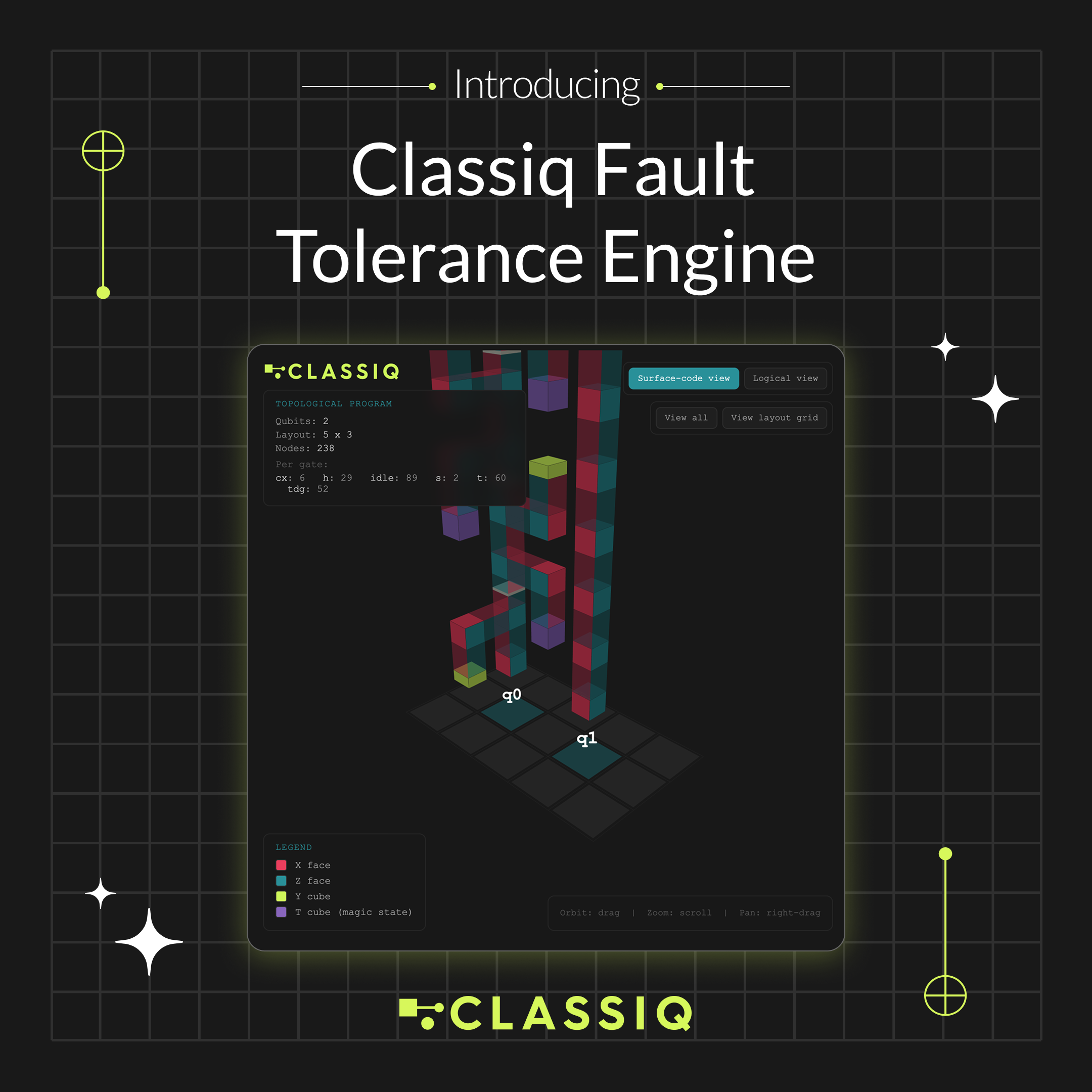
Quantum software synthesis provider Classiq has introduced its Fault Tolerance Engine, a compiler and translation suite integrated directly into the Classiq SDK. The tool maps high-level, optimized logical quantum circuits (written in Classiq’s Qmod language or Clifford+T QASM) into concrete, three-dimensional spatial-temporal execution plans across fault-tolerant quantum processing units (QPUs). By moving beyond static algorithmic resource formulas, the engine generates hardware-aware routing schedules, magic-state cultivation plans, and empirical physical qubit and error-rate estimates.
The Fault Tolerance Engine bridges high-level functional synthesis and physical quantum error correction (QEC). Logical circuits are mapped onto a 3D surface-code lattice where physical qubits are grouped into patches, and multi-qubit gates are executed via lattice surgery (merging and splitting patches over repeated syndrome extraction cycles). The engine automates 3D routing and scheduling for T-gate magic state cultivation alongside Clifford operations, producing an execution plan optimized to minimize total physical qubit overhead and total runtime.
| [ Classiq Fault Tolerance Engine Technical Specifications & Capabilities ] | ||
|---|---|---|
| Technical Domain | Engine Specification & Modality Scope | Strategic Architecture & Workflow Functions |
| • QEC Code Schemes | • Currently supported: 3D Surface Code • In active development: QLDPC codes & Color codes | • Maps logical qubits to spatial-temporal surface-code patches; automates lattice surgery routing |
| • Hardware Modalities | • Modality-agnostic across hardware supporting surface-code QEC (superconducting, neutral atoms, trapped ions, silicon spin) | • Integrates customizable physical noise models (1Q/2Q depolarizing, measurement, idle readout errors) |
| • Routing & Scalability Benchmarks | • Tensor hypercontraction chemistry workload: – 219 logical qubits – 2.5M–2.6M logical gates (~1.3M CX gates) – Routed in ~1 hour | • Evaluates physical qubit counts, code distance (d), total error-correction cycles, and magic state factory bottlenecks |
| • SDK Integration | • Native Qmod high-level modeling • Clifford+T transpilation export • Interactive 3D lattice surgery visualizer | • Evaluates total accumulated logical error across physical noise profiles prior to hardware availability |
According to technical clarifications provided by Classiq QEC Team Lead Ron Cohen and executive team members, the engine currently targets 3D surface-code schemes across all compatible physical qubit hardware modalities. Development is underway to extend support to Quantum Low-Density Parity-Check (QLDPC) and color codes. By providing complete execution plans for large-scale workloads, the engine allows application developers and hardware design teams to identify physical resource bottlenecks, optimize code distance parameters, and determine real-world hardware requirements prior to fault-tolerant QPU availability.
Review the primary release announcement here, read the technical insight blog here, access the end-to-end tutorial notebook here, inspect the user guide here, and examine the SDK reference manual here.
October 1, 2026