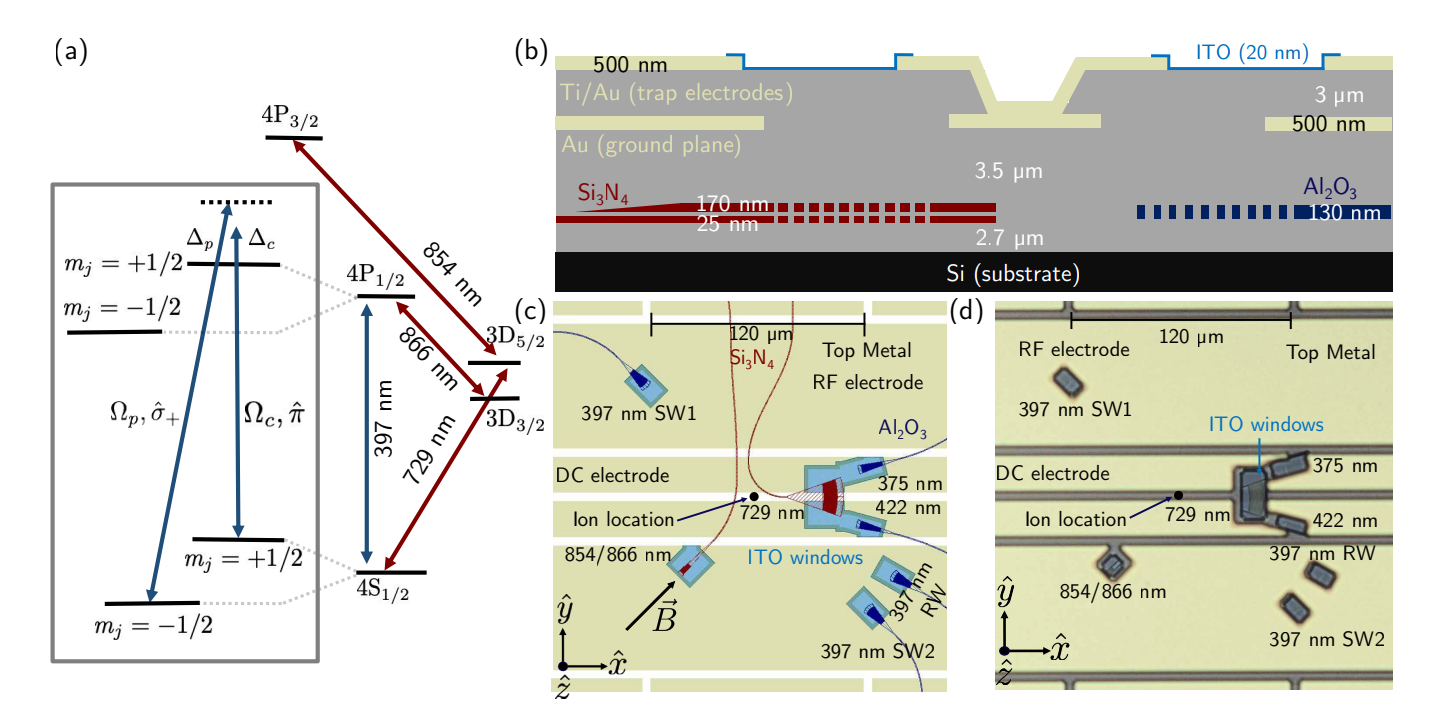
Researchers at Cornell University, led by Professor Karan Mehta, have achieved the first experimental demonstration of standing-wave (SW) Electromagnetically Induced Transparency (EIT) cooling for trapped ions—validating theoretical predictions dating back to Cirac et al. (1992). Performed on a foundry-fabricated surface ion trap with integrated ultraviolet-to-near-infrared photonic waveguides, the experiment utilized Nullspace ES electrostatic simulation software to solve the 3D potential landscapes and DC control voltage sets required for axial confinement, sub-micron ion positioning, and 45° radial mode rotation.
By trapping a single 40Ca+ ion 50 μm above the chip surface and positioning it at the intensity node of an integrated 397 nm standing wave, the researchers completely nulled first-order carrier excitations while driving energy-extracting red-sideband transitions. The carrier-nulled standing-wave EIT scheme cooled all single-ion motional modes across a ~5 MHz bandwidth to near the quantum ground state (n̄ ≈ 0.05 for the target radial mode) within 150 μs. Compared to conventional running-wave (RW) EIT protocols, the standing-wave scheme delivered a 3.3× faster cooling rate, a lower final phonon occupancy limit, and broader multi-mode bandwidth from a single drive field.
| [ Cornell Trapped-Ion EIT Cooling Benchmark Comparison ] | ||
|---|---|---|
| Performance Metric | Conventional Running-Wave (RW) EIT | Standing-Wave (SW) EIT (Cornell Result) |
| Ground-State Cooling Duration | • 500 μs | • 150 μs (3.3× Execution Speedup) |
| Target Mode Occupancy (n̄ss) | • n̄ = 0.088 ± 0.005 | • n̄ = 0.050 ± 0.003 (Near Ground-State Limit) |
| Multi-Mode Bandwidth | • Narrow (Negligible cooling on off-target modes) | • Broadband (~5 MHz) (Simultaneously cools all 3 modes) |
| Carrier & Sideband Coupling | • Finite power-broadened carrier excitation | • Carrier Nulled at standing-wave intensity node |
To support rapid experimental iteration, the Cornell team developed an open-source Python package (trap_sim_nullspace) that ingests GDS chip layouts, executes Method-of-Moments electrostatic calculations in Nullspace ES, and outputs experimentally usable voltage sets. The ability to rapidly cool multiple motional modes to the ground state addresses a major operational latency bottleneck in Quantum Charge-Coupled Device (QCCD) architectures, where repeated cooling cycles dominate runtime during ion shuttling and reconfiguration.
Review the official press release on GlobeNewswire here, inspect the technical case study on Nullspace Inc. here, read the open-access research paper on arXiv here, and explore the open-source toolkit on GitHub here.
September 23, 2026

