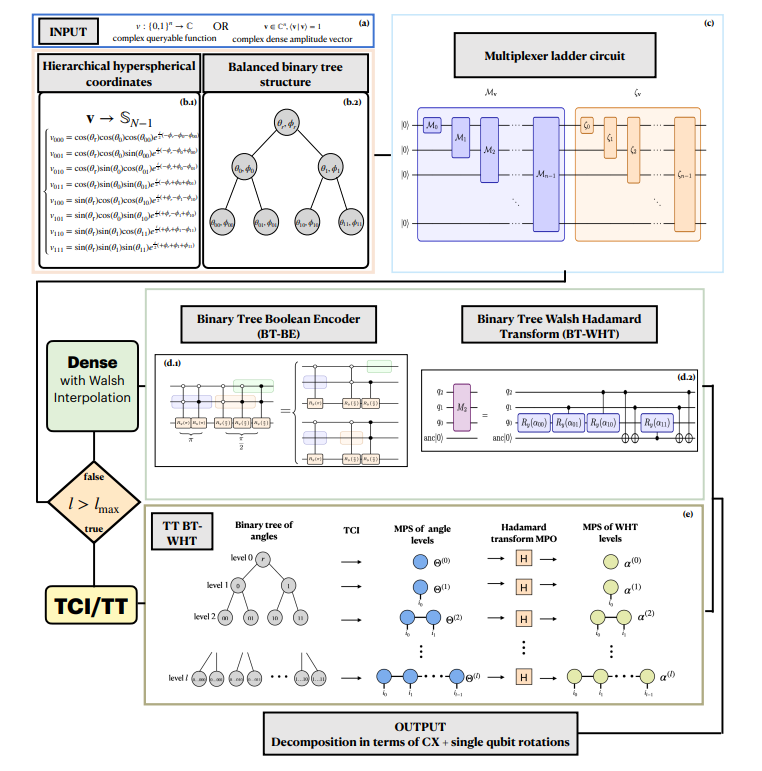
Researchers at the German Aerospace Center (DLR) Institute of Software Technology and the University of Cologne have introduced a deterministic quantum state-preparation framework to mitigate the exponential circuit-depth bottleneck inherent to classical data loading. Published on arXiv in the paper “Scalable Unitary State-Encoding for Generic Large Data,” the architecture combines tensor-network representations with Boolean logic minimization and Walsh–Hadamard transformations, reducing two-qubit gate depth by up to two orders of magnitude compared to standard multiplexer compilers and achieving sub-linear depth scaling across structured function classes.
| DLR Scalable State-Encoding Architecture & Benchmark Profile | ||
|---|---|---|
| Module / Benchmark | Technical Specification | Operational Function & Scaling Impact |
| Angle Hierarchy | Hierarchical hyperspherical coordinates over balanced binary trees | Parametrizes arbitrary complex states into l-controlled multiplexer layers; prunes zero-norm subtrees to compress angle volume. |
| BT-BE Algorithm | Finite-precision basis projection mapped to Disjoint Sum of Products (DSOP) logic | Eliminates redundant controls across identical rotation angles; synthesizes multi-controlled rotations via clean-ancilla Toffoli ladders. |
| BT-WHT Algorithm | Walsh–Hadamard transform (WHT) decomposed via a single clean ancilla | Extracts dominant spectral components; executes controlled rotations through parity CNOT ladders ordered by greedy Hamming cycles. |
| Memory Compression | Tensor Cross Interpolation (TCI) over Tensor Train / Matrix Product State (MPS) | Reduces classical memory scaling from O(2l) to O(2lχ2) for bond dimension χ; enables encoding of out-of-core queryable datasets up to 36 qubits. |
| Physical QPU Validation | IQM Emerald (20 qubits, square-lattice superconducting architecture) | Executes 2D Gaussian state encoding at total circuit depth 56 (CZ depth 26); measures state infidelity I = 0.011 ± 0.002 across 256,000 shots. |
Data loading represents a structural bottleneck for algorithms that rely on state initialization, including the Harrow-Hassidim-Lloyd (HHL) linear solver, quantum partial differential equation (PDE) integration, and quantum machine learning models. Exact state preparation for generic data is theoretically lower-bounded by a gate depth of Θ(2n/n) on n qubits, a threshold that rapidly exceeds hardware coherence budgets before computation begins. Existing compilers mitigate this only by introducing exponential ancilla overheads or non-deterministic measurement loops.
The DLR framework circumvents exponential depth limits by permitting bounded, tunable infidelities across continuous and discrete data profiles. For shallow multiplexer layers, the pipeline applies BT-BE to minimize multi-controlled rotation counts through Boolean logic heuristics. For deeper layers, BT-WHT truncates the high-frequency spectral tail of the rotation angles, executing the surviving coefficients along an optimized Hamming path. When operating on complex high-dimensional datasets, Tensor Cross Interpolation samples the angle tree directly to construct MPS representations without populating dense arrays.
In comparative benchmarks across Lorentzian, polynomial, and financial jump-diffusion distributions, the hybridized compiler demonstrated asymptotic depth plateaus at fixed infidelity levels (~5 × 10⁻³), breaking the exponential scaling curves produced by standard state-preparation tools in Qiskit. Hardware-level viability was confirmed on the 20-qubit IQM Emerald processor, where a compiled 2D Gaussian distribution operated within coherence limits (median T1 = 48.96 μs, median T2 = 14.78 μs) under Pauli twirling and dynamical decoupling.
Algorithmic formulations, circuit proofs, and benchmark datasets are available in the technical paper here.
November 9, 2026