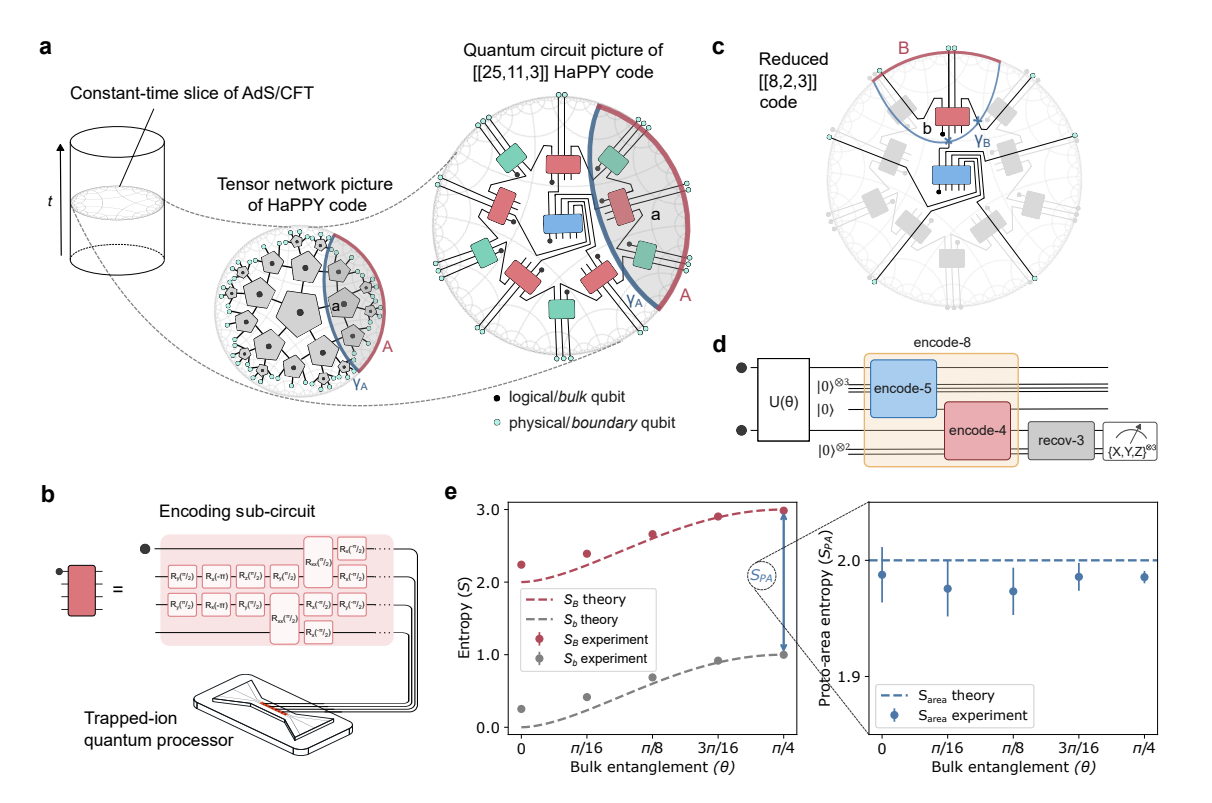
Researchers from Duke University, Virginia Tech, the University of Maryland (QLab), BlueQubit, IonQ, and Caltech have experimentally realized stabilizer and non-stabilizer holographic quantum error-correcting codes on IonQ’s Forte trapped-ion quantum processor, observing entropy signatures analogous to gravitational backreaction and wormhole connectivity. By exploiting the isometric structure of the two-layer 25-qubit Harlow-Pastawski-Preskill-Yoshida (HaPPY) code to compress boundary-subregion measurements into resource-efficient 8-, 10-, and 16-qubit circuits, the team demonstrated how programmable quantum hardware can serve as an experimental testbed for emergent spacetime models under the AdS/CFT correspondence.
| Holographic HaPPY Code Trapped-Ion Experiments (IonQ Forte-1) | |
|---|---|
| Experimental Protocol | Code Configuration & Measured Holographic Signature |
| FLM Formula Verification | Isometrically reduced [[8, 2, 3]] stabilizer HaPPY code (23 native ZZ gates; 2,100 shots/Pauli basis); confirms state-independent proto-area entropy SPA ≈ 2 bits across bulk entanglement θ ∈ [0, π/4] |
| Single-Copy Magic Enrichment | Non-Clifford gate angle offsets (total magic M = 2.23 and 5.79) induce positive slope in SPA(θ), modeling state-dependent gravitational backreaction on minimal surface area |
| Two-Sided Wormhole Analogues | Coupled 10-qubit (2 × [[5, 1, 3]], up to 31 ZZ gates) and 16-qubit (2 × [[8, 2, 3]], up to 56 ZZ gates, M = 1.95) codes show decreasing SPA(θ) as inter-code bulk entanglement increases |
| Hardware & Compilation | IonQ Forte-1 trapped-ion QPU (mean cumulative 2Q ZZ fidelity 0.9960–0.9966); custom compiler cuts single-qubit gate counts by ≥60% over standard Qiskit transpilation |
In their first experiment, the researchers verified the Faulkner-Lewkowycz-Maldacena (FLM) relation on a stabilizer HaPPY code, confirming via maximum-likelihood quantum state tomography that the proto-area entropy separating boundary and recoverable bulk entropies remains fixed regardless of bulk entanglement. Because pure stabilizer codes represent rigid background geometries without gravitational backreaction, the team subsequently injected non-stabilizer resources (“magic”) by applying controlled coherent angle offsets to the encoding gates, observing a state-dependent increase in proto-area entropy that scales with both total and non-local magic.
Extending the framework to two coupled copies of the magic-enriched HaPPY code to test the ER=EPR entanglement-geometry correspondence, the team entangling bulk logical qubits across both sides observed the opposite trend: proto-area entropy decreased as inter-code entanglement grew, mirroring the shortening of a cross-wormhole geodesic in holographic duality. Cross-checks against unconstrained optimal recovery channels confirmed that the state-dependent signals persist beyond variational recovery ansatz approximations, pointing toward larger-scale tomographic and correlation-based probes of emergent geometry.
Access the technical paper on arXiv here.
November 28, 2026