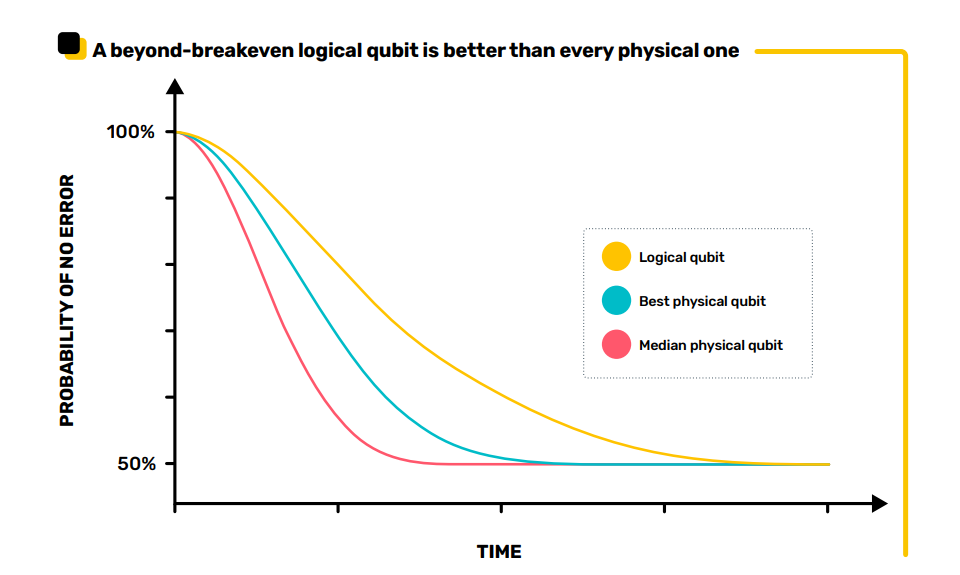
is “beyond breakeven” when the logical qubit decays more slowly than the best-performing constituent physical qubit.
Researchers at Alice & Bob have published a white paper that proposes five criteria to benchmark logical qubit claims. Here is a summary of their proposal.
The quantum computing industry’s primary focus has shifted from Noisy Intermediate-Scale Quantum (NISQ) engineering toward Fault-Tolerant Quantum Computing (FTQC). However, the term “logical qubit” is frequently used inconsistently across academic literature and commercial press releases, complicating standard benchmarking efforts. To provide investors, enterprise architects, and technical analysts with a standardized framework, this brief outlines five diagnostic criteria designed to evaluate experimental logical qubit claims independently of hardware modality.
The Five Diagnostic Core Criteria
Evaluating the structural readiness of an error-corrected logical quantum memory requires checking validation metrics across five distinct technical thresholds:
- Physical Breakeven Performance: The experimental system must demonstrate a logical qubit lifetime (τL) that strictly exceeds the physical lifetime (τP) of its best-performing constituent physical qubit component (τL > τP). This threshold proves that the overhead of executing quantum error correction (QEC) operations does not introduce more faults than the underlying code layer suppresses.
- 2. Scalable Parameter Families: The logical architecture cannot rely on a single, isolated hardware footprint. It must belong to a parametrized code family—such as an adjustable code distance d—where the probability of a logical error decreases exponentially as more physical resources are added, or via continuous physical-level squeezing and bosonic stabilization adjustments.
- 3. Sufficient QEC Stabilization Cycles: To measure true logical error rates rather than artificial initial states, the total number of continuous syndrome extraction rounds executed must exceed the code distance (Ncycles) ≥ d). Running too few cycles stops the experiment before multi-qubit error propagation patterns have sufficient time to manifest, leading to underestimated logical error trajectories.
- 4. Raw Performance Uncorrected by Cherry-Picking: Documented logical error rates must account for all experimental runs without relying on post-selection techniques where failed rounds are filtered out. Production-grade FTQC applications require operational quantum error correction, meaning the hardware must actively fix encountered errors mid-circuit rather than discarding broken states.
- 5. Application-Relevant Utility Timescales: The sustained preservation of logical states must match the runtime demands of production algorithms, which range from ten hours for Shor’s factorization matrix to several weeks for complex condensed matter simulations. Operating over extended durations is necessary to demonstrate that the code can actively isolate rare, non-local correlated noise events, such as those caused by environmental cosmic ray impacts.
Algorithmic Validation Mapping across Industrial Horizons
The practical necessity for rigid, multi-round QEC validation is highlighted by the physical resource requirements of major industrial algorithms. When mapping the code distance required to reach a target error probability (Ptarget), current experimental parameters show that lower physical error rates drastically compress the required number of physical qubits. For example, executing a 2048-bit RSA integer factorization using Shor’s algorithm requires a sustained fault-tolerant computation window of roughly eight hours. If a logical system fails to satisfy the criteria of non-post-selected, multi-cycle stabilization, the underlying calculations succumb to error propagation before achieving practical utility.
Agnostic Performance Evaluation Standards
| Analytical Metric | Diagnostic Check Protocol | Primary Operational Objective |
| Breakeven Threshold | Verify if τlogical > τphysical-best | Validate that the active QEC matrix delivers net-positive hardware utility. |
| Code Modularity | Assess resource scalability vs. error reduction | Ensure a repeatable path exists to compress logical error rates toward Ptarget |
| Cycle Duration | Check if Nrounds ≥ d | Prevent premature measurement termination from masking multi-round error propagation. |
| Data Retention | Audit dataset for “post-selection” filters | Enforce strict accountability for faulty syndrome extraction and decoding loops. |
| Sustained Operation | Measure total continuous operational runtime | Verify system resilience against low-frequency, non-local environmental noise bursts. |
The complete structural analysis and analytical scoring methodology can be accessed via the Alice & Bob research repository here.
June 5, 2026