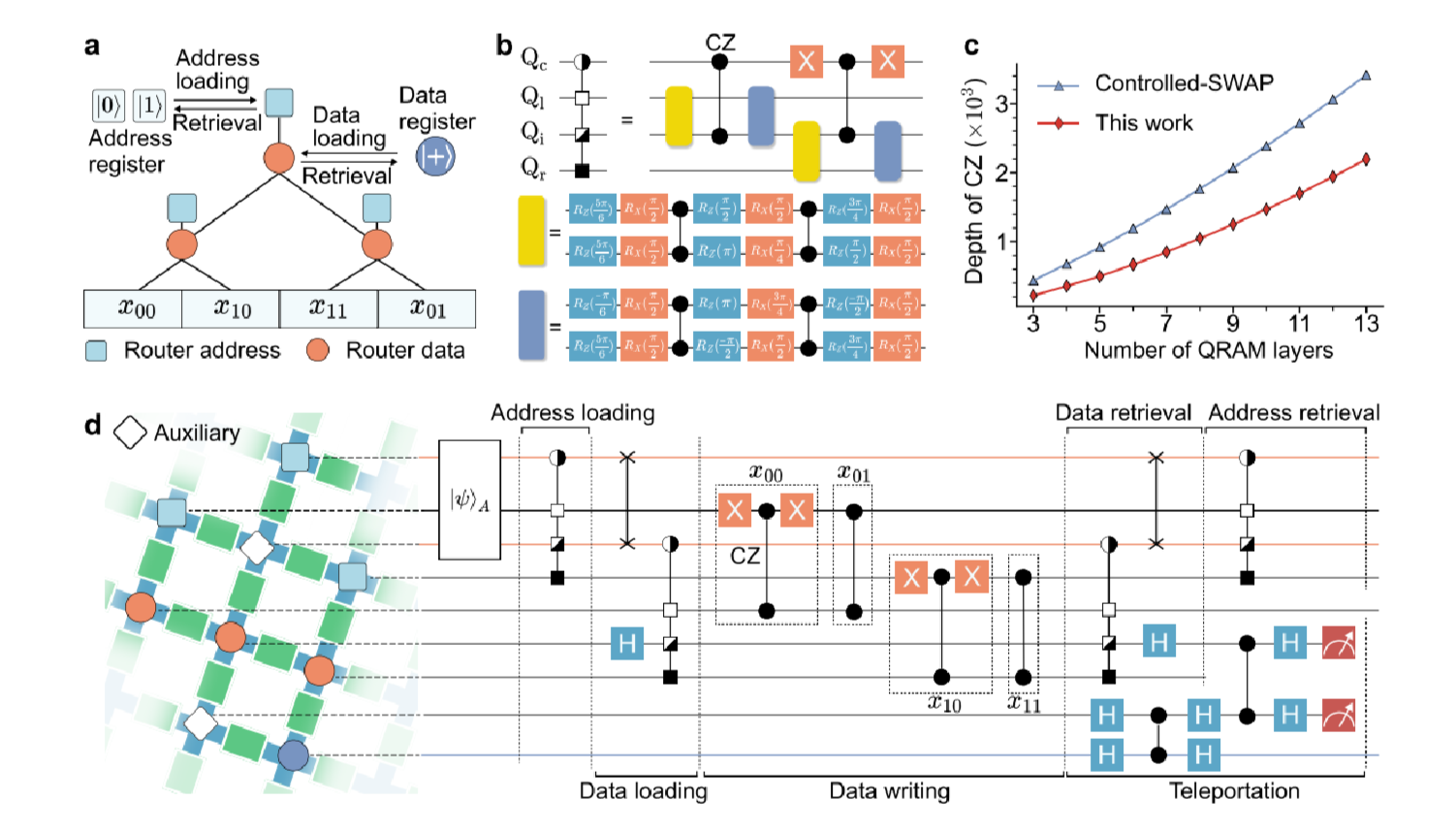
A research team from Zhejiang University has reported the physical implementation of a circuit-based, bucket-brigade Quantum Random Access Memory (QRAM) architecture on a programmable superconducting quantum processor. Detailed in Nature Physics, the experiment investigates a hardware interface designed to address the data-loading bottleneck that occurs when classical binary datasets are prepared for quantum processing. While many quantum algorithms assume rapid, coherent access to classical information arrays, physical data-entry layers often introduce severe latency and decoherence. This implementation provides a practical circuit framework to load conventional binary structures into quantum superposition states using active routing mechanisms on a superconducting substrate.
Gate Decomposition and Query Fidelity Parameters
The experimental setup maps a binary tree of quantum routers across a two-dimensional square grid of superconducting qubits, targeting the O(log N) active switching scaling originally proposed in the foundational bucket-brigade model. To manage the short coherence lifetimes and circuit depth limits of current hardware, the researchers introduced a hardware-efficient gate decomposition scheme for individual quantum routing nodes. This technique compressed the necessary quantum circuit depth by more than 30% relative to standard controlled-SWAP (CSWAP) implementations. Operating on the superconducting substrate, the team evaluated two-layer and three-layer routing trees. Assistant Professor Lu Liqiang noted that the prototype processed 4-bit and 8-bit classical data formats, yielding measured query fidelities of 0.809±0.025 and 0.604±0.005, respectively, alongside an active error mitigation protocol to stabilize the routing paths.
Industrial Use-Cases and Engineering Scaling Boundaries
The ability to simultaneously route multi-input data structures is a prerequisite for executing big-data quantum algorithms, including molecular property extraction in chemical databases, transaction pattern tracking for fraud detection, and multi-parameter quantum machine learning models. However, the data reveals clear engineering limits to current scalability. The sharp drop in query fidelity from the 4-bit to the 8-bit configuration underscores the severe noise accumulation native to multi-layer quantum trees. Expanding this architecture from small-scale proofs-of-concept to the multi-megabit arrays required for commercial data mining will require an increase in physical qubit gate fidelities, lower cross-talk during parallel routing operations, and the integration of robust quantum error correction over the memory bus.
The complete peer-reviewed experimental study can be accessed via Nature Physics here, with early technical draft variations available in the open-access arXiv repository here. For supplementary reporting regarding regional quantum research initiatives and related computing developments, read the industry overviews tracked by the Seoul Economic Daily here and the South China Morning Post here.
June 6, 2026