
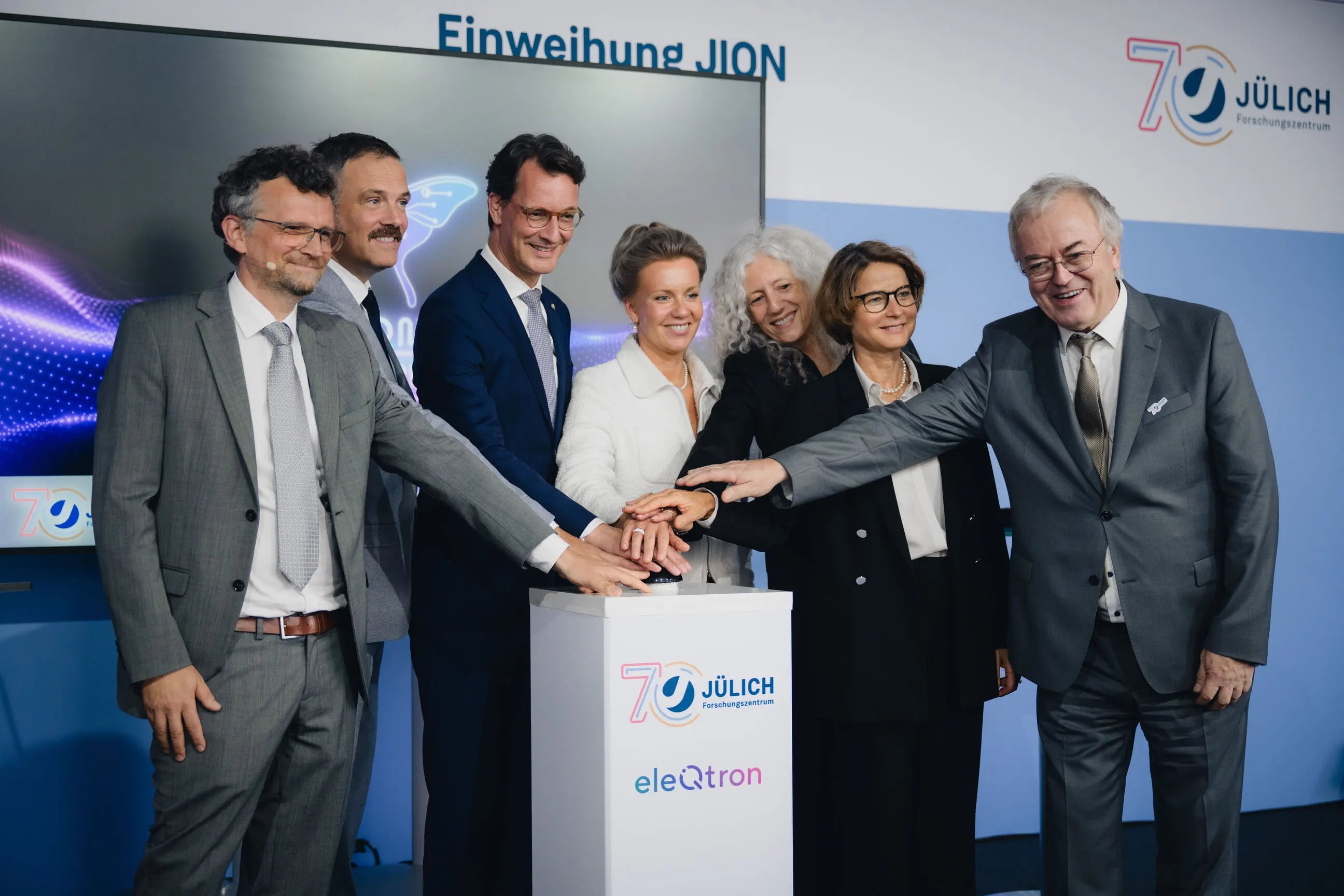
Research center Forschungszentrum Jülich and University of Siegen spin-off eleQtron GmbH have officially brought the JION (Jülich trapped-ION) quantum computer into operation at the Jülich Supercomputing Centre (JSC). Integrated into the JUNIQ (Jülich UNified Infrastructure for Quantum computing) platform, the gate-based trapped-ion processor is linked directly to JSC’s High-Performance Computing (HPC) supercomputing cluster—including the JUPITER exascale system—to enable hybrid quantum-classical workloads across transport optimization, materials science, and chemical simulation.
| [ JION Hardware Architecture & NRW Funding Framework ] | ||
|---|---|---|
| Hardware & Control Stack | Project & Integration Platform | State & EU Funding Allocations |
| • Trapped Ytterbium (171Yb+) Atomic Qubits | • EPIQ Partnership (FZJ & eleQtron) | • EPIQ Project: €21M (NRW Science Ministry) |
| • MAGIC Control (Microwave & Magnetic Gradients) | • JUNIQ User Infrastructure (JSC) | • SQALING Project: ~€25M (EU ERDF/JTF Funding) |
| • Room-Temperature Trap Operation (RF Paul Trap) | • HPC Offloading via Modular Supercomputing | • Q-STAR.NRW Project: ~€35M (InvKG Coal Region Fund) |
MAGIC Microwave Control and Room-Temperature Qubit Trapping
Unlike conventional trapped-ion architectures that rely on complex, multi-laser optical setups for individual qubit addressing, JION employs eleQtron’s proprietary MAGIC (Magnetic Gradient Induced Coupling) technology:
- Microwave Control Fields: Replaces individual laser beams with static magnetic field gradients and globally applied microwave pulses, allowing precise single-qubit addressing and multi-qubit gate operations through radio-frequency (RF) signals.
- Reduced Thermal Constraints: Operating trapped Ytterbium ions inside electromagnetic fields eliminates the need for dilution refrigerators required by superconducting QPUs, allowing the core trap assembly to operate at room temperature.
- All-to-All Qubit Connectivity: Long-range magnetic gradient coupling enables direct gate operations between non-adjacent ions within the trap array, minimizing compiler SWAP gate overhead during circuit synthesis.
NRW Strategic Funding: SQALING and Q-STAR.NRW Programs
Co-developed under the four-and-a-half-year, €21 million EPIQ (Development Partnership for Ion-Trap Quantum Computers in NRW) program funded by the Ministry of Culture and Science of North Rhine-Westphalia, JION’s commissioning was accompanied by two additional state funding commitments:
- SQALING (€25M): Awarded to eleQtron through EU ERDF/JTF funds to transition MAGIC trapped-ion systems toward scalable, planar chip-based quantum processing architectures.
- Q-STAR.NRW (€35M): Dedicated to procuring and integrating a semiconductor quantum computer (scaling up to 200 qubits) into JUNIQ to support structural economic transformation in the Rhenish mining region.
Review the official press releases via Forschungszentrum Jülich here and the University of Siegen here.
September 4, 2026