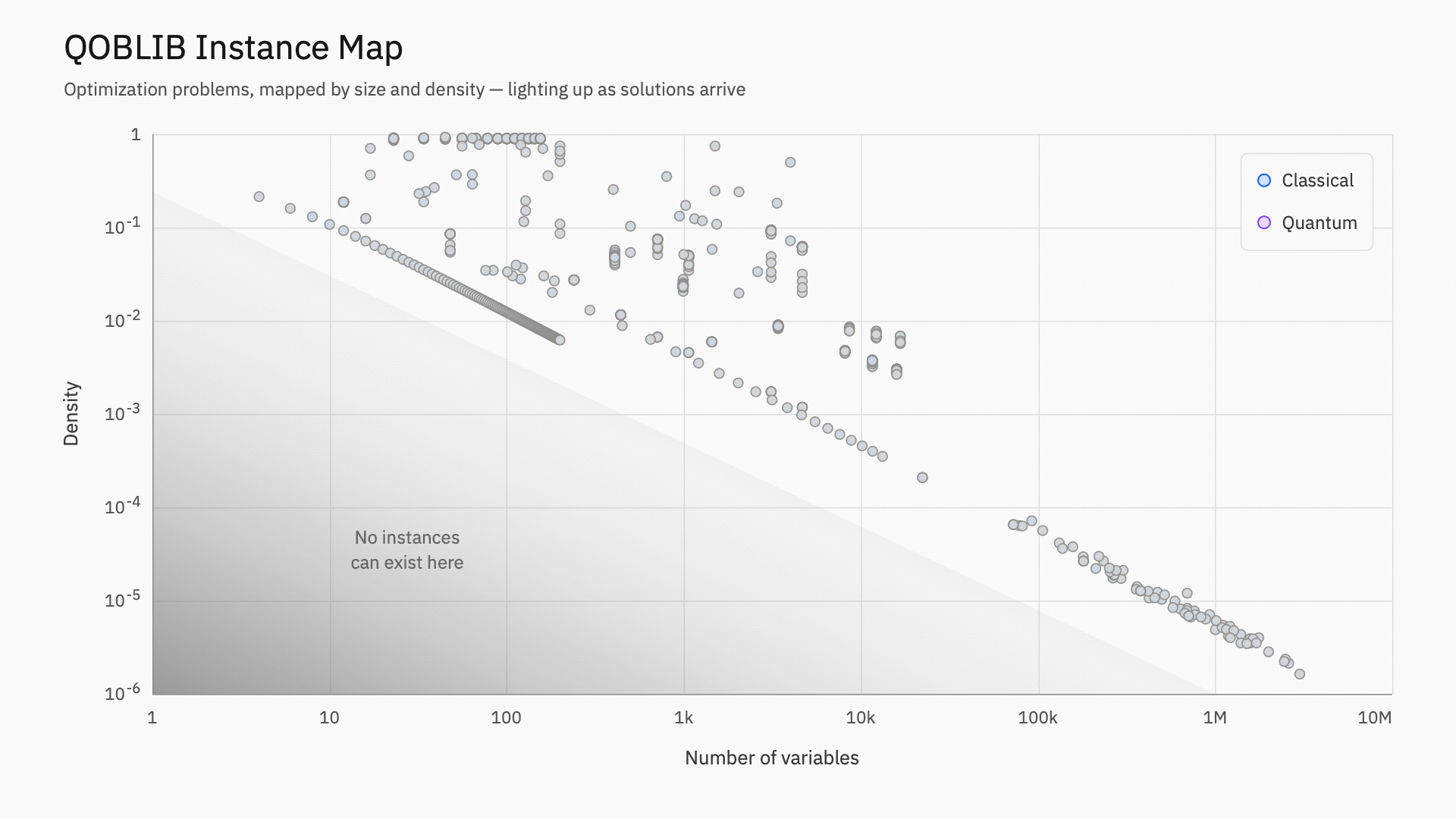
An international research consortium led by IBM Quantum, Zuse Institute Berlin (ZIB), Technische Universität Berlin, and Purdue University—alongside global academic and industrial partners—has introduced the Quantum Optimization Benchmarking Library (QOBLIB). Published in Nature Computational Science (“The Quantum Optimization Benchmarking Library“), the open-source initiative establishes a standardized, model-independent benchmarking framework to evaluate quantum, classical, and hybrid algorithms across ten NP-hard combinatorial optimization problem classes.
                       [ QOBLIB Model-Independent Benchmarking Stack ]
                                              │
     ┌────────────────────────────────────────┼────────────────────────────────────────┐
     ▼                                        ▼                                        ▼
  The "Intractable Decathlon"             Open-Source Repository & Web Portal      Cross-Paradigm Evaluation
  • 10 Hard Combinatorial Classes.        • 1,260+ Curated Problem Instances.      • Head-to-Head Solver Tracking.
  • 20 to 3,000,000+ Variables.           • 2,600+ Benchmark Submissions.          • Classical MIP/QUBO Baselines.
  • MIP, ILP, MIQP, & QUBO Formulations.  • Live Best-Known Solution Tracking.     • Near-Term Quantum Hardware Runs.
Structuring the “Intractable Decathlon”
QOBLIB addresses a critical gap in quantum optimization: while heuristic algorithms like the Quantum Approximate Optimization Algorithm (QAOA) or quantum annealing lack theoretical performance guarantees, empirical advantage claims require rigorous comparisons against state-of-the-art classical solvers. The library curates 1,264 specific instances spanning ten problem classes that become computationally hard for classical solvers at scales ranging from tens to tens of thousands of decision variables:
- Market Split (Multidimensional Subset Sum): Hard binary integer linear programming (ILP) instances with dense constraint matrices (20–140 variables).
- Low-Autocorrelation Binary Sequences (LABS): A canonical spin-glass benchmark with applications in radar and signal processing (2–100 variables).
- Minimum Birkhoff Decomposition: Doubly stochastic matrix decomposition coupling assignment structures with cardinality objectives (3–100 variables).
- Steiner Tree Packing: Modeling VLSI wire-routing density and non-conflicting grid demand networks (16–2.6M variables).
- Sports Tournament Scheduling: Highly constrained round-robin timetabling and satisfaction problems (408–16,680 variables).
- Portfolio Optimization: Financial models incorporating multi-period transaction costs, short selling, and borrowing constraints (711–4,666 variables).
- Maximum Independent Set (MIS): Unweighted graph stability problems mapped directly to compact Quadratic Unconstrained Binary Optimization (QUBO) formulations (17–4,000 variables).
- Network Design: Traffic-routing and degree-constrained telecommunication infrastructure planning (101–13,249 variables).
- Capacitated Vehicle Routing (CVRP): Logistics optimization combining route selection, time windows, and capacity constraints (441 variables).
- Topology Design (Graph Golf): Degree-diameter optimization models targeting low-latency communication architectures (22,261–3.0M variables).
Model-Independent Framework and Public Tracking
Unlike hardware-specific benchmarks, QOBLIB employs a model-independent architecture. Researchers can formulate problem instances as Mixed-Integer Programming (MIP), Integer Linear Programming (ILP), or QUBO representations depending on the execution platform. To track community progress, the consortium launched a public web portal featuring an interactive complexity-landscape visualization, mapping instances by size and matrix density. The site hosts a live registry of best-known classical and quantum solutions, supported by an automated submission builder that validates pull requests to ensure reproducible, fair reporting.
Broad Ecosystem Adoption and Baseline Dynamics
At launch, the library logged over 2,600 submissions across 24 contributing institutions. Early contributors include industrial end-users (E.ON Digital Technology), national supercomputing centers (STFC Hartree Centre, Forschungszentrum Jülich), academic groups (National University of Singapore, University of Southern California, City University of Hong Kong), and commercial quantum software providers (Q-CTRL, Kipu Quantum, Aqarios, Qunova Computing, ParityQC, JIJ, and Qoro Quantum). Demonstrating the evolving nature of classical baselines, solver advancements since QOBLIB’s initial preprint release have nearly doubled the largest solved Market Split instances from 60 to 110 variables, elevating the performance target required for quantum processors to claim practical advantage.
Co-authored by researchers across the founding consortium, including lead authors Thorsten Koch (ZIB/TU Berlin) and Stefan Woerner (IBM Quantum), QOBLIB serves as an open, evolving standard to evaluate quantum optimization algorithms as hardware scales.
Review the peer-reviewed study in Nature Computational Science here, explore the interactive benchmark portal and submission builder via QOBLIB here, and read the project background on the IBM Quantum Blog here.
August 15, 2026