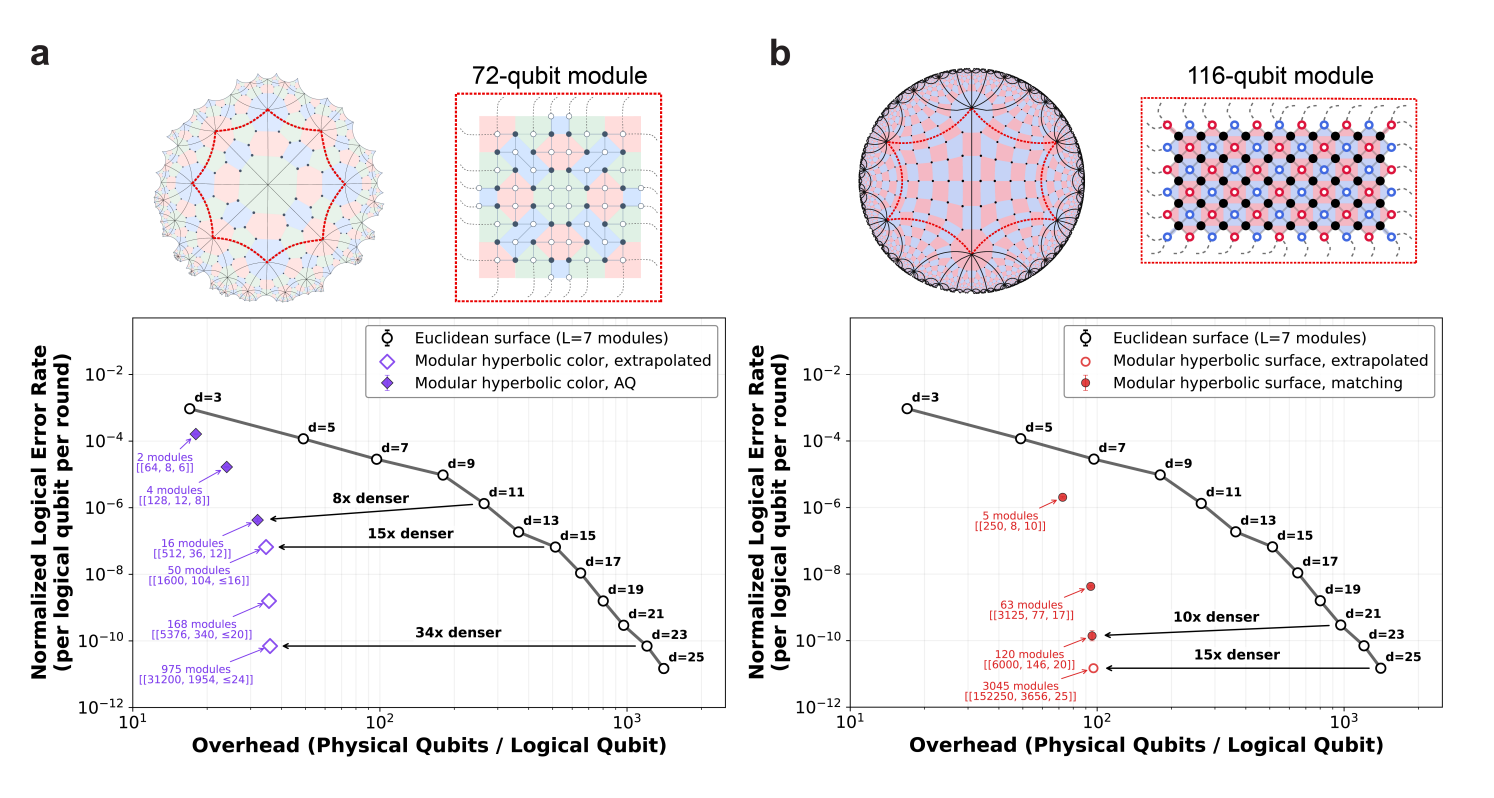
In a joint technical manuscript published on arXiv, researchers from Google Quantum AI, Google DeepMind, and MIT have introduced a modular quantum error correction (QEC) architecture that reduces physical qubit overhead by more than 30x compared to standard 2D surface codes.
The study (“Low-Overhead Quantum Error Correction with Boundary-Connected Planar Modules“) demonstrates that networking small, flat 2D Euclidean planar chips (~100 qubits) via sparse, static inter-module boundary couplers arranged in a hyperbolic tiling geometry (genus g ≥ 2) unlocks the high encoding rates of Quantum Low-Density Parity-Check (qLDPC) codes without requiring complex on-chip long-range wire crossings.
| [ Fault-Tolerant Memory Architecture Benchmark Comparison ] | |||
|---|---|---|---|
| QEC Memory Architecture | Code Parameters [[n, k, d]] | Physical Qubits / Logical Qubit | Hardware & Interconnect Complexity |
| • Euclidean Surface Code | • [[~20,000, 20, 22]] | • > 1,000 physical / logical | • Monolithic 2D nearest-neighbor planar grid. |
| • Two-Gross Bivariate Bicycle Code | • [[288, 12, 18]] | • 48 physical / logical (~20x savings) | • Monolithic chip requiring dense, crossing long-range couplers. |
| • Modular Hyperbolic Surface Code | • [[6000, 146, 20]] | • ~95 physical / logical (10x–15x savings) | • Modular 116-qubit planar modules; flexible inter-module edge links. |
| • Modular Hyperbolic Color Code | • [[6400, 104, 30]] | • 36 physical / logical (> 30x savings) | • Modular 72-qubit planar modules; rate k/n = 1/16 at distance d ≥ 22. |
By fine-graining closed hyperbolic surfaces with Euclidean lattice patches of side-length L, the architecture partitions the global QEC code into flat 72-qubit or 116-qubit modules. Stabilizers spanning adjacent modules are measured across boundary seams using cat-flagged syndrome extraction circuits. Circuit-level simulations under the SI1000 noise model (p = 0.1%) decoded via the AlphaQubit neural network and correlated minimum-weight perfect matching (MWPM) demonstrated high tolerance to elevated inter-module seam noise (p_seam = 1%), maintaining low logical error rates even when inter-chip cable error rates are 10x higher than on-chip gate errors.
To support universal fault-tolerant logic without space overhead, the team developed fault-tolerant walking circuits that execute logical gates via code automorphisms (global tiling permutations) alongside modular ribbon extractors—a closed ancilla loop attached along module boundaries that is ~4.5x smaller than the memory itself.
Review the technical manuscript on arXiv here.
October 15, 2026