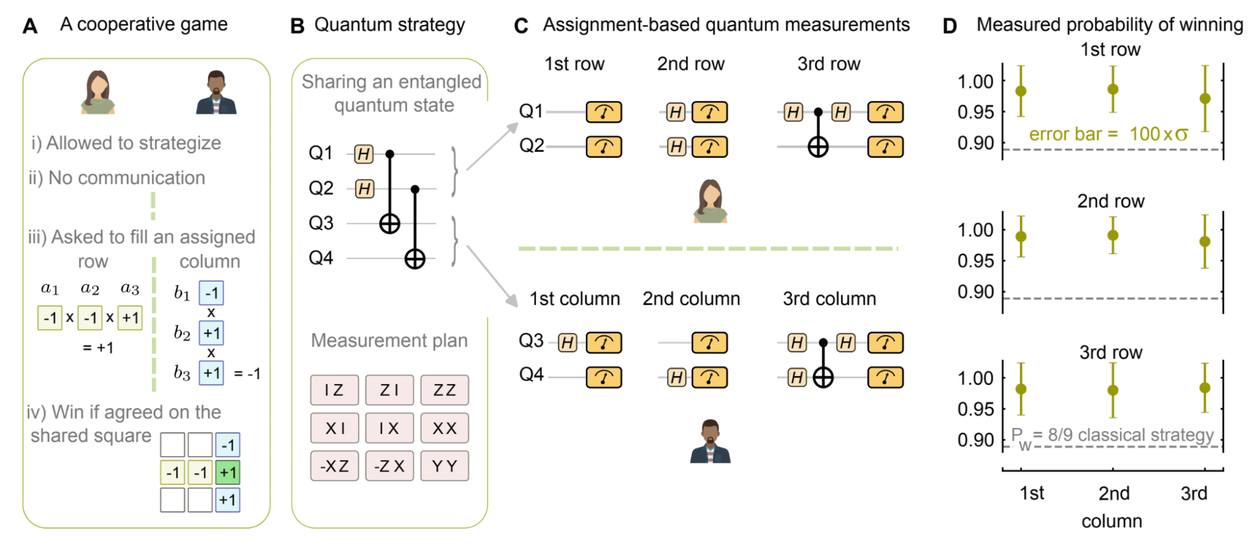
Google Quantum AI has published cover research in Science demonstrating that quantum measurement contextuality persists at many-body scale on superconducting processors and yields measurable computational separations in bounded-resource tasks. Conducted on 72-qubit and 105-qubit Willow processors, the experiments move contextuality testing from small few-particle systems to large two-dimensional qubit arrays while establishing a hardware benchmark sensitive to coherent control errors.
| Google Quantum AI Contextuality & Bounded-Resource Hardware Benchmarks | |||
|---|---|---|---|
| Experimental Protocol | Qubit Scale | Measured Quantum Performance | Classical Theoretical Limit |
| Mermin-Peres Magic Square Game | 4 qubits (2 Bell pairs) | 98.30% ± 0.01% win rate (900,000 trials) | 88.89% (8/9 rounds) |
| Kochen-Specker-Bell Inequality (χKSB) | 2 data qubits + 1 ancilla | 5.618 ± 0.005 (540 sequential QND measurements) | χ ≤ 4.0 (quantum ceiling: 6.0) |
| N-Player GHZ Parity Game | Up to 71 qubits | Exceeded classical win rate across all sizes; 45-qubit genuine entanglement | 75% at N = 3, decaying toward 50% |
| 2D Hidden Linear Function (HLF) | 9 to 105 qubits | Success probability > 0.5; effective depth ~4 to ~6 layers | Logarithmic classical circuit depth |
Unlike entanglement alone, measurement contextuality captures the principle that quantum observables do not possess predetermined values independent of which compatible measurements are performed alongside them. To verify this property without disturbing the underlying quantum register during the state-independent Kochen-Specker-Bell test, the team used a resettable ancilla qubit and calibrated virtual-Z phase rotations to execute 540 consecutive quantum nondemolition (QND) measurements per run. At larger scales, randomized breadth-first-search Greenberger-Horne-Zeilinger (GHZ) state preparation sustained contextuality up to 71 qubits, while constant-depth four-layer controlled-Z circuits solved 2D hidden linear function instances across grids up to 105 qubits.
Beyond probing the theoretical resource linked to non-Clifford magic states in fault-tolerant computing, Google researchers noted that contextuality tasks provide a sensitive hardware diagnostic for structured applications such as molecular simulations in chemistry and materials science. Because structured parity and hidden-function tests require exact multi-qubit phase agreement, they expose small coherent over-rotations that random-circuit sampling tends to average out, offering a fixed physical ceiling against which future processors can be calibrated even though the Clifford-based test circuits remain efficiently simulable classically via tools such as Stim.
Read the peer-reviewed study in Science here, view Google’s overview announcement here, and read the technical deep dive on the Google Research blog here. Readers can also access foundational theoretical papers on quantum pseudo-telepathy by Brassard, Broadbent, and Tapp here, shallow-circuit quantum advantage by Bravyi, Gosset, and König here, and contextuality in magic state distillation by Howard et al. here.
November 19, 2026