Researchers from the University of Gothenburg and Chalmers University of Technology have demonstrated a modular neural decoder for surface code quantum error correction (QEC) capable of transferring across hardware architectures, variable noise profiles, and multi-patch logical operations. In a preprint titled Modular Neural Decoder for Surface Code Memory and Logic on Superconducting Processors, the team validated the architecture on superconducting hardware data from IBM Quantum’s Nighthawk r1 generation (ibm_berlin) and Google Quantum AI’s below-threshold Sycamore processor. The framework outperforms minimum-weight perfect matching (MWPM) on memory experiments and successfully decodes a real two-patch ZZ-merge lattice-surgery operation while remaining trainable on a single commercial GPU.
Renormalization-Inspired Graph Architecture and Experimental Decoding Milestones
State-of-the-art neural decoders such as AlphaQubit rely on dense recurrent Transformer blocks that require extensive high-performance computing clusters to train and scale with prohibitive O(d4) attention bottlenecks across code distance d. To circumvent model bloat, the Swedish team designed a hierarchical architecture inspired by the renormalization group: a shared local graph neural network (GNN) processes small 3×3×2 space-time clusters of syndrome detection events, which are subsequently coarse-grained via lightweight convolutional aggregation layers and integrated across time by a gated recurrent unit (GRU). Because scaling to larger code distances adds only small convolutional layers rather than expanding the primary neural backbone, the total parameter count remains bounded at roughly two to three million parameters across distances d = 3, 5, 7, and 9.
| Modular Neural Decoder Experimental Benchmarks across QEC Regimes | ||
|---|---|---|
| Experimental Benchmark | Hardware & Dataset Platform | Demonstrated Decoding Performance |
| Planar Memory (d = 3 & d = 5) | IBM Quantum (ibm_berlin Nighthawk r1) | Halves logical error per round relative to MWPM at d = 3 (1.26% vs. 2.60%); outperforms MWPM at d = 5 (2.48% vs. 3.79%). |
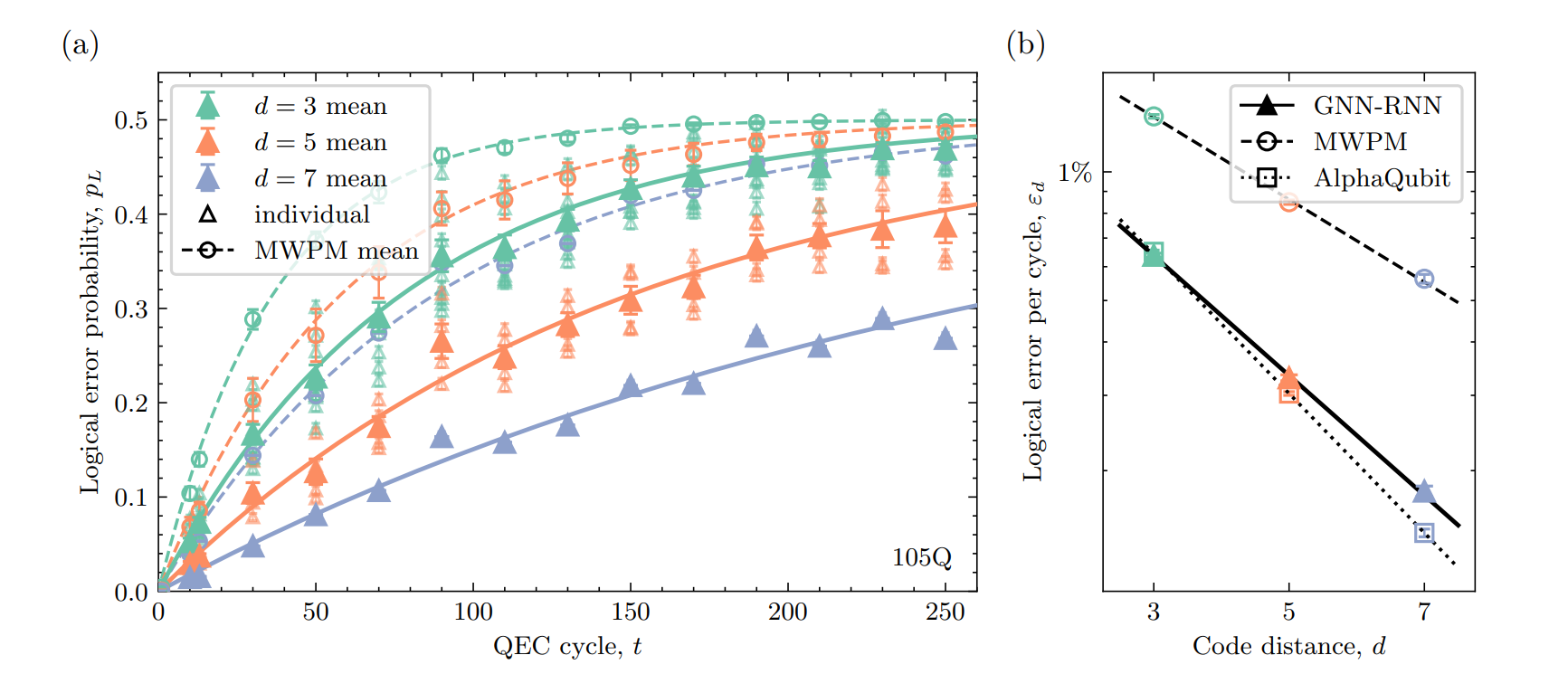
| Below-Threshold Memory (d = 3 to 7) | Google Quantum AI (Sycamore Public Dataset) | Achieves ε3 ≈ 0.638%, ε5 ≈ 0.330%, and ε7 ≈ 0.179% (Λ ≈ 1.9), closely matching AlphaQubit on Z-basis trials. |
| X-Type Stability Sweep | IBM Quantum (Continuous RX(α) Readout Rotation) | A single neural model fine-tuned across 17 distinct noise settings beats per-setting calibrated MWPM across all error rates without retraining. |
| Lattice Surgery ZZ-Merge | IBM Quantum (Two-Patch d = 3 Bell Preparation) | Corrects joint logical parity to 58.2% correlation accuracy, outperforming hardware MWPM (56.2%) and uncorrected raw data (54.2%). |
Portability Advantages and Latency Bottlenecks in Fault-Tolerant Logic
The demonstration highlights a structural shift in neural decoder design: moving away from monolithic, task-specific deep-learning models toward reusable modules that generalize across different operational tasks. While prior neural decoders were restricted to static memory preservation, the Gothenburg-Chalmers decoder adapted directly to multi-patch boundaries by tiling three overlapping GNN encoders across two logical patches and their intermediate measurement bridge. However, translating these training and accuracy efficiencies into production-grade fault-tolerant computing requires addressing real-time hardware execution. While the fixed parameter size enables single-GPU training, streaming multi-round error correction on superconducting processors requires sub-microsecond inference. Achieving this throughput will depend on compiling the modular GNN-RNN architecture directly onto dedicated FPGA or ASIC accelerators to prevent syndrome backlogs during extended lattice-surgery circuits.
The preprint is indexed on arXiv, with open-source models and training scripts available on GitHub.
October 28, 2026