
By Pallavi Soni
In a recent geopolitical scenario, more and more people are interested in knowing how the energy, oil, and gas sectors will look in the future and how quantum will help build better opportunities for countries to balance their future with alternative energy sources. In a deep-tech world where trillions of users are using AI tools, backed by interconnected technologies like data centers, clouds, and different AI models, technology is moving faster and getting better. It is important to be aligned with the advancements and the changing demands of natural resources and energy to sustain these infrastructures at a very fast pace.
We at GQI believe that quantum technologies are going to make an impact at different levels in building better energies for specific problems, requiring fewer natural resources like oil and gas. To understand the impact, GQI translates quantum technologies used for these three different universally accepted value chain streams in the industry alongside our three stacks:
- Upstream (Exploration and Production)
- Midstream (Transportation and Storage)
- Downstream (Refining and Petrochemicals)
Alongside our three strongest stacks of GQI:
- Quantum Computing Stack
- Quantum Sensing Stack
- Quantum Safe Stack
To understand what to solve and what not to solve using quantum technologies, it is not enough to just ask:
- When to get the quantum advantage
- When will we see a quantum winter
- How to get skilled
- What programming language one can learn
- How to start
- Where to start
- Are we on a competitive edge of quantum technologies or just hallucinating out of it?
Here comes GQI, the third party, unbiased towards vendors, governments, companies, investors, or startups. We are a third party analyzing what is important for leaders to understand and how they can translate their problems and bring solutions using our data-driven, expert-validated taxonomy. GQI’s taxonomy provides actionable intelligence by mapping the most critical energy challenges across the value chain to the specific quantum technology best suited to solve them.
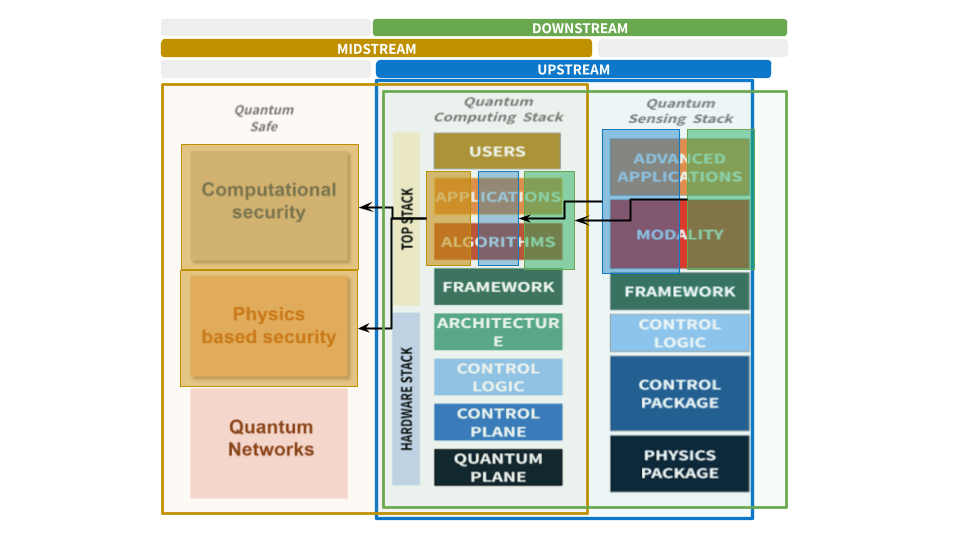
Upstream: Solving the Blind Nature of Exploration
Exploration and production fall under upstream, where the primary challenge lies in the “blind” nature of subsurface exploration. Traditional methods often struggle with low resolution and high operational costs when characterizing deep-seated reserves. Inaccurate subsurface imaging can lead to “dry holes,” increasing the environmental footprint and financial risk.
By applying the Quantum Sensing Stack, leaders can utilize highly precise quantum gravimeters and magnetometers reaching Prototype TRL 7-8 status. These tools detect minute variations in gravity and magnetic fields with sensitivity far beyond classical sensors, allowing for high-resolution subsurface mapping and identifying oil, gas, and mineral deposits with greater certainty. This minimizes the need for invasive exploratory drilling and heavy ground impact, ensuring data is correct the first time.
While sensing identifies resources, the sector faces massive computational bottlenecks processing petabyte-scale datasets to extract them efficiently. These complex physics variables overwhelm classical binary processing. By utilizing the Quantum Computing Stack, companies can accelerate subsurface mapping using algorithms like the quantum Hadamard edge detection algorithm to identify 3D seismic faults—a method already being tested by Saudi Aramco on quantum emulators. Quantum computing further allows for accurately modeling fluid interactions within porous rock formations to optimize extraction strategies.
Midstream: Precision Monitoring and Network Logic
The midstream sector focuses on the transportation and storage of energy resources. The primary advantage here is combining high-precision data with advanced optimization logic.
Utilizing the Quantum Computing Stack, companies can solve complex “combinatorial optimization” problems that classical systems struggle with, such as managing pipeline pressure variables across thousands of miles in real-time. Quantum algorithms can determine the absolute most efficient flow state, significantly reducing the energy required for transport. This is reaching TRL 9 commercial status, available through solvers like D-Wave or Toshiba SBM.
Real-world safety is also being transformed. Players like QLM Technology are already deploying “TDLidar Methane Systems”. These reach TRL 9 by combining single-photon detection with Beer-Lambert fitting signal processing to identify and localize gas leaks with a precision classical sensors cannot match. On the logistics side, mapping the control logic layer of the computing stack allows quantum optimization to navigate millions of tankers and storage variables simultaneously, balancing global maritime supply chains instantly.
Downstream: Molecular Simulation and Digital Defense
Refining and petrochemical operations are governed by molecular interactions that are natively quantum mechanical. Classical computers must rely on approximations for electron interactions, which often limits accuracy.
The Quantum Computing Stack allows for exact molecular simulation, enabling the design of new catalysts that operate at lower temperatures. This dramatically cuts refining costs and carbon intensity. These methods are currently accessible at TRL 3-4 Lab PoC levels through frameworks like Qiskit or Cirq. Beyond production, quantum simulation is essential for environmental stewardship, such as evaluating underground geological spaces for carbon sequestration. By processing datasets far beyond classical limits, leaders can identify stable storage sites with much higher certainty.
Finally, as refineries become automated and interconnected, they become targets for cyber-attacks. The Quantum Safe Stack provides TRL 9 commercial status security, using computational and physics-based layers like Kyber (ML-KEM) to protect multi-billion dollar proprietary chemical formulas and critical control systems from future decryption threats.
March 25, 2026

