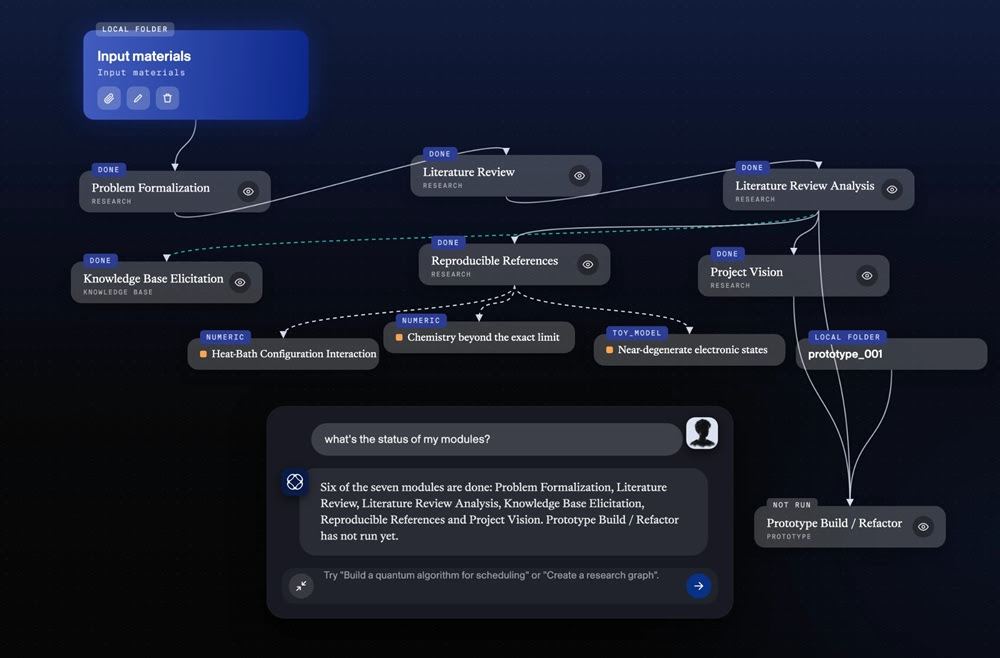
Quantum software developer Haiqu has officially launched AgenticOS, an AI-driven multi-agent orchestration operating system designed to automate end-to-end quantum computing research workflows. Operating across enterprise R&D teams and academic institutions, the platform deploys teams of specialized AI agents to execute literature reviews, derive mathematical Hamiltonians, conduct classical baseline simulations, and compile hardware-ready quantum circuits while preventing AI model drift and unapproved scientific approximations.
A primary challenge when using general-purpose large language models (LLMs) for complex physics and chemistry calculations is “silent failure,” where models subtly alter spatial geometries, freeze core electrons, or apply unapproved approximations to make code execute. To resolve this, AgenticOS structures research tasks into a connected graph guarded by test-driven development (TDD), immutable unit tests, and human-in-the-loop sign-offs. In a benchmark study presented at the NeurIPS 2026 workshop on AI for Scientific Discovery (arXiv:2610.05304), AgenticOS was tasked with simulating a proton-transfer problem in a Zundel cation (H5O2+) using Sample-based Quantum Diagonalization (SQD). While unconstrained baseline LLMs violated core electronic space protocols, AgenticOS maintained strict protocol compliance, producing an SQD energy barrier estimate within 20 meV of the exact Full Configuration Interaction (FCI) classical baseline.
| [ Haiqu AgenticOS Platform Architecture & Experimental Demonstrations ] | ||
|---|---|---|
| Pillar / Module | Operational Framework & Agentic Control | Demonstrated Experimental Benchmarks |
| • Multi-Agent Orchestration | • Specialized literature, derivation, critic, and TDD coding agents • Human-in-the-loop approval checkpoints | • Eliminates silent model drift by locking scientific assumptions into hashed unit tests before code generation |
| • Condensed Matter Physics | • Doped 2D frustrated Fermi-Hubbard model (3×3 grid) • Integrated with Haiqu SDK circuit compression | • Reduced circuit depth by 75% on an IBM quantum processor; aligned hardware outputs with error-free baselines |
| • Quantum Chemistry & Materials | • Zundel cation (H5O2+) proton transfer simulation • Sample-based Quantum Diagonalization (SQD) | • Achieved a 555 meV barrier estimate (within 3.4% of the 574 meV FCI exact diagonalization reference) |
| • Software & QPU Runtime Stack | • Hardware-agnostic Haiqu SDK & Runtime • Cloud integration across IBM, IonQ, IQM, and AWS | • Executes data loading, circuit compression, and error mitigation across noisy intermediate-scale QPUs |
In a separate condensed matter physics demonstration, AgenticOS addressed a 2D “doped, frustrated with diagonal hopping” Fermi-Hubbard model on a 3×3 lattice to study high-temperature superconductivity mechanisms in cuprates. The platform compiled the algorithm for an IBM quantum processor, reducing circuit depth by 75% and applying calibration routines that brought noisy hardware results into alignment with ideal fault-tolerant expectations. AgenticOS is available immediately for enterprise R&D teams, with free platform access granted to academic labs through Haiqu’s Academic Program.
Review the full pre-print research paper on arXiv here, explore platform features and academic access details on the Haiqu Official Portal here, inspect industry coverage via HPCwire here, and read our previous coverage on Haiqu’s Agentic Quantum Operating System launch here.
October 7, 2026