By Doug Finke
When I was a young product manager at Intel, the corporate executives used to teach classes to the employees on a variety of topics to improve their skills. I remember taking the Constructive Confrontation course from Andy Grove was really striking. But one course I think that is still very relevant for today’s quantum industry was a course on marketing given by Bill Davidow who was VP of Marketing at the time and later started the Mohr Davidow Venture firm.
When I took the course, Bill’s main thesis was that technology companies that want to be successful shouldn’t just sell a chip, but rather a whole ecosystem including development tools, software, and training that support usage of the chip.
Before IBM adopted an Intel Microprocessor for their PC, the microprocessor market was not all that big. It was a new technology, hard to use, and most engineers really weren’t familiar with how to use it. Sound familiar?
To help solve this problem, Bill and his team came up with the Intel System Design Kit. These systems allowed an engineer to develop, debug their software programs, and evaluate performance before they designed the microprocessor chip into their specific circuit board design. And at one point, Intel’s Development System Operation responsible for marketing these products was a significant one within the company, but declined in importance after the PC became available.
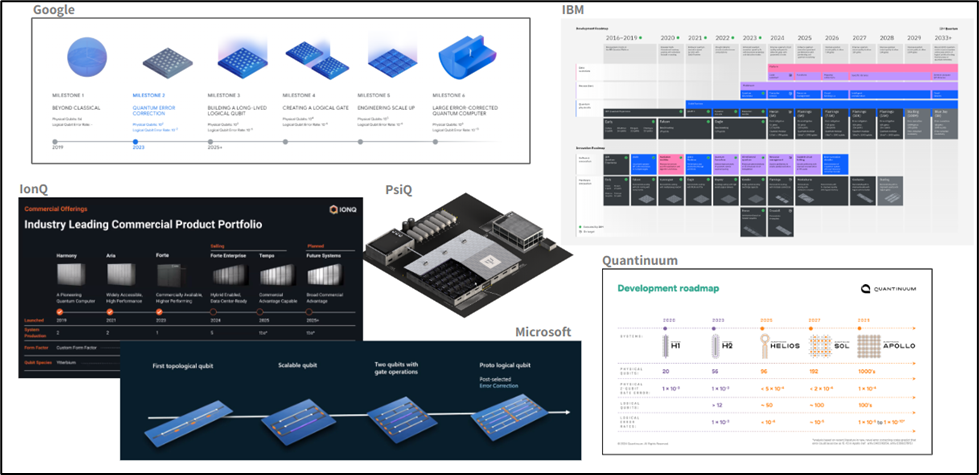
There are some lessons here for quantum providers. In the past few months we have reported on a number of roadmap releases from many different companies including IBM, Pasqal, Oxford Quantum Circuits, Oxford Ionics, Microsoft, Alice & Bob, IQM, and others. And most of those roadmaps only discuss the hardware and sometimes the QEC implementations in the mid-stack, but less about what they are doing to help end users working with the top of the stack.
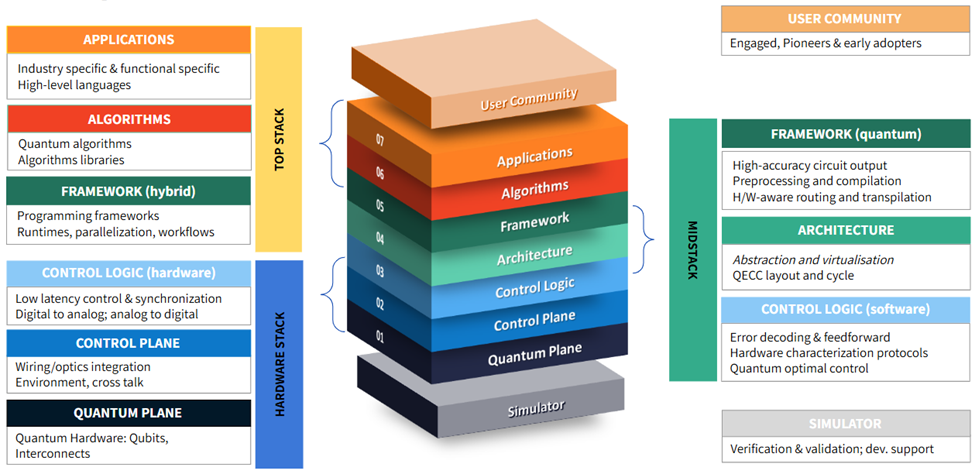
It may help to remind you of GQI’s framework for how a complete quantum computing system is put together:
Another helpful thing is to view GQI’s conceptual picture of where we stand today in achieving Quantum Advantage. Improvements need to be made in both the hardware and software until we are able to cross the bridge.
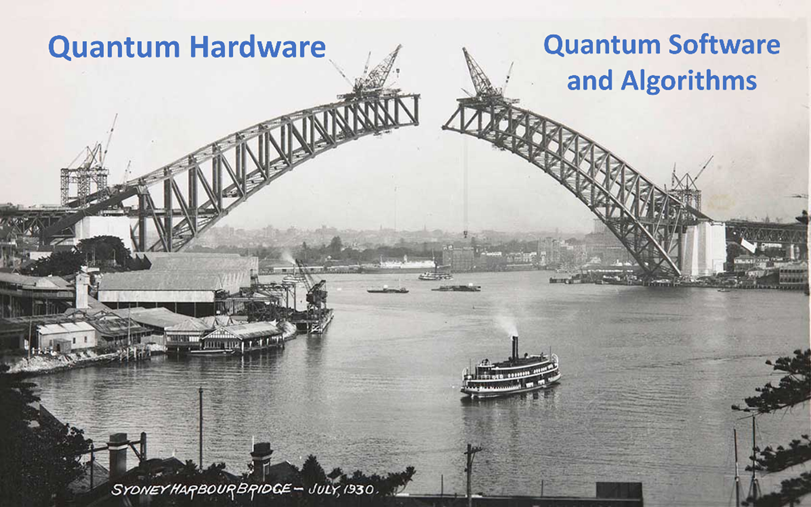
The industry needs to continue making progress in both the hardware and software areas to reach the goal so it is concerning that many of the roadmaps ignore the software side of the picture.
A lot of the software side at the top of the stack is using classical or AI technology, but that does not make it any less challenging. Here are a few of the things that we think are not being covered adequately in the roadmaps:
- All successful quantum implementations will ultimately be hybrid quantum/classical in nature. This means there is going to be a deep integration of their quantum QPUs with classical CPUs and GPUs. There will be many non-trivial requirements to efficiently network data back and forth, minimize latency, schedule jobs, provide job queueing, monitor status, maintain uptime, implement security, etc. How will this be handled?
- Efficient transpiling can make a large difference in the gate count and gate depth of a quantum circuit. This will impact the run time of the circuit, the accuracy of the result, and whether or not the circuit can be run on the available quantum processor. This, by itself, it probably an NP-Hard problem! Some of the more advanced techniques today use AI to help optimize this process, but one future possibility is that we might see someone develop a way to use a quantum computer to create optimal transpilations of other quantum circuits!
- Although hardware capabilities are improving, we all know that the quantum hardware is not ideal and probably will never be large enough or good enough for some future problems. Either a problem can’t fit because too few qubits are available, or the gate fidelities aren’t high enough to support large depth computations. However, there are software techniques available at both the mid-stack and top-stack levels that can make up for some of these deficiencies such as circuit cutting and knitting, error suppression and mitigation, classical post-processing, and others.
- For quantum computing to really take off, it will be necessary to provide tools that can accept a high-level input from a subject matter expert and convert it to a quantum circuit. In much the same way that we don’t see people using x86 assembly language for programming new personal computer apps, I don’t think we will see many folks in a few years manually creating their quantum programs out of individual gates such as Hadamard, CNOT, Toffoli, and other low-level gates. I would expect that AI will again play a big part in making this happen and a few software companies are working in this area. But more needs to be done.
- And more work needs to be done with quantum algorithms to find better ways of doing calculations is also very important. The recent paper from Google that showed how to factor a 2048 integer with 1 million qubits is a great example of how better algorithms can make a huge difference. The previous estimate from Google was that 20 million qubits would be needed. We need more breakthroughs like this.
Some companies may be working in these areas but are not be showing it in their published roadmaps. We realize that smaller companies may not have all the resources to do this on their own, but we suggest they should implement an aggressive partner program in order to find software partners who can help them provide a complete solution. Large companies like IBM have their own resources to work on some of this, but even they have an extensive partner program. And to IBM’s credit they are one of the few that show some of their full-stack plans in their roadmap.
So all quantum providers should look at their technology portfolios and make sure they have in place all elements of a full quantum stack. Although a few end users might be able to create something meaningful without the missing pieces, most will not. And it would be great for the providers to show more on how they will be supporting the full stack in future releases of their quantum roadmaps.
July 12, 2025