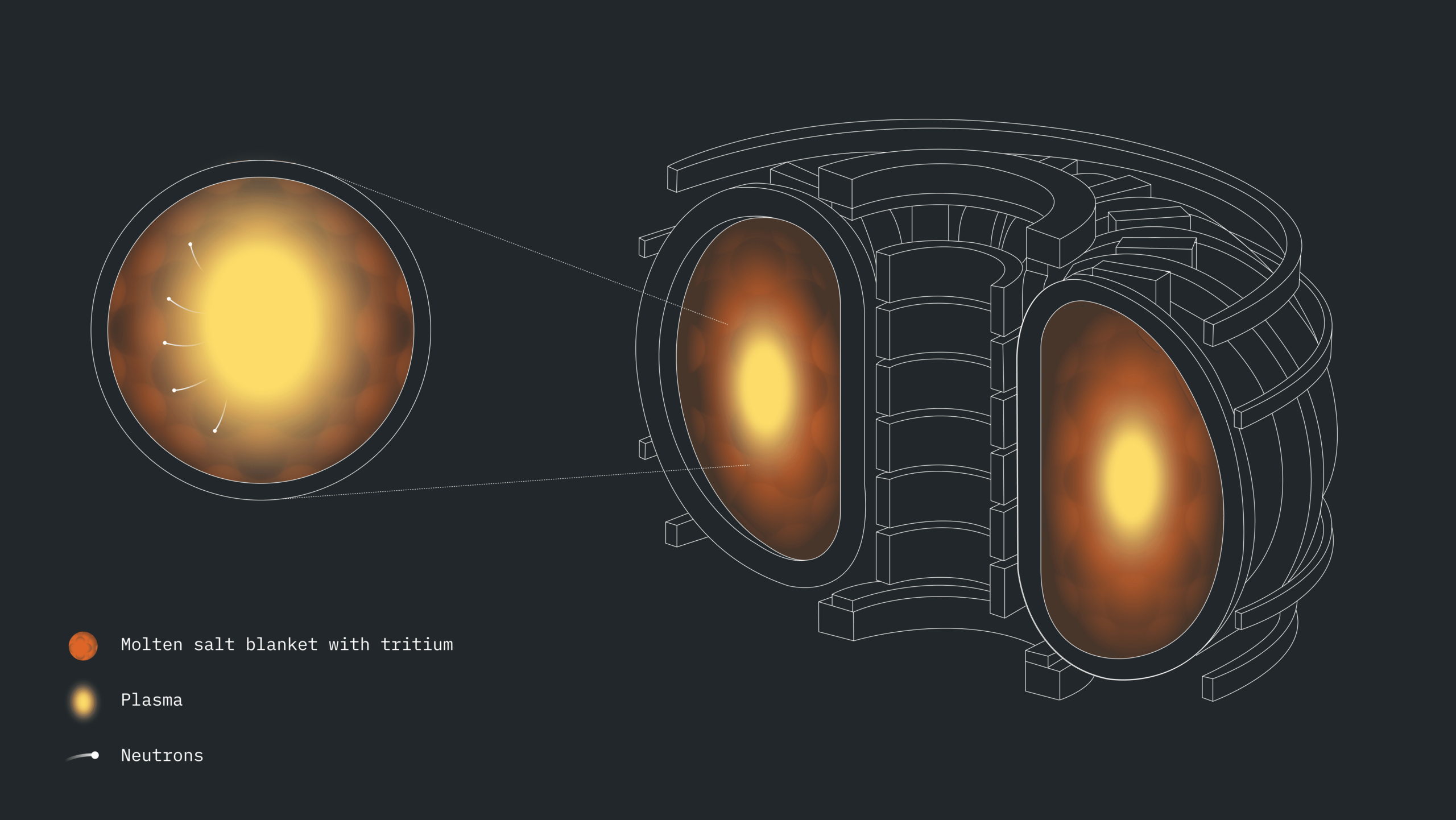
A research collaboration between Oak Ridge National Laboratory (ORNL), the Cleveland Clinic, and IBM Quantum has completed the first heterogeneous quantum-classical simulation of tritium binding within a liquid inorganic molten salt. Released as a preprint on arXiv by a team including ORNL Section Head Tom Beck, Corporate Research Fellow Al Geist, and Cleveland Clinic staff scientist Dr. Kenneth Merz Jr., the project uses quantum-centric supercomputing to resolve electronic ground-state energies for clusters of fluorine, lithium, and beryllium (FLiBe; 2LiF–BeF2). The joint venture serves as a baseline proof-of-concept for the U.S. Department of Energy’s (DOE) Genesis Mission, which aims to eliminate the tritium extraction and fuel-breeding bottlenecks that hinder commercial nuclear fusion power plants.
                         [ ORNL - LBNL - IBM Simulation Stack ]
  Compute Architecture─► Heterogeneous CPUs, GPUs, and cloud-accessible IBM Quantum QPUs.
  Physical Mechanism  ─► Active tritium extraction & conformational energy modeling in liquid FLiBe blankets.
  Algorithmic Engine  ─► Embedded-Wavefunction (EWF) partitioning & Extended Sample-Based Quantum Diagonalization.
To achieve self-sustaining nuclear fusion within magnetic-confinement tokamaks, reactors must breed their own tritium (3H) fuel on-site by wrapping the high-temperature plasma wall in a thick blanket of liquid salt. When high-energy neutrons bombard lithium-6 atoms inside the fluid, they split to yield fresh tritium gas. However, optimizing the chemical recipe of a liquid salt that shifts dynamically under radiation, magnetic fields, and intense thermal loads is an intractable challenge for classical supercomputers. Classical techniques like Density Functional Theory (DFT) introduce free-energy error margins as high as 10%, failing to predict whether the liberated tritium will drift out safely as a harvestable gas or bind with fluorine to create corrosive tritium fluoride (TF).
To overcome the exponential scaling overhead of tracking subatomic electron correlations in a highly polarized, charged ionic mixture, the team adapted an automated wave function-based embedding framework originally deployed to model a massive 12,635-atom protein configuration. The hybrid workflow utilizes a multi-step computation cycle:
- Embedded-Wavefunction (EWF) Partitioning: The classical system extracts localized structural clusters—comprising 21 ions each—drawn from ab initio molecular dynamics simulations of the churning bulk liquid, partitioning them into discrete, atom-centered fragments.
- Sample-Based Quantum Diagonalization: While classical computers execute calculations for the simpler, less entangled fragments, the most computationally complex multi-body clusters are mapped onto an IBM Quantum hardware platform. The hardware uses extended sample-based quantum diagonalization (ext-SQD) to solve ground-state calculations across nine representative molecular conformations.
The physical hardware validations matched the accuracy benchmarks of leading classical fragment-solution approximations, reproducing ground-state fragment energies within 0.7 kcal/mol of full configuration interaction, alongside a tight mean absolute deviation of 0.3 kcal/mol. Concurrently, the datasets revealed that fragmented and unfragmented conformational energy differences shifted by an average of 12 kcal/mol, while standalone tritium binding energies varied by 110 kcal/mol, isolating the physical construction of the fragments rather than the QPU execution as the primary source of remaining algorithmic bias. The team intends to expand the workflow into a closed-loop AI architecture, where automated agents propose candidate salts from ORNL’s 70-year molten-salt registry, execute fast neural network approximations of the fluid dynamics, and route the high-precision chemistry to scaled-up quantum processors to engineer specialized nuclear digital infrastructure.
The official project announcements, collaborative milestones, and institutional press releases can be reviewed through the IBM Newsroom here and the IBM Quantum Blog here. The unfragmented electronic ground-state datasets, peer-reviewed computational methodologies, and ext-SQD algorithmic error bounds can be audited directly via arXiv here.
July 6, 2026