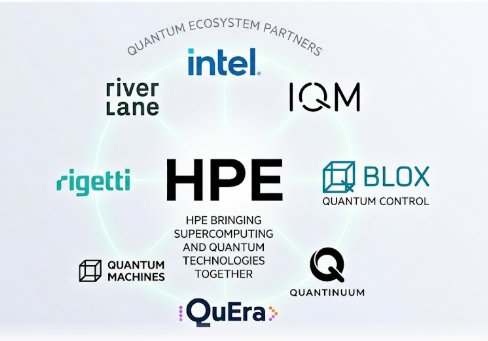
Hewlett Packard Enterprise (HPE) has announced an expansion of its quantum computing strategy, securing collaboration agreements with eight prominent players across the quantum hardware, control systems, and error correction landscape. The initiative aims to integrate the company’s market-leading HPE Cray high-performance computing (HPC) platform with a diverse array of quantum modalities, positioning HPE as a central systems integrator for hybrid classical-quantum computing.
The eight partners named in the announcement span virtually major technological stacks in the industry including:
- Hardware Modalities: Intel (silicon spin qubits), IQM and Rigetti Computing (superconducting), Quantinuum (trapped ion), and QuEra Computing (neutral atom).
- Control & Error Correction: Qblox and Quantum Machines (quantum control infrastructure), and Riverlane (quantum error correction).
This move by HPE represents a logical and necessary evolution for an HPC giant facing the gradual integration of quantum accelerators into the supercomputing fabric. Rather than placing a single bet on an internal hardware modality, HPE is leveraging its core strength, the massive, tightly coupled networking and classical infrastructure of its Cray supercomputers, to serve as the connective tissue for the broader quantum ecosystem. HPE’s strategy focuses heavily on co-design, software interoperability, and system-level performance benchmarking, which are critical hurdles for data center managers looking to deploy hybrid workflows.
By including neutral atom, ion trap, superconducting, and silicon spin technologies, HPE is creating a vendor-agnostic testbed. This broad approach allows the company to evaluate architectural trade-offs without committing to a single modality before the industry reaches consensus on fault tolerance. Furthermore, the inclusion of Riverlane highlights that HPE is already looking past NISQ (Noisy Intermediate-Scale Quantum) machines toward the integration of heavy-overhead quantum error correction (QEC) protocols into classical architectures. For the quantum hardware and software startups involved, partnering with HPE provides a critical enterprise channel and validation. It ensures their systems are being engineered to meet strict data center requirements from day one. The challenge ahead for HPE will be moving these relationships beyond high-level collaborative frameworks and joint testbeds into standardized, commercially available product offerings that can seamlessly orchestrate workloads across classical CPUs, GPUs, and QPUs.
HPE announced this effort at its HPE Discover Las Vegas 2026 event today. A press release provided by HPE about it can be found here.
June 15, 2026

