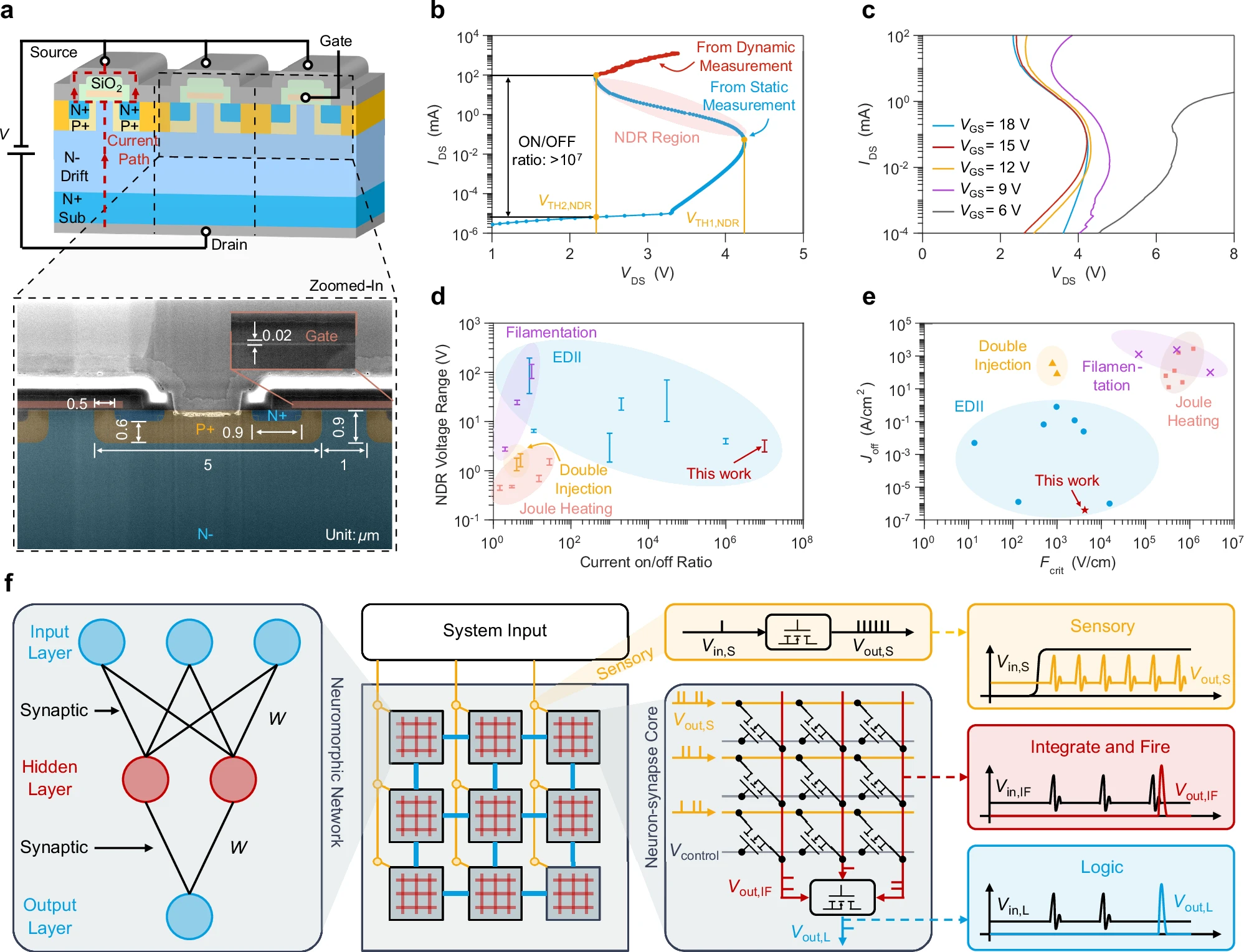
Solid-state electronics researchers from the University of Hong Kong’s (HKU) Department of Electrical and Computer Engineering, working alongside the Centre for Advanced Semiconductors and Integrated Circuits (CASIC), have achieved a significant material physics breakthrough in cryogenic electronics. Led by Professor Yuhao Zhang and PhD student Xin Yang, the team has engineered a programmable, brain-like neuromorphic hardware platform that operates near absolute zero (10 mK). Published in Nature Communications, the study demonstrates how the intrinsic atomic properties of industry-standard Silicon Carbide (SiC) power transistors can be harnessed to construct energy-efficient, local data processing networks inside quantum dilution refrigerators. This milestone introduces a practical pathway to eliminate the severe wiring bottlenecks that currently limit the scalability of universal quantum computers.
Harnessing Electron-Donor Impact Ionization for Millikelvin Spiking
The foundation of the research relies on the discovery of a stable mechanism to generate and modulate S-shape negative differential resistance (NDR) inside standard commercial SiC MOSFETs at temperatures below 2 K. Traditional silicon-based control circuitry relies on thermal carrier excitation to function; when subjected to extreme cryogenic environments, these standard controllers experience carrier freeze-out, forcing operators to position the dense control electronics far away from the quantum processor. This spatial separation requires thousands of coaxial cables to bridge the thermal gap, creating an unscalable thermal and physical wiring bottleneck.
The HKU team discovered that cooling SiC MOSFETs to the millikelvin regime triggers an intrinsic material phenomenon known as electron-donor impact ionization (EDII). By modulating the transistor’s gate voltage, the carrier dynamics within the silicon carbide’s atomic lattice can be precisely controlled to mimic the energy-efficient “spiking” and action potential behavior of biological neurons. Because the EDII mechanism is an intrinsic physical property of the SiC crystal lattice rather than a thermal side-effect, it remains exceptionally stable, predictable, and highly repeatable across separate manufacturing batches.
Industrial 300-mm Wafer Scaleup and Deep-Space Application Horizons
A key advantage of the HKU platform is its structural compatibility with existing commercial semiconductor foundries. Unlike exotic superconducting logic blocks or quantum-dot electronics that require completely new fabrication workflows, these neuromorphic cryogenic controllers can be manufactured immediately on standard 300-mm wafers using established automotive and power-grid supply chains. The research demonstrates that these single-transistor neuromorphic nodes can be successfully cascaded into complex, integrated neural networks directly on-chip.
Operating thousands of times more energy-efficiently than conventional silicon architectures, this local neuromorphic processing block dramatically reduces the thermal load inside cryogenic dilution setups, enabling local execution of real-time quantum control algorithms and dense quantum error correction (QEC) matrix decoding. Beyond anchoring sovereign quantum infrastructure, the ruggedized, radiation-tolerant nature of silicon carbide makes these biomimetic chips ideally suited for deep-space exploration payloads, allowing autonomous instruments to survive the extreme, unheated environments of the lunar surface and outer solar system bodies.
The complete peer-reviewed research paper detailing the underlying crystal carrier dynamics, gate-controlled S-shape current-voltage sweeps, and cascaded spiking waveforms can be accessed directly through the Nature Communications here. For corporate syndication logs, institutional media archives, and adjacent semiconductor foundry milestone briefs, track the primary engineering dashboard hosted via the active HKU Pressroom here.
June 12, 2026