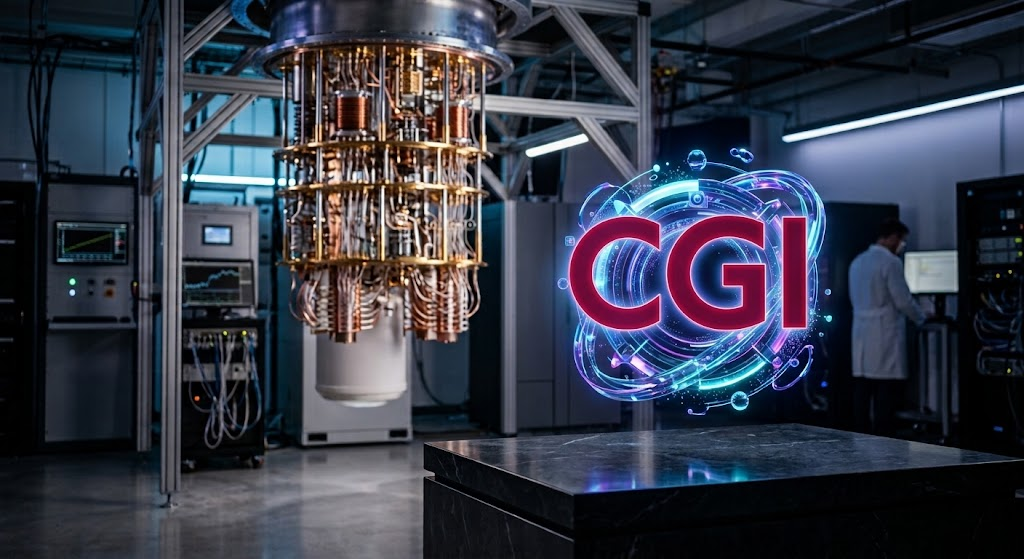
The technology sector is currently experiencing a profound inflection point in quantum computing, marked by substantial capital investments, regulatory shifts, and a transition from abstract planning to concrete execution. At the center of this transition are global systems integrators like CGI, a massive consulting firm with roughly 90,000 consultants managing end-to-end IT services across both commercial enterprise and federal government sectors. Rather than investing in the fundamental scientific research required to build the next physical qubit, CGI is positioning itself at the threshold of commercialization. Through conversations with Victor Foulk, Vice-President of Emerging Technology at CGI Federal, and Curtis Nybo, Global Quantum Computing Lead at CGI, a clear picture emerges of how an IT consulting giant approaches quantum integration: by bridging the gap between cutting-edge hardware and real-world business applications.
A Commercial, Pragmatic Approach to Quantum
CGI’s foundational philosophy in the quantum space is to leverage existing capabilities to drive immediate returns on investment. The company does not build quantum computers; instead, its primary goal is to connect clients who possess complex use cases with the appropriate hardware and tools. By abstracting the intense complexity of quantum mechanics, CGI ensures that end-users do not need to understand whether a process is powered by a classical CPU, a GPU, or a quantum processing unit. Ultimately, the user only needs to know that they are receiving superior solutions faster.
To achieve this, CGI maintains a flexible, multi-architecture approach. Through partnerships, as well as AWS and Azure subscriptions, CGI teams access a wide variety of quantum computing providers, spanning both annealing and gate-based architectures. This flexibility allows consultants to precisely match the best hardware to a client’s specific challenge. While interest in quantum technology was largely exploratory just a few years ago, CGI has noted a massive recent increase in client demand for actual, applied use cases, signaling a rapid maturation in the market. Much like the accelerated adoption of generative AI in recent years, organizational leadership is now well-versed in the basics of quantum mechanics, allowing consulting teams to skip elementary introductions and proceed directly to technical discovery. Furthermore, mature software development kits (SDKs) provided by hardware companies have drastically lowered the barrier to entry, allowing client teams with basic Python knowledge to begin exploring use cases immediately.
Bridging the Gap: Systems Integration and Agentic AI
Moving a quantum application from a proof-of-concept into full production involves challenges far beyond the quantum hardware itself. CGI views its role fundamentally through the lens of systems integration: taking new quantum algorithms and weaving them into existing, often decades-old organizational architectures. To function in production, a quantum application must securely intake parameters from legacy data systems and output its results into familiar user interfaces, dashboards, or reporting structures.
Artificial intelligence plays a critical supporting role in this transition. Rather than viewing AI as a competitor to quantum computing, CGI utilizes it as a necessary bridge. Through platforms utilizing an agentic digital workforce, AI can parse legacy enterprise IT, reverse-engineer classical logic, and separate large tasks into discrete components. The AI layer then routes the appropriate sub-tasks to a quantum computer while leaving others for classical processing.
Things to Consider When Planning on Introducing Quantum Apps into an Enterprise Workflow
- Redefining Production Workloads: While quantum annealing systems might run ongoing, continuous optimizations in the background, a production workload on a gate-based architecture may simply look like a research team routinely executing targeted simulations as part of a larger workflow.
- Managing Operational Change: Upgrading to a quantum solution requires organizations to retire existing classical optimization models that internal teams may have invested heavy time and capital into developing.
- Stakeholder Training: CGI heavily emphasizes client education, integrating stakeholders into the application development process to demystify the technology and build enduring trust.
- Workflow Incorporation: Production use cases require quantum outputs to seamlessly feed into broader AI agentic workflows or decision engines without causing operational friction for the end-user.
Strategic Alliances and High-Value Use Cases
Optimization problems are currently driving the bulk of CGI’s quantum engagements, as they naturally align with the most pressing challenges in industries like logistics, manufacturing, and healthcare. To tackle these workloads, CGI recently formalized a partnership with D-Wave. This alliance allows CGI to leverage D-Wave’s optimization tools and annealers—systems capable of 99% uptime—to run continuous background re-optimizations for highly dynamic production environments.
In the public sector, CGI Federal is actively developing solutions for defense logistics. The company recently established a fiscal year 2027 research and development agreement with the US Defense Logistics Agency, the largest military logistics agency in the government. Working alongside strategic industry alliances and an onshore delivery center in Knoxville, Tennessee, CGI is commercializing quantum technologies for warehouse management, reverse supply chain disposition, and contested logistics. In these environments, even minor optimizations to delivery routes or supply chain logic can generate a 10% reduction in delivery costs and lower maintenance overhead.
Beyond optimization, CGI is also seeing early industry traction in computational chemistry. Clients manufacturing physical materials, such as paint, are actively exploring how quantum simulations can model material degradation over time under specific environmental conditions, effectively accelerating testing timelines that would normally require drawn-out, complex laboratory environments.
Security, Sovereignty, and the Post-Quantum On-Ramp
For many organizations, the initial entry point into quantum technology is not optimization, but security. The impending threat of quantum decryption has made post-quantum cryptography (PQC) a significant driver of overall quantum interest. CGI’s cybersecurity teams are actively helping clients execute digital transformations to replace legacy systems with NIST-approved PQC algorithms, which often requires identifying where cryptography is currently buried across massive enterprise data estates. As organizations map their architectures and prepare for these mandates, it frequently sparks a broader realization of quantum’s power. Clients often ask CGI consultants what else quantum computers can accomplish if they possess the power to break RSA encryption, seamlessly transitioning the conversation from defensive cybersecurity to offensive business use cases.
In the federal sector, these security upgrades are bound by strict sovereignty requirements. Establishing accredited hybrid classical-quantum systems for secure government operations demands that infrastructure be domestically housed, managed by US personnel, and secured via encrypted links and managed certificates. Additionally, there is a pressing need to educate the federal acquisition workforce on how to purchase and deploy this technology. Technicians do not need to understand how to design a qubit or manage extreme cooling temperatures; they simply need to know what workloads the hardware handles best and how to integrate it securely.
CGI Federal’s overarching objective is to mitigate this structural complexity so government agencies can focus squarely on their mission outcomes. Rather than measuring success by standard profit-and-loss metrics, the federal practice prioritizes “Mission Return on Investment”—tailoring systems to decrease execution costs and accelerate delivery speed. By deploying the strategic playbooks refined during the AI boom, CGI is actively preparing the workforce and IT infrastructure to ensure quantum technology lands responsibly, securing a decisive advantage for its commercial and government clients.
October 1, 2026