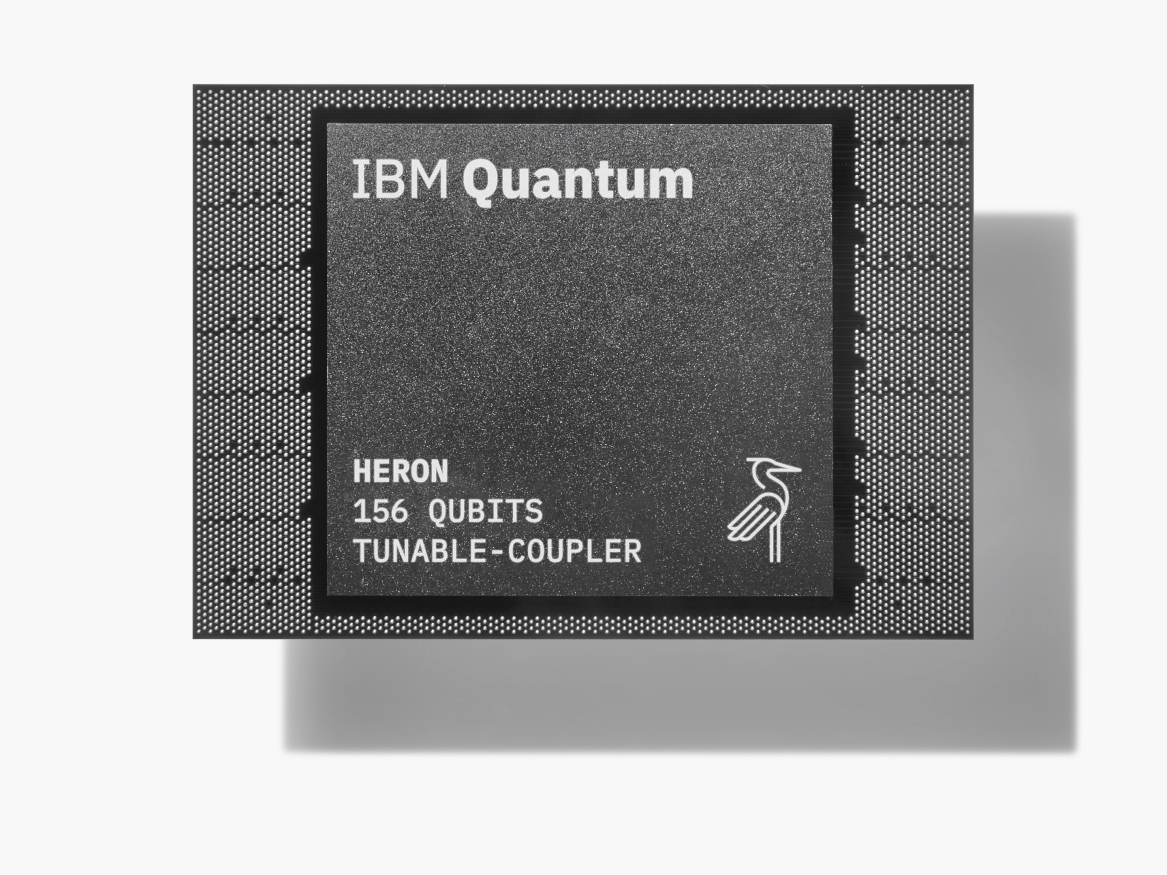
Researchers from Rutgers University, IBM Quantum, and collaborating academic institutions have demonstrated real-time quantum feedback control across 100 qubits on a 156-qubit IBM Quantum Heron superconducting processor (`ibm_fez`). Published in Nature Physics, the study implements adaptive quantum circuits that interleave entangling gates with mid-circuit measurements and resets, providing experimental validation of non-unitary dynamics critical for scalable quantum error correction (QEC).
The experiment executed nearly 5,000 two-qubit entangling gates and nearly 5,000 mid-circuit measurement-based resets across 100 linearly connected qubits. By stochastically competing information-scrambling operations (a quantum analog of the classically chaotic Bernoulli map) against local resets pushing qubits toward the zero state, the team observed and characterized a dynamical control-induced phase transition (CIPT) between chaotic volume-law and controlled unentangled phases.
| [ IBM Heron 100-Qubit Adaptive Circuit & Phase Transition Parameters ] | |||
|---|---|---|---|
| Dynamical Regime | Control Rate (p) & Operations | Entanglement & Lyapunov Scaling | Measured Critical Exponents |
| • 1. Chaotic Volume-Law | • 0 ≤ p < 0.3 • Scrambling unitaries dominate | • Extensive volume-law entanglement; positive Lyapunov exponent (λ > 0). | • N/A (Fully scrambled state) |
| • 2. Chaotic Area-Law | • 0.3 < p < 0.5 • Interleaved unitaries and resets | • Subextensive area-law entanglement; retains exponential superposition components. | • N/A (Area-law trajectory) |
| • 3. Critical Point (CIPT) | • p = pc ≈ 0.5 • Balanced scrambling and resets | • Unbiased random walk dynamics; diffusive growth of magnetization (⟨Mz⟩). | • pc = 0.495(1) • ν = 1.05(2) • z = 2.08(1) (Dynamical) • β = 1.05(2) |
| • 4. Controlled Phase | • 0.5 < p ≤ 1.0 • Resets dominate scrambling | • Unentangled state; system locks to fixed target state (|0…0⟩) (λ < 0). | • N/A (Absorbing fixed point) |
Quantum Fluctuation Sampling and Hardware Certification
To distinguish true coherent quantum dynamics from classical noise, the researchers measured the variance of shot-to-shot quantum fluctuations (varQ[Mz]) across 10,000 shots per circuit configuration. Comparing experimental distributions against classical dephasing Markov models using Kullback-Leibler (KL) divergence confirmed that the processor sampled a genuine quantum random process rather than purely incoherent stochastic noise.
The study marks one of the largest experimental realizations of real-time feedback and non-unitary adaptive circuits to date, validating theoretical matrix product state (MPS) models and statistical mechanics mappings on physical hardware.
Review the peer-reviewed study in Nature Physics here, inspect the institutional report on Rutgers Today here, and read the technical preprint on arXiv here.
October 22, 2026