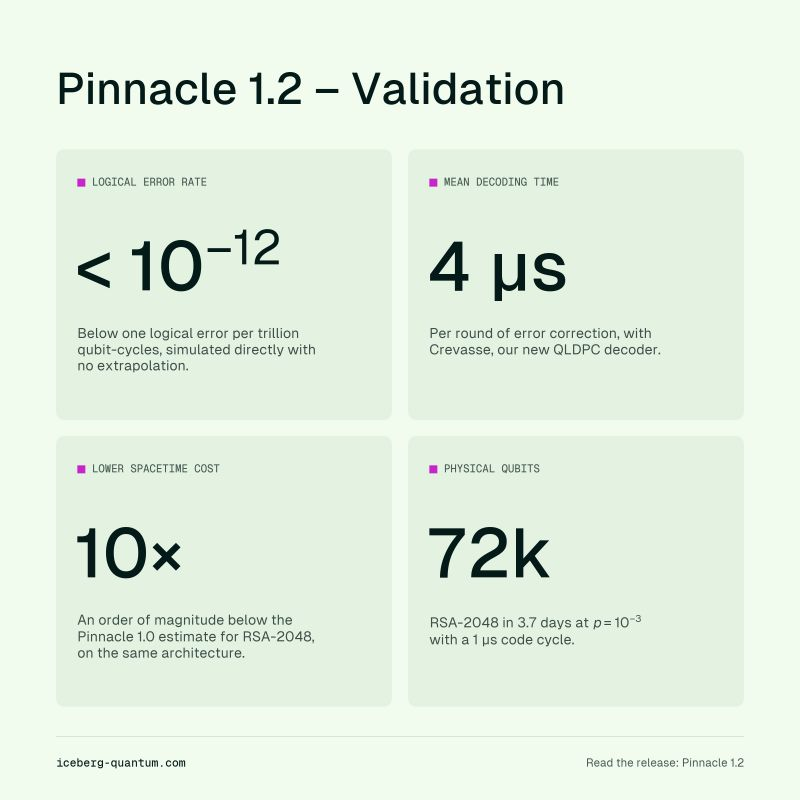
Fault-tolerant quantum architecture startup Iceberg Quantum has released Pinnacle 1.2, demonstrating direct circuit-level simulations of quantum low-density parity-check (QLDPC) codes that validate logical error rates below 10-12 per logical qubit-cycle—the threshold required to execute 2048-bit RSA integer factorization.
The breakthrough is enabled by Crevasse, Iceberg Quantum’s new QLDPC decoder. Crevasse achieves an average decoding latency of 4 microseconds per error-correction round, enabling the team to execute trillions of simulated error-correction cycles directly rather than relying on statistical extrapolations. By combining Crevasse’s decoding efficiency with compiled modular exponentiation circuits, Iceberg Quantum updated its resource estimates for breaking RSA-2048 to 72,000 physical qubits in 3.7 days at a physical error rate of p = 10-3 (and 48,000 physical qubits in 0.98 days at p = 10-4 for a 1-microsecond code cycle time), representing a significant reduction in spacetime overhead compared to Pinnacle 1.0.
| [ Pinnacle 1.2 RSA-2048 Factoring Resource Benchmarks ] | |||
|---|---|---|---|
| Physical Error Rate (p) | Code Cycle Time (dt) | Physical Qubit Footprint | Expected Total Runtime |
| • p = 10-4 | • 1 microsecond (Atomic / Photonic) | • 48,000 physical qubits (d = 10) | • 0.98 days |
| • p = 10-3 | • 1 microsecond (Atomic / Photonic) | • 72,000 physical qubits (d = 16) | • 3.7 days |
| • p = 10-4 | • 1 millisecond (Trapped Ion) | • 714,000 physical qubits (d = 10) | • 29 days |
| • p = 10-3 | • 1 millisecond (Trapped Ion) | • 2.1 million physical qubits (d = 16) | • 32 days |
| • Frozen Pinnacle (p = 10-3) | • 1 microsecond (Fixed-degree 8 Superconducting) | • 99,000 physical qubits | • 5.0 days |
Direct Error-Correction Sampling and Circuit Compilation
To establish these metrics, Iceberg Quantum simulated one trillion samples across Pinnacle memory and processing blocks without encountering logical failures under smaller code distances: observing only three logical errors on its d = 16 ([[254,14,16]]) code at p = 10-3 (a logical error rate of 2 × 10-13) and zero logical errors on its d = 10 ([[126,12,10]]) code at p = 10-4 (≤ 3 × 10-13). The use of smaller code distances reduces spatial overhead by ~40% and temporal overhead by ~30% compared to Pinnacle 1.0 benchmarks.
The team verified complete modular exponentiation circuits against models of the Pinnacle architecture using forced-gap post-selection for state injection into magic state distillation blocks, achieving injection error rates of (1.3 ± 0.3) × 10-6 (d = 10) and producing output magic states with failure rates near pout ≈ 3.5 × 10⁻¹¹. Applied to Frozen Pinnacle—a variant designed for fixed 8-degree connectivity superconducting systems—the improved compilation reduces resource requirements to 99,000 physical qubits and a 5.0-day execution runtime.
Review the announcement via Iceberg Quantum Release Notes here, examine the executive summary on Larry Cohen’s LinkedIn post here, inspect the founding Pinnacle 1.0 research paper on arXiv here, read the forced-gap post-selection study on arXiv here, review Google Quantum AI’s RSA security analysis on Google Research Blog here, examine the Frozen Pinnacle architecture paper on arXiv here, and read the Pinnacle 1.1 hardware release on Iceberg Quantum Pinnacle 1.1 here.
October 22, 2026