
IonQ (NYSE: IONQ) has detailed two milestones across its quantum sensing subsidiary, Vector Atomic, targeting GPS-denied Position, Navigation, and Timing (PNT) for maritime and airborne defense platforms. The updates pair a Phase II Option award from the Defense Advanced Research Projects Agency (DARPA) to develop an airborne strapdown quantum gravimeter with field data from a 51-day U.S. Navy-sponsored maritime deployment of Vector Atomic’s commercial Evergreen-30 (EG-30) optical atomic clock.
| IonQ / Vector Atomic Quantum Sensing & PNT Specifications | ||
|---|---|---|
| System / Program | Core Architecture & Parameters | Operational & Development Milestones |
| Evergreen-30 (EG-30) Optical Clock | 3U 19-inch rackmount molecular iodine optical clock (29 L, 20 kg, 80 W); 2.5 × 10⁻¹⁴ instability at 1 s, <4 × 10⁻¹⁵/day drift, and 30-day holdover within 10 ns. | Completed a 51-day Navy-sponsored deployment aboard the TS Patriot State in 2026, building on a 21-day RIMPAC sea trial (<300 ps/day drift across three units). |
| DARPA GRAVMAP Gravimeter | Strapdown rubidium atomic gravimeter paired with conventional inertial sensors for vibration-immune airborne operation. | Awarded DARPA Phase II Option after completing top-level assembly vibration analysis; lab evaluation through late 2026 and flight/field tests in 2027. |
| Dual Optical Frequency Comb (DUAL-OFC) | 9 L rackmount module (8 kg, <25 W) Er-fiber dual frequency comb at 1560 nm (<5 × 10⁻¹⁷ stability at 1 s optically referenced). | Supports picosecond-level optical time transfer and multi-wavelength synchronization alongside EG-30 (1064 nm CW and 1560 nm comb outputs). |
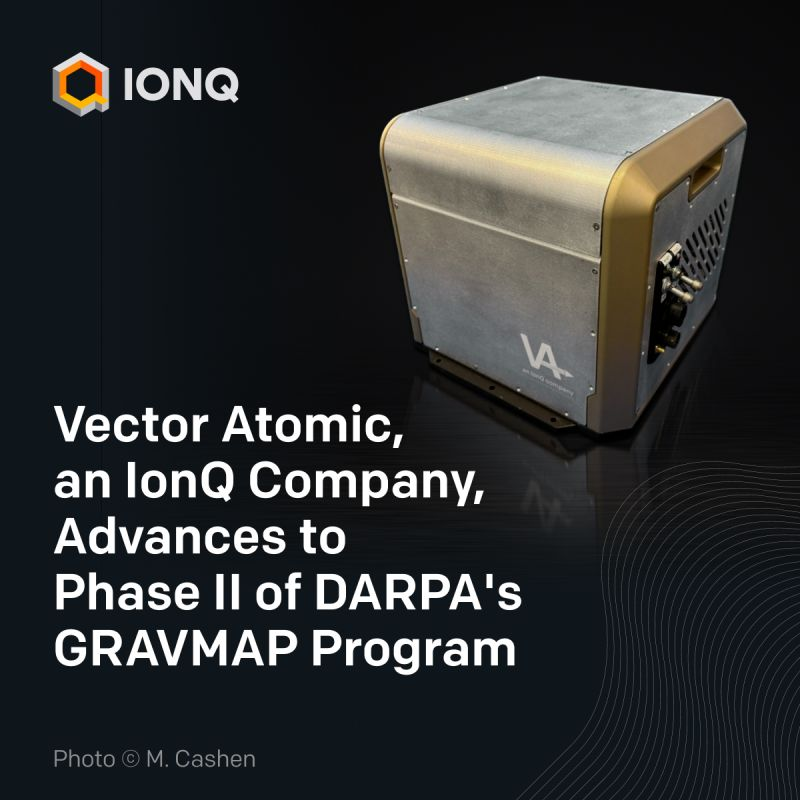
Under DARPA’s Gravimeter using Rubidium Atoms with Vibration-immunity for the Maritime and Airborne Platforms (GRAVMAP) program, originally awarded in September 2025, Vector Atomic is engineering an atomic gravimeter designed to operate without active motion stabilization during representative flight dynamics. Focusing on reductions in size, weight, and power (SWaP) and manufacturability, the team will complete full system integration and laboratory characterization through the remainder of 2026 ahead of airborne platform demonstrations in 2027.
Complementing its passive gravitational and magnetic navigation sensors, IonQ highlighted the autonomous holdover performance of the turnkey EG-30 iodine optical clock, which requires no vacuum chamber or reference cavity and delivers 100 MHz, 10 MHz, 5 MHz, and 1 PPS microwave outputs alongside optical references. Validated under live sea conditions aboard the training ship TS Patriot State, the clock provides continuous timing resilience when satellite signals are jammed or spoofed.
Read IonQ’s technical overview on optical clock holdover here, view IonQ’s LinkedIn announcements on the DARPA GRAVMAP Phase II Option here and maritime PNT deployments here, and inspect the Evergreen-30 here and Dual Comb here product datasheets.
November 24, 2026