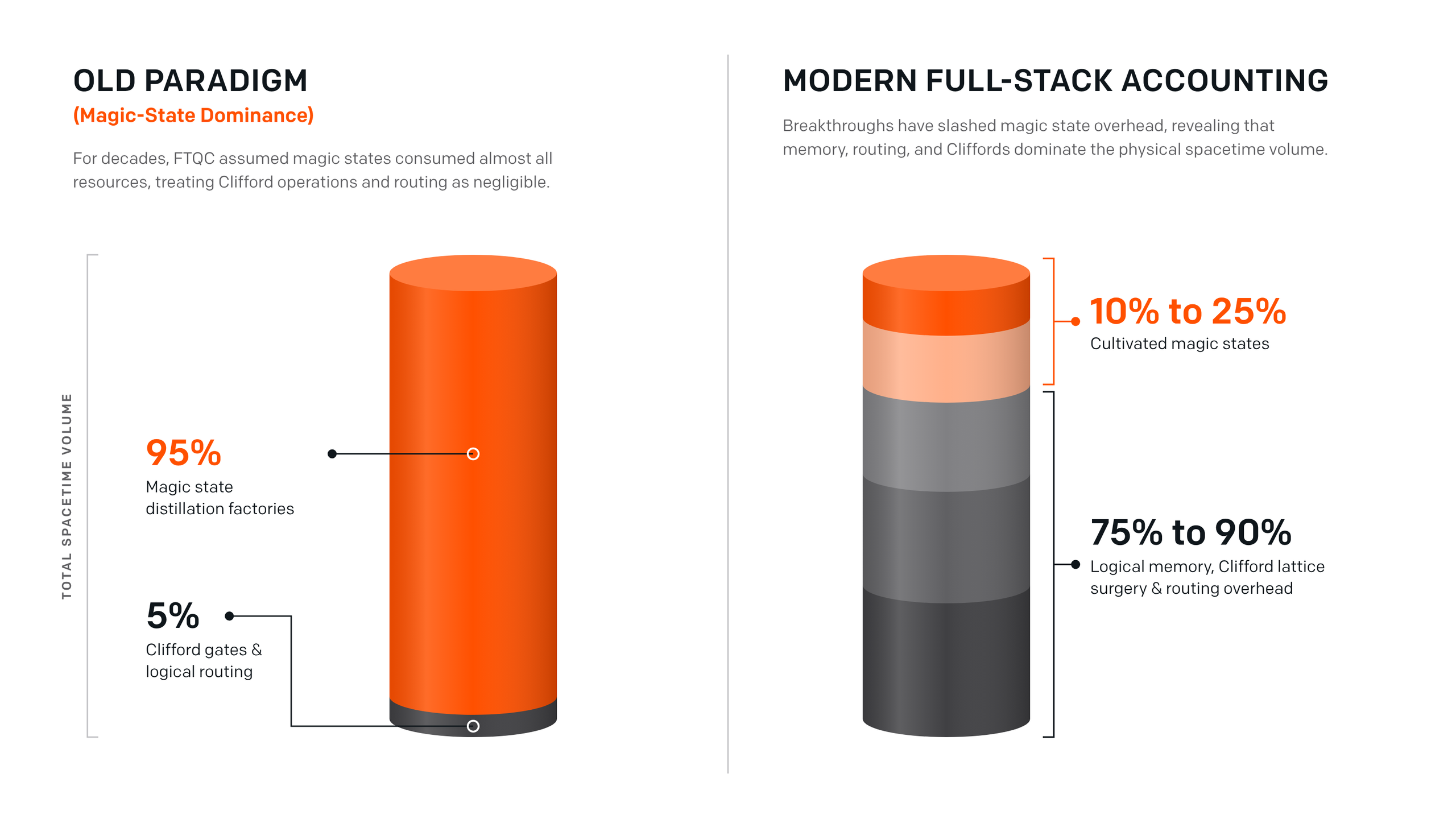
Hardware developer IonQ and quantum software firm Classiq have published a joint technical analysis examining how shifting cost dynamics in fault-tolerant quantum computing (FTQC) invalidate non-Clifford gate minimization as an isolated proxy for performance. In a technical brief titled “From Magic States to Full-Stack Accounting: How Resource Estimation for Fault-Tolerant Quantum Computing Is Growing Up,” the authors evaluate compiler benchmarks indicating that reductions in magic state preparation overhead leave routing, Clifford gates, and logical memory retention as the primary determinants of physical spacetime volume.
Historically, FTQC resource estimation models assumed non-Clifford operations—principally T and Toffoli/CCZ gates implemented via magic state distillation—governed over 90% of total physical spacetime volume. Recent advances in magic state cultivation and compact distillation routines have lowered non-Clifford state overhead toward parity with logical Clifford gates. As a result, routing overhead, qubit layout constraints, and idle logical memory cycles represent an increasing fraction of physical footprint, often accounting for 50% to over 90% of total spacetime volume.
Full-stack compilation experiments demonstrate that minimizing T-gate count alone can increase overall system requirements. Benchmarks conducted using Classiq’s synthesis platform on a Grover-style search routine under a transversal fault-tolerance model showed that a 3% reduction in T-states inflated physical spacetime volume by 41% due to increased routing lines and memory overhead. In that instance, magic state production consumed 6% to 26% of physical spacetime, while encoded memory and circuit execution required 74% to 94%. Similarly, IonQ’s resource projection for solving 256-bit elliptic curve discrete logarithms on its trapped-ion “Walking Cat” architecture indicates that while 39 million Toffoli gates require 13.3 days of execution, total runtime reaches 25.7 days due to Clifford scheduling and system-level operations.
The analysis concludes that evaluating fault-tolerant algorithms requires moving beyond scalar gate metrics toward full-stack compilation that maps circuits to physical layouts, error-correcting codes, and dynamic resource allocation between active memory and magic state generation.
The technical brief can be accessed via the IonQ Analysis here. Readers can also review related QCR coverage of hardware-level non-Clifford state overhead reductions in Google Quantum AI Demonstrates Magic State Cultivation on Willow Processor in Science Milestone here and software synthesis tooling in Classiq Launches Fault Tolerance Engine for Hardware-Aware Quantum Application Synthesis here.
November 9, 2026