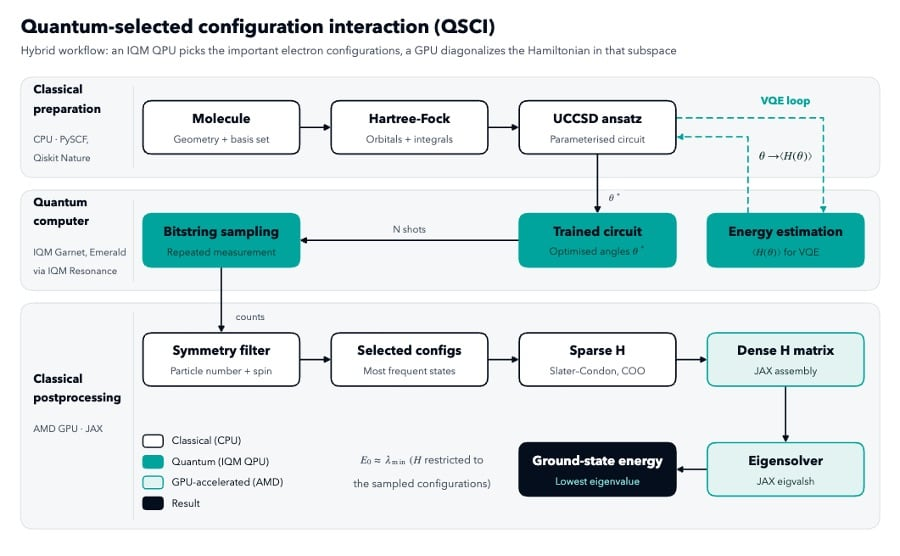
IQM Quantum Computers (Nasdaq: IQMX) and AMD have demonstrated an end-to-end hybrid quantum-classical computational chemistry workflow that partitions molecular ground-state energy calculations across IQM’s 20-qubit superconducting IQM Garnet processor and AMD Instinct GPUs running the open-source ROCm software stack. Detailed in the first installment of a planned technical series, the collaboration establishes a multi-vendor alternative for supercomputing centers integrating quantum processors with classical GPU accelerators.
The workflow implements Quantum-Selected Configuration Interaction (QSCI) to bypass the exponential memory scaling of exact classical diagonalization. Accessed via the IQM Resonance cloud platform, the Garnet processor prepares a parameterized trial circuit and samples bitstrings to identify dominant electron configurations, while an AMD GPU filters unphysical samples, constructs the projected subspace Hamiltonian, and executes cubic-scaling (O(N3)) matrix diagonalization using JAX on ROCm.
The teams validated the full pipeline on molecular hydrogen (H2 in the minimal STO-3G basis), reproducing the dissociation curve across 17 bond lengths on physical hardware while resolving ROCm version-pinning dependencies for hybrid execution. Candidly framed as an interoperability validation rather than a demonstration of quantum advantage, the workflow is available as an open-source Jupyter notebook on IQM Academy for execution on AMD Developer Cloud GPU instances as the partners work toward tighter physical interconnects and larger molecular active spaces above eight qubits.
Read the joint AMD and IQM technical post here.
November 17, 2026