Superconducting quantum computer developer IQM Quantum Computers (Nasdaq: IQMX) and European rail operator Deutsche Bahn have published joint research demonstrating the execution of a hybrid quantum-classical optimization algorithm on real-world operational railway data. Executed end-to-end on IQM’s Emerald quantum processor, the study addresses the complex challenge of rolling stock planning—assigning physical train units to scheduled trips while minimizing operational costs and adhering to strict maintenance constraints.
The collaboration evaluated a real operational dataset provided by Deutsche Bahn’s IT subsidiary, DB Systel, consisting of 190 scheduled trips across five major German cities (Cologne, Munich, Berlin, Frankfurt, and Hamburg) over a two-day planning window. To translate the scheduling problem into a form suitable for quantum execution, IQM mapped the constraints into a Maximum-Weight Independent Set (MWIS) problem on a conflict graph. In this formulation, graph nodes represent feasible, closed train cycles (incorporating mandatory two-hour maintenance stops in Hamburg and a 4,000 km distance cap), while edges connect incompatible cycles that service the same scheduled trip.
                  [ IQM & Deutsche Bahn Hybrid Scheduling Architecture ]
  Operational Data Input     ──► 190 Trips / 5 Cities / 2-Day Timetable
                                 │
                                 ▼
  Conflict Graph Generation  ──► ~98,500 Feasible Train Cycles (MWIS Formulation)
                                 │
                                 ▼
  Divide-and-Conquer Framework──► Iterative Subgraph Extraction (e.g., k = 20 Nodes)
                                 │
                                 ▼
  Quantum Execution (IQM QPU)──► QAOA (p = 1) Solves Subgraph MWIS + Pruning
                                 │
                                 ▼
  Global Graph Update        ──► Selected Cycles Removed; Unserviced Trips Re-iterated
Because full-scale cycle generation yielded an MWIS graph containing approximately 98,500 feasible cycles—a search space too large for direct processing on present-day QPUs—the researchers engineered a quantum divide-and-conquer framework. The classical outer loop iteratively extracts manageable subgraphs (e.g., 20 nodes) prioritized by passenger-carrying trip density. The quantum subroutine then executes the Quantum Approximate Optimization Algorithm (QAOA) at depth p=1 to select partial solutions. A classical post-processing pruning procedure resolves conflicting choices to ensure valid, edge-free independent sets before updating the global graph.
Experimental results confirmed three core findings:
- End-to-End Execution on Today’s Hardware: The hybrid framework produced feasible, high-quality schedules for a real enterprise dataset without requiring fault-tolerant QPUs.
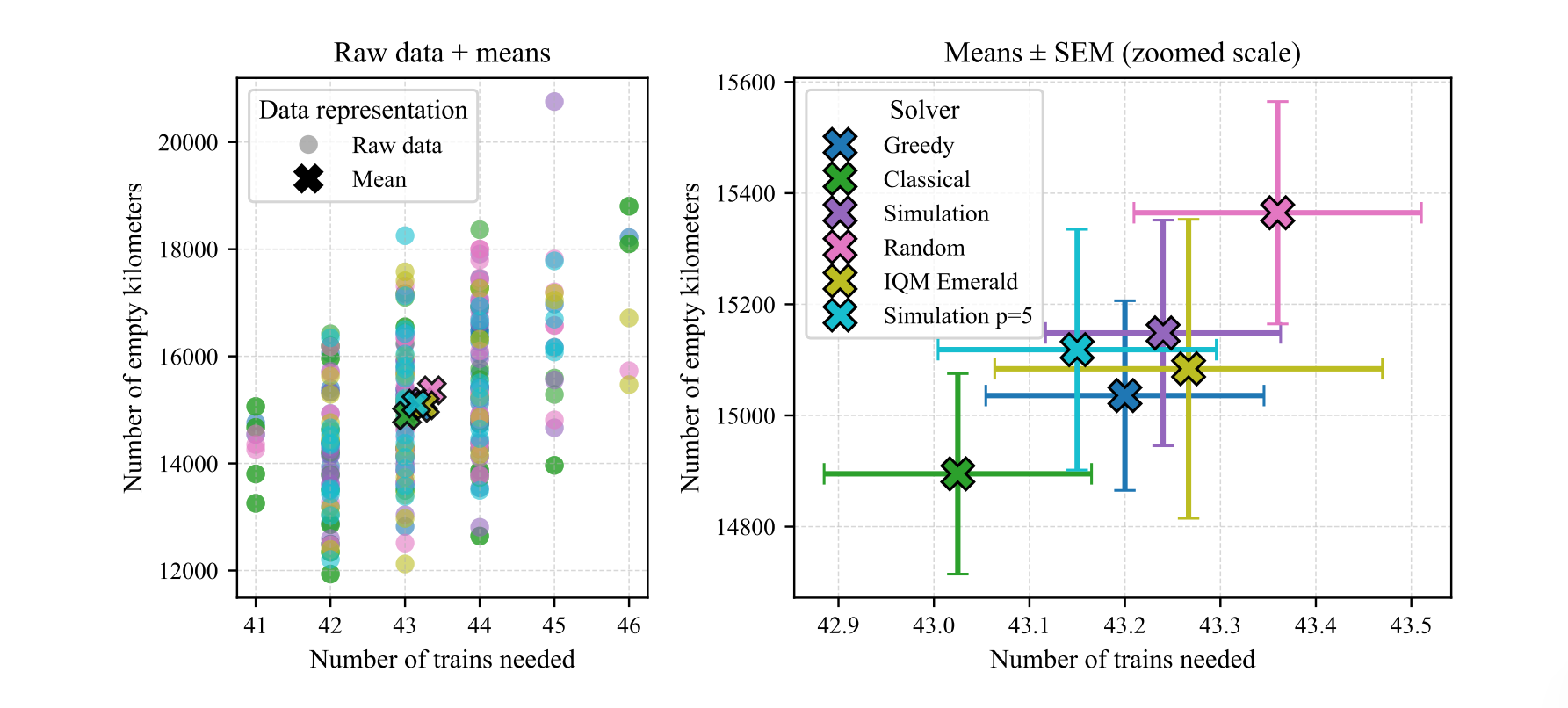
- Predictable Scaling with Subgraph Size: Benchmarking via classical exact solvers demonstrated a statistically significant relationship (P=1.04×10⁻⁹): as subgraph sizes increase, the hybrid framework yields a direct reduction in empty kilometers (unproductive distance traveled without passengers).
- Automatic Hardware Improvement: As quantum processors scale in qubit count, connectivity, and gate fidelity to handle larger subgraphs, the underlying algorithmic architecture will deliver superior scheduling outcomes without requiring structural redesign.
The milestone arrives following IQM’s public listing on the Nasdaq Global Select Market and Nasdaq Helsinki in July 2026 under the ticker IQMX. Both organizations noted that while the initial study focused on deterministic, offline planning, the divide-and-conquer architecture could eventually be adapted for real-time disruption management, allowing rail operators to dynamically reassign rolling stock during unexpected service delays.
Review the full technical case study on IQM here, download the technical whitepaper here, inspect the academic pre-print on arXiv here.
August 1, 2026