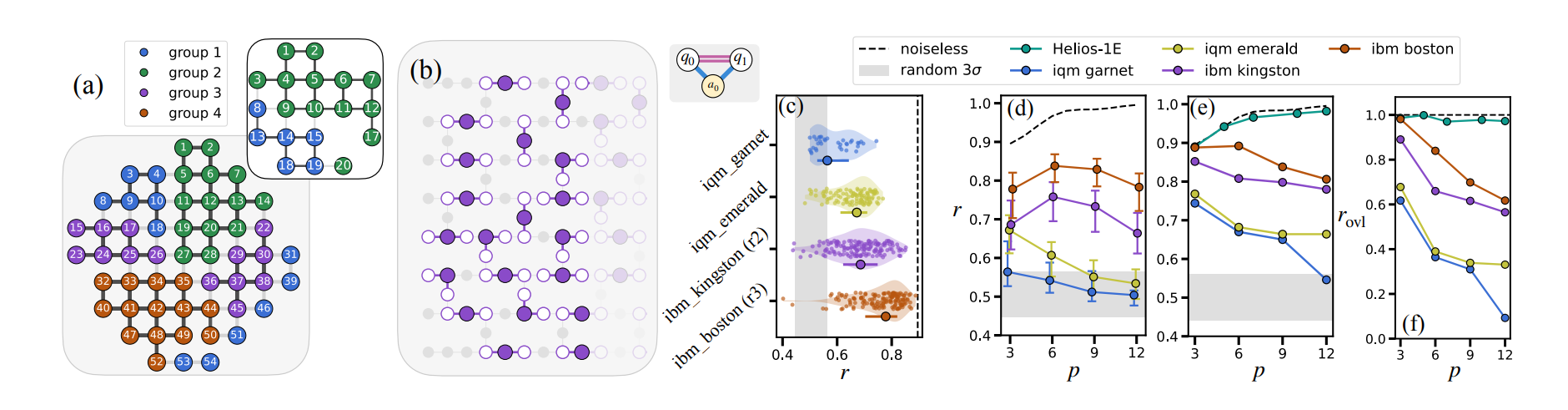
A benchmark study published by researchers at Germany’s Jülich Supercomputing Centre (JSC) has evaluated key Quantum Error Correction (QEC) primitives—including mid-circuit measurement (MCM), qubit reset, dynamic feed-forward control, and spectator idling—across ten commercial quantum processing units (QPUs) from Quantinuum, IBM, and IQM.
The study, titled “Evaluating the performance of QEC primitives on quantum processors at large width and depth“ (arXiv:2610.05928), introduces a low-sampling algorithmic benchmark utilizing a Linear-Ramp Quantum Approximate Optimization Algorithm (LR-QAOA) framework. By mapping the interaction and check structures of distance-scaled surface codes, triangular color codes, and bivariate-bicycle quantum Low-Density Parity-Check (qLDPC) codes directly into the algorithm, the researchers measured effective depolarizing error rates (λeff) accumulated during repeated syndrome-extraction rounds.
| [ Jülich Supercomputing Centre QEC Primitive Benchmark Findings ] | ||
|---|---|---|
| QPU Platform / Vendor | MCM Overhead & Error Rate (λeff) | Tested Code Structures & Scale |
| • Quantinuum (Helios-1, H2-1) | • MCM error contribution comparable to two-qubit gate error rates (λeff ~0.22% to 0.49%) | • Color codes up to d=11 (91 data qubits) • Surface codes up to d=9 (81 data qubits) • qLDPC BB48 (48 data qubits, 44 MCMs/layer) |
| • IBM Quantum (Heron & Eagle QPUs) | • Generational gains on Heron (ibm_boston); MCM error rate remains ~10x baseline two-qubit gates (λeff ~1.1% to 3.2%) | • Surface codes up to d=5 (25 data qubits) • Validated against logical memory runs on ibm_phoenix (ρs ~0.83 to 0.88) |
| • IQM Quantum (Emerald, Garnet) | • Signal decay accelerated beyond 2-data-qubit chains due to conditional control and routing constraints | • 1D MCM chains and minimal triplet configurations |
According to the findings, Quantinuum’s trapped-ion systems demonstrated the strongest overall performance across the tested QEC primitives, maintaining algorithmic signal clarity (r = 0.733) on a 91-data-qubit triangular color code requiring 45 MCM operations per layer across 98 physical qubits. Additionally, the researchers validated the benchmark on an 11-patch surface-code (d=3) memory experiment on ibm_phoenix, establishing a high correlation (ρs = 0.83 to 0.88) between the low-shot LR-QAOA metric and actual logical error survival probabilities (PL).
Review the full pre-print manuscript on arXiv here.
October 7, 2026