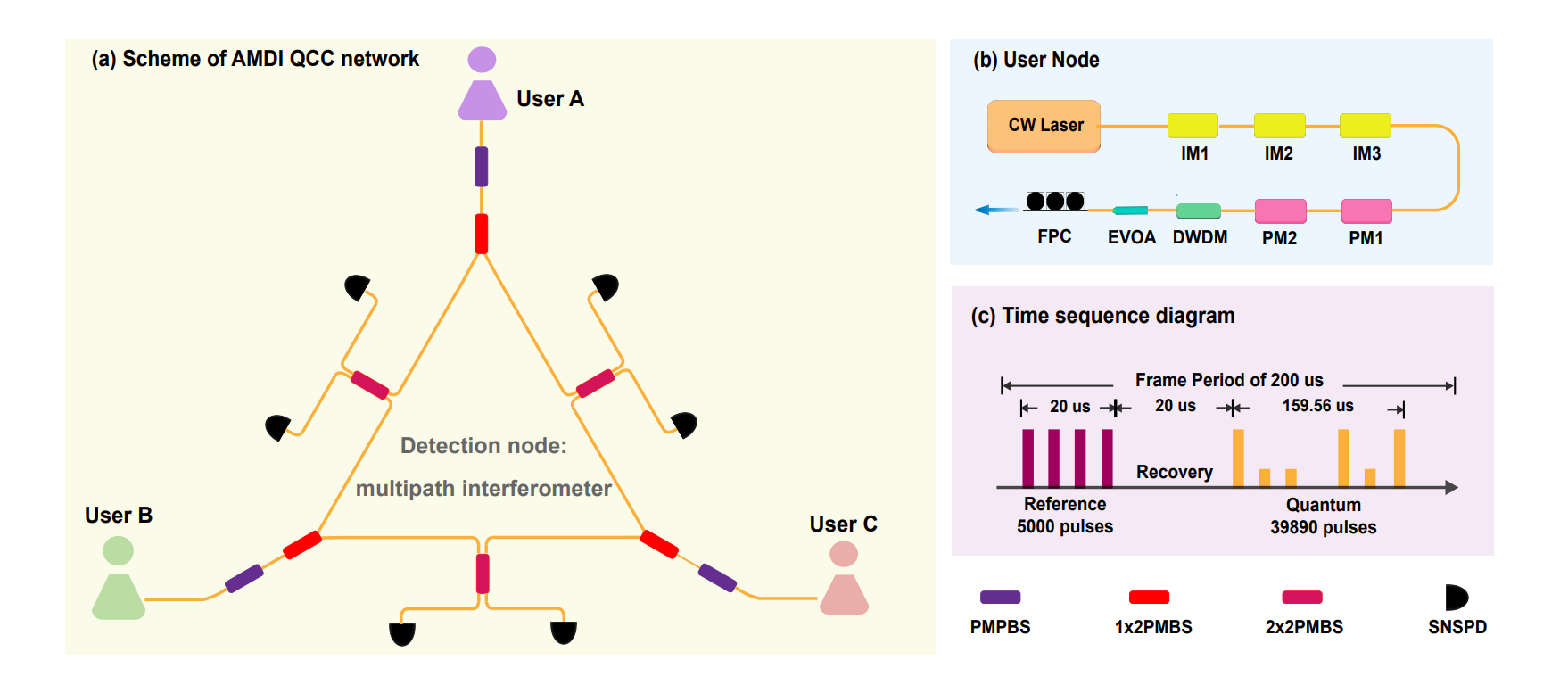
QCC).
A research team at Nanjing University, led by Professor Xiao-Song Ma, has experimentally demonstrated an Asynchronous Measurement-Device-Independent Quantum Cryptographic Conferencing (AMDI QCC) network across three independent user nodes. Detailed in a paper published in Physical Review Letters, the protocol resolves two major bottlenecks in multi-party quantum communication: scaling key generation rates over high optical channel losses and eliminating the need for active, complex global phase locking across independent lasers.
In conventional multi-user MDI quantum conferencing protocols, key generation relies on simultaneous multi-photon coincidence events across all N users, causing the key rate R to scale as O(ηN), where η represents single-user channel transmittance. The asynchronous mode-pairing protocol decoupling time-stamped single-photon detection events during classical post-processing fundamentally changes this scaling behavior to O(η)—rendering loss scaling independent of the total number of network participants. The experimental system tolerated a maximum total loss of 59.6 dB across the three-user network, delivering a secure key rate of 4.470 × 10-9 bits per pulse and expanding loss tolerance by more than 38 dB compared to prior polarization-encoded MDI conferencing setups.
| [ Nanjing University 3-User AMDI QCC Performance Benchmarks ] | ||
|---|---|---|
| Channel Loss Profile (dB) | Secure Key Rate (R, bits per pulse) | Key Technical Innovations |
| • 39.3 dB Total System Loss | • R = 3.940 × 10⁻⁸ bpp | • O(η) Scaling: Asynchronous single-photon mode pairing |
| • 48.6 dB Total System Loss | • R = 3.937 × 10⁻⁸ bpp | • FFT Frequency Drift Estimation: 0.4s interval tracking |
| • 59.6 dB Total System Loss | • R = 4.470 × 10⁻⁹ bpp | • Post-Phase Drift Compensation: Passive thermal stability |
To operate without global optical phase locking across free-running continuous-wave lasers, the team implemented a fast Fourier transform (FFT) algorithm on interleaved reference pulses to track inter-laser frequency differences and compensate for phase drift within the central GHZ multipath fiber interferometer. By transforming dynamical phase noise into software corrections during post-processing, the setup reduced the X-basis quantum bit error rate (QBER) from 50.02% to 40.76%, offering a practical, hardware-efficient path toward scaling intercity multi-party quantum networks.
Review the peer-reviewed study on Physical Review Letters here, read the open-access preprint on arXiv here, and inspect public data releases on EurekAlert! here.
September 23, 2026