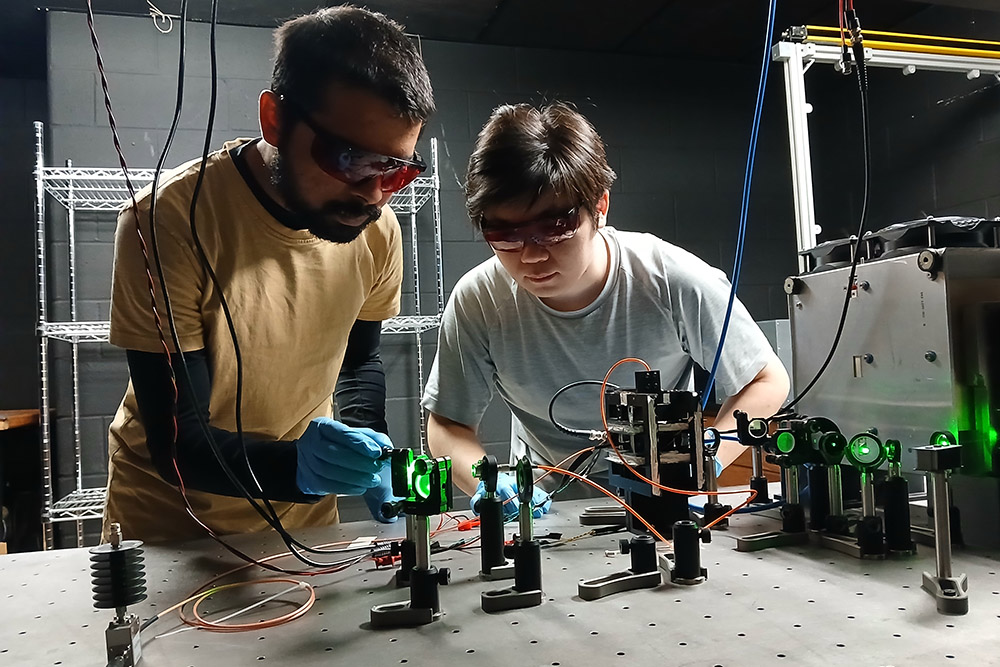
Researchers from Stony Brook University and the University of Hawaiʻi at Mānoa have been awarded a three-year, $600,000 grant from the National Science Foundation (NSF) under its Foundations of Emerging Technologies program to develop Quantum Intelligent Sensor Networks (QISNs). Co-led by Assistant Professor Hyeongrak “Chuck” Choi (Stony Brook) and Assistant Professor Bo-Han Wu (Hawaiʻi at Mānoa), the collaborative initiative shifts the quantum metrology paradigm from optimizing single isolated sensors to engineering distributed, entangled sensor nodes that operate as a coordinated system.
The research project focuses on utilizing distributed quantum resources—specifically continuous-variable squeezed light, integrated photonics, and complementary metal-oxide-semiconductor (CMOS) integrated diamond spin color center nodes—to extract weak, spatially varying signals beyond classical sensing limits. Rather than treating individual detectors independently, Choi’s group at Stony Brook will deploy information-theoretic tools, such as quantum Fisher information, to evaluate fundamental sensitivity limits and analyze how network topology, optical loss, phase noise, and entanglement distribution impact real-world performance. Concurrently, Wu’s team at the University of Hawaiʻi will lead computational modeling and continuous-variable photonic optimization, integrating specialized quantum error correction (QEC) strategies to preserve sensing capabilities under environmental noise and hardware imperfections.
| [ Quantum Intelligent Sensor Network (QISN) Technical Architecture ] | ||
|---|---|---|
| Research Thrust | Institutional Lead & Tooling | Core Technical Function & Platform Target |
| • Network Architecture & Information Bounds | • Stony Brook University (Hyeongrak “Chuck” Choi) | • Quantum Fisher information modeling • Entanglement distribution topology & noise loss trade-offs • CMOS-integrated diamond spin color center nodes |
| • Photonic Optimization & Sensing QEC | • University of Hawaiʻi at Mānoa (Bo-Han Wu) | • Continuous-variable (CV) squeezed-light modeling • Quantum error correction for lossy optical channels • Dynamic parameter re-configuration for target signals |
| • Target Application Domains | • Joint Collaborative Framework | • Distributed magnetic-field sensing & biomedical imaging • Quantum radar & environmental oceanography • Secure, resilient quantum network communications |
The initiative complements ongoing AI-driven quantum research at Stony Brook’s AI Innovation Institute (AI3), exploring the intersection of neural networks and physical quantum intelligence. By establishing formal design principles for entangling sensing nodes over optical channels, the project supports long-term deployments in environmental ocean monitoring, disaster preparedness, magnetic field imaging, and resilient communications.
Review the official university announcement via the Stony Brook University Newsroom here and examine related regional quantum infrastructure in our detailed coverage of Stony Brook’s 13-mile free-space quantum link here.
September 30, 2026