
NVIDIA has released CUDA-QX 0.4, a new version of its software development kit designed to streamline quantum error correction (QEC) and application development. The release provides researchers and algorithm developers with tools for creating end-to-end QEC workflows, from defining and simulating codes to configuring decoders and deploying them with physical QPUs.
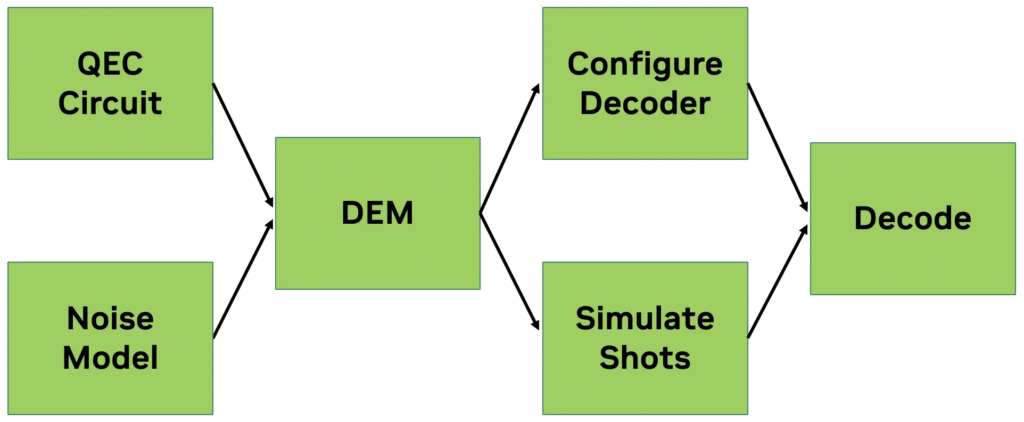
The new release introduces the ability to automatically generate a detector error model (DEM) from a specified QEC circuit and noise model, which is then used for circuit sampling and syndrome decoding. CUDA-QX 0.4 also adds an open-source, GPU-accelerated tensor network decoder, which achieves theoretical optimum decoding accuracy by exploiting the cuQuantum libraries. Additionally, the release adds an implementation of the Generative Quantum Eigensolver (GQE), a hybrid algorithm for finding eigenstates of quantum Hamiltonians using generative AI models.
Other improvements in CUDA-QX 0.4 include enhanced flexibility and monitoring capabilities for the GPU-accelerated Belief Propagation + Ordered Statistics Decoding (BP+OSD) implementation. These enhancements provide features such as adaptive convergence monitoring and algorithm selection. The release addresses the focus of QPU builders and algorithm developers on QEC as a core challenge. By providing tools for defining, simulating, and decoding QEC codes, NVIDIA aims to accelerate the path toward building larger-scale, commercially viable quantum computers.
Read more about this release on the NVIDIA Developer Blog here. For complete information on CUDA-Q QEC’s BP+OSD decoder, see the latest Python API documentation here, C++ API documentation here, and an example here. For complete details on the Solvers implementation of GQE, see the Python API documentation here and examples here.
August 14, 2025

