
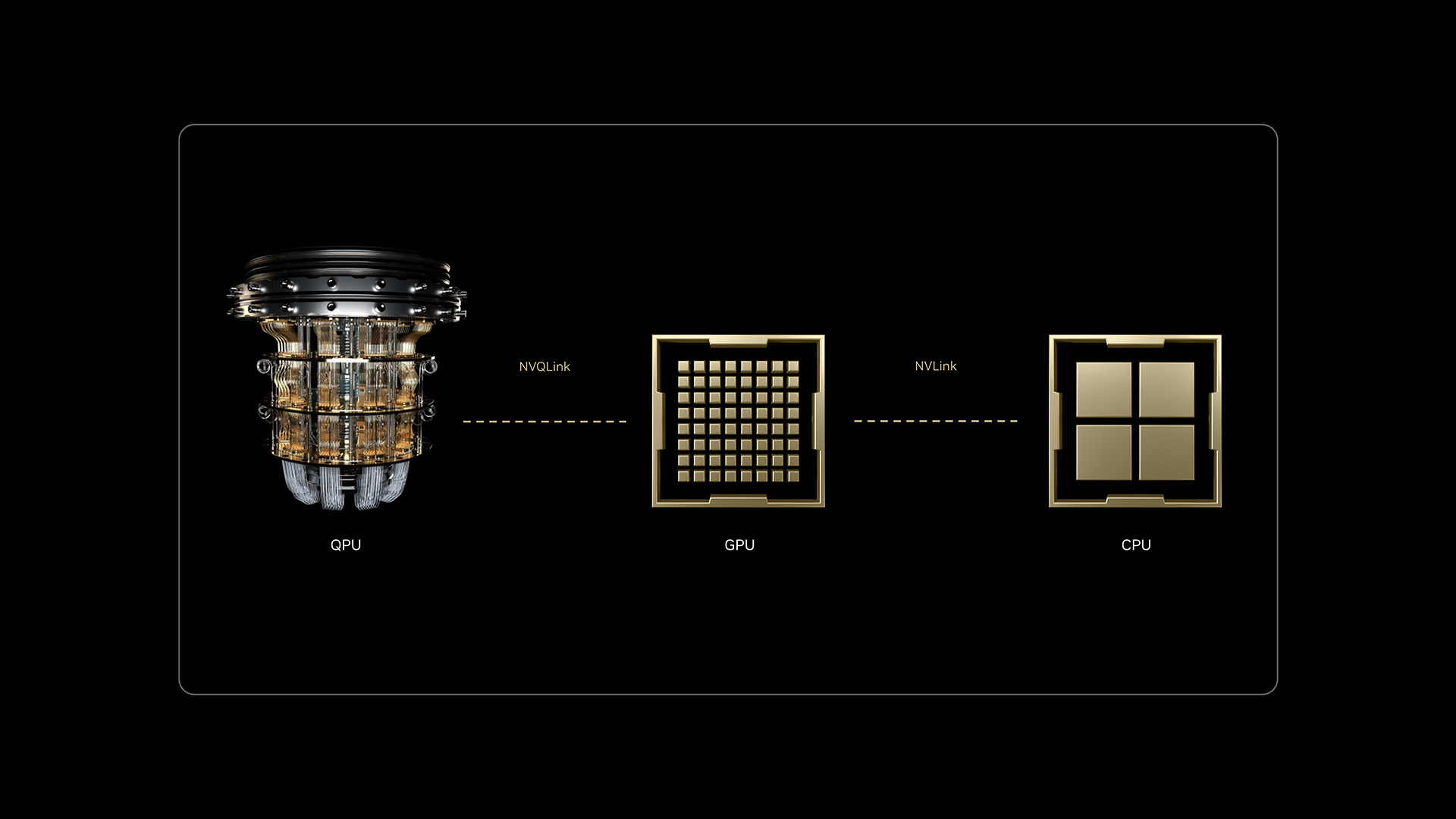
NVIDIA has launched NVQLink, an open system architecture for tightly coupling GPU computing with quantum processors to build accelerated quantum supercomputers. The platform is designed to provide the demanding low-latency, high-throughput interconnect required for the complex control algorithms of large-scale quantum computing and Quantum Error Correction (QEC). The development of NVQLink was guided by researchers from leading supercomputing centers at nine U.S. national laboratories, including Brookhaven National Laboratory, Fermi Laboratory, and Oak Ridge National Laboratory.
NVQLink is integrated with the NVIDIA CUDA-Q platform and supports 17 Quantum Processing Unit (QPU) builders and five control system providers. The interconnect enables researchers and developers to create and test hybrid quantum-classical systems, accelerating applications in chemistry and materials science. Jensen Huang, founder and CEO of NVIDIA, positioned NVQLink as the critical technology uniting quantum and classical supercomputers into a single, coherent system.
Key performance specifications for the NVIDIA CUDA-Q platform with NVQLink include:
- P32 Compute: 160 TFLOPS per GB200
- FP4 Tensor Core (with sparsity): 40,000 TFLOPS per GB200
- GPU-QPU Throughput: Up to 400 Gb/s, configurable
- GPU-QPU Latency: < 4.0 miroseconds round trip, PGA-GPU-FPGA
Multiple key partners simultaneously announced their adoption of the architecture:
- Pasqal (Neutral Atom): Integrates its QPUs to enable better logical architectures and accelerate roadmaps toward Fault-Tolerant Quantum Computing (FTQC).
- IQM (Superconducting): Combines NVQLink with its IQM Constellation processor architecture and Zurich Instruments’ control systems, targeting real-time decoding and control at scale.
- Alice & Bob (Cat Qubit): Utilizes the platform for logical orchestration, decoding, and live calibration, allowing GPUs to perform tasks previously limited to dedicated hardware.
- Quantum Machines (QM) (Control Systems): The open architecture extends QM’s microsecond-latency control solution, enabling real-time data exchange and deterministic feedback.
- Zurich Instruments (Control Systems): Will use the end-to-end integration of supercomputing resources, like NVIDIA’s Realtime Host, with Zurich Instruments’ high-performance quantum control systems to enable users to efficiently time their workflows with real-time capabilities that seamlessly link classical and quantum computation steps.
- Qblox (Control Systems): Will leverage NVIDIA NVQLink to allow for the tight integration of NVIDIA GPUs with Qblox Q1 pulse processors and meet the stringent timing requirements for high-performance interaction between classical and quantum processors.
- SEEQC (Digital Interface Systems): Announced the integration of its Digital Interface System with NVQLink, creating a fully digital link between QPUs and GPUs. The system, built on energy-efficient Single Flux Quantum (SFQ) logic, replaces analog interfaces and is claimed to reduce logical data bottlenecks from QPUs by over 1,000×. This digital interface is intended to eliminate core latency and throughput bottlenecks that limit FTQC.
Other companies supporting NVQLink include Anyon Computing, Atom Computing, Diraq, Infleqtion, IonQ, ORCA Computing, Oxford Quantum Circuits, Quandela, Quantinuum, Quantum Circuits, Inc., Quantum Motion, QuEra, Rigetti, and Silicon Quantum Computing, Keysight Technologies, Quantum Machines, and QubiC.
Significant companies that have NOT announced support for NVQLink at this point include IBM, Google, Microsoft, Amazon, and PsiQuantum. In addition, since D-Wave and Quantum Computing Inc. are not currently producing gate-base quantum computers, it’s not surprising that they also have not announced support for NVQLink.
The Chris Wright, the U.S. Secretary of Energy stated that the collaboration between national laboratories, startups, and industry partners like NVIDIA is central to the mission of maintaining America’s leadership in HPC and solving grand scientific challenges. This widespread adoption of a standardized interface is intended to accelerate the global timeline for hybrid quantum-classical computing.
Read the full NVIDIA product announcement here. Additional partner announcements from Pasqal here, IQM here, Alice & Bob here, Quantum Machines here, Zurich Instruments here, Keysight here, Infleqtion here, Quandela here, Rigetti here, Oxford Quantum Circuits here, Qblox here, Silicon Quantum Computing here, Diraq here, and SEEQC here. In addition, NVIDIA has provided a web page for the product that provides additional information about how NVQLink can be used and the benefits of using it.
A detailed technical paper has just been posted by NVIDIA on arXiv and it can be accessed at Platform Architecture for Tight Coupling of High-Performance Computing with Quantum Processors.
October 28, 2025

