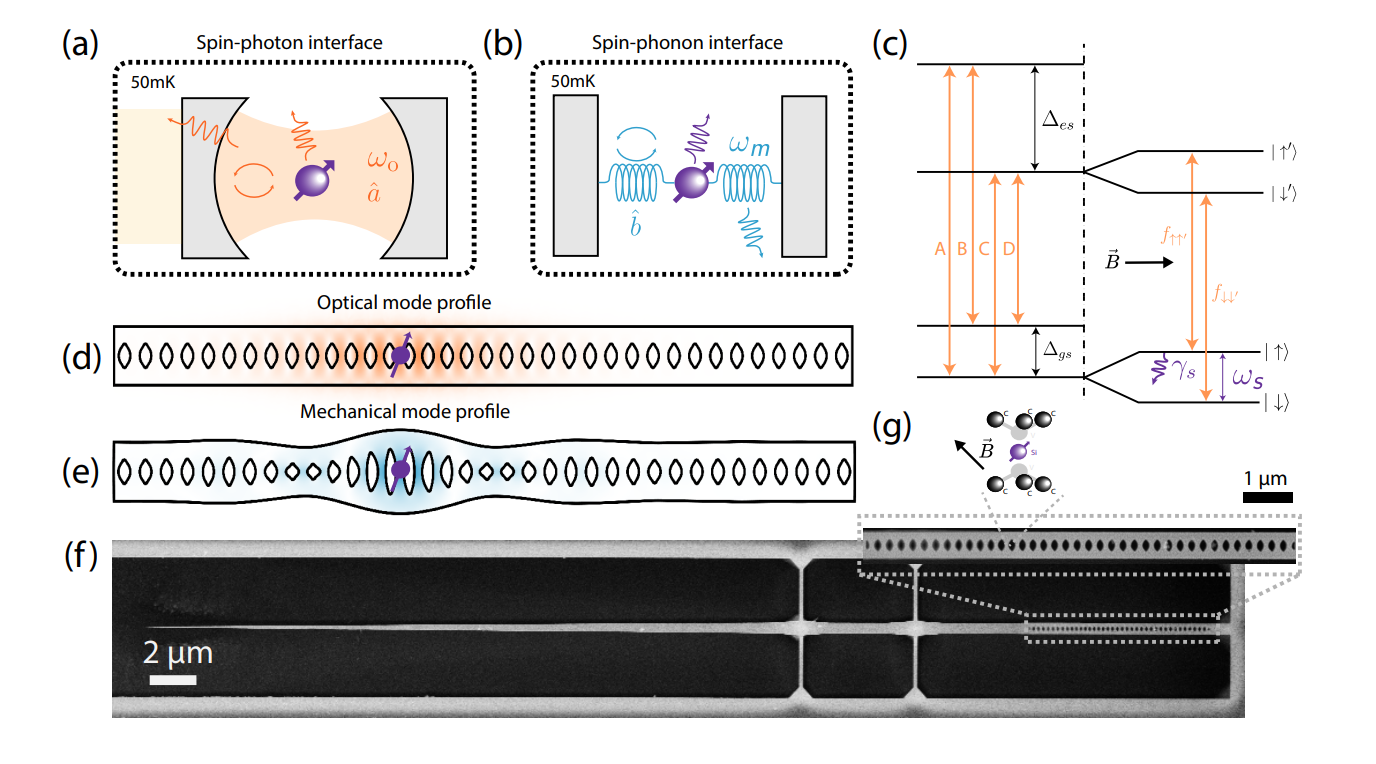
interactions, and (b) spin-phonon interactions.
In a study recently published on arXiv, researchers from Harvard University and several international institutions reported the first observation of the acoustic Purcell effect using a single silicon vacancy (SiV) center in diamond. Traditionally, the Purcell effect describes the enhancement of an atom’s spontaneous emission when placed inside an electromagnetic resonator. Here, the team engineered a microwave-frequency nanomechanical resonator around the color-center spin qubit to control its interaction with phonons (acoustic quanta) rather than photons. By placing the SiV center in a specifically designed optomechanical crystal (OMC), they created an environment where the spin qubit’s relaxation is predominantly governed by a single, well-defined acoustic mode.
Experimental Platform and Optomechanical Coupling
The experimental system simultaneously realizes an efficient spin-photon interface and a spin-phonon interface. The device consists of a diamond nanophotonic waveguide featuring an array of air holes that create simultaneous photonic and phononic bandgaps. This structure co-localizes a TE-like optical mode and a 12.06 GHz mechanical breathing mode. To avoid laser-induced heating at the milliKelvin temperatures required for the experiment (typically ~50 mK), the researchers used the co-localized optical mode to probe the spin state at the single-photon level. This minimally invasive window allowed them to perform laser spectroscopy while maintaining the mechanical modes near their quantum ground state. The mechanical properties, such as the intrinsic linewidth (κ m /2π≈350 kHz) and quality factor (Qm ≈ 34,000), were characterized independently using heterodyne optomechanical spectroscopy.
Acoustic Purcell Enhancement and Broadband Sensing
By applying a magnetic field to Zeeman-split the SiV energy levels, the researchers tuned the spin transition frequency (ωs) into resonance with the 12 GHz mechanical mode. They observed a ten-fold increase in the spin relaxation rate—from approximately 1 kHz off-resonance to 10 kHz on-resonance—a direct manifestation of the acoustic Purcell effect. This corresponds to a T1-based spin-phonon cooperativity (CT1) of approximately 10, the highest recorded to date. Furthermore, by sweeping the magnetic field to vary the spin frequency, they utilized the SiV center as an atomic-scale probe to map the broadband phonon spectrum of the nanostructure up to 28 GHz. This spectroscopy revealed multiple acoustic resonances beyond the breathing mode, established by the orientation-dependent coupling of the spin to the diamond lattice’s strain environment. These results provide a foundation for developing hybrid quantum interconnects between solid-state spin memories and superconducting or acoustic quantum devices.
You can find the full technical details of the research in the arXiv preprint here. For more information on the silicon vacancy center and its role in quantum networking, visit the Harvard SEAS Lončar Group page here.
May 14, 2026