
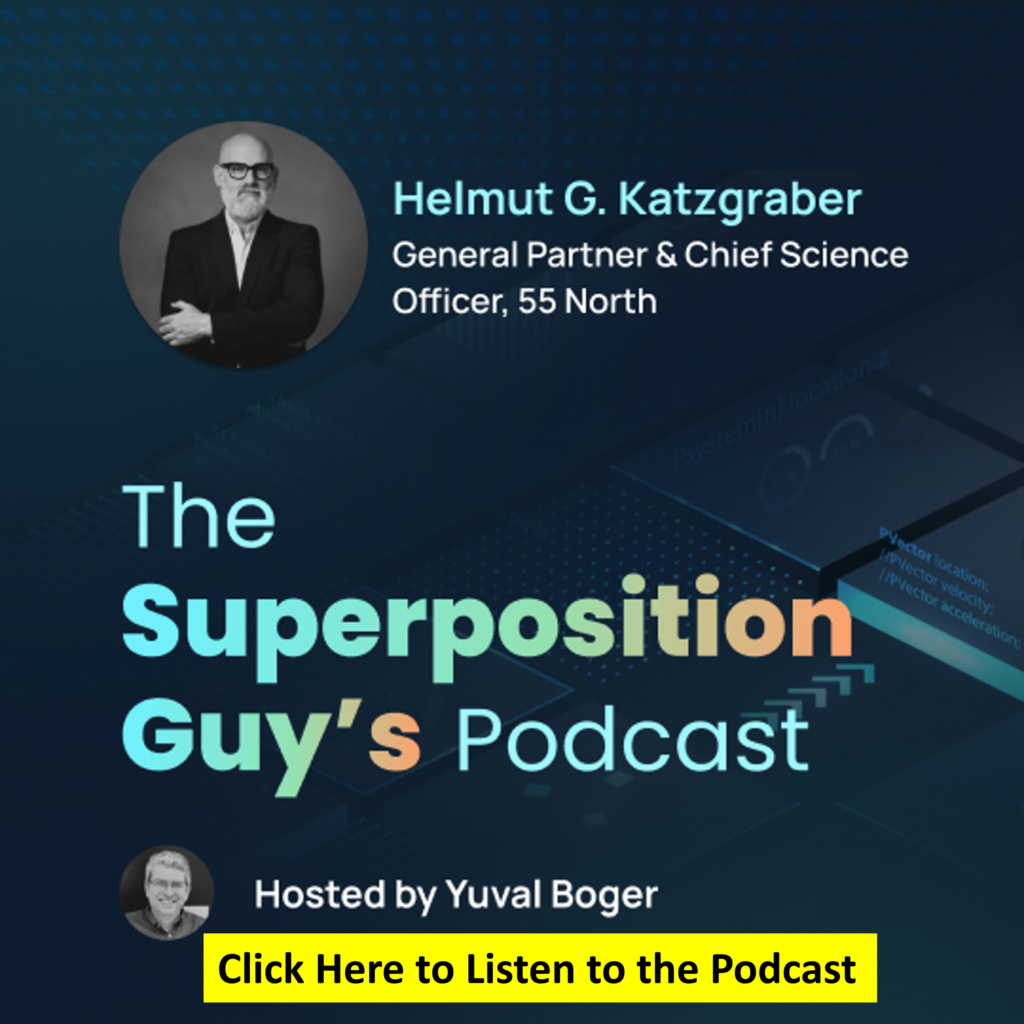
Yuval Boger interviews Helmut Katzgraber, general partner at 55North and former quantum leader at AWS. They discuss Helmut’s view that the most promising near- to mid-term quantum applications are in quantum simulation for materials, chemicals, and pharma, rather than optimization. They also explore European competitiveness, venture opportunities across the quantum stack, cloud and on-prem deployment models, and the workforce and product skills needed to turn quantum ideas into successful companies.
Transcript
Yuval: Hello, Helmut, and thank you for joining me today.
Helmut: Hi, Yuval. Nice talking to you again.
Yuval: So who are you and what do you do?
Helmut: My name is Helmut Katzgraber. I have had several different roles in the past, and now I’m general partner at 55North, which is a VC fund focused on quantum technologies out of Denmark and to the world.
Yuval: And I realized that I interviewed you two years ago when you were at AWS, and I guess I missed an interview when you were a professor at the University of Texas, right?
Helmut: Yeah, Texas A&M, but let’s not talk about that. That’s long in the past. Long in the past.
Yuval: So now that you’re no longer at AWS, what can you tell me about the quantum world? What have you learned about quantum in the past two years while you were making that transition?
Helmut: Surprisingly a lot. As you remember, or might remember, I led a team of scientists that now are being taken care of by Martin Schuetz, who’s a fantastic new leader, focused on a) finding applications of quantum technologies. You know, where can a quantum device have impact in the real world, not in toy problems, but be also, you know, kind of raise the bar for quantum by solving the problems classical in a perfect world, having solutions running in production environment of AWS as customers. And not just during the past two years, but during the last five to seven years, even when I was at Microsoft, I gathered a lot of experience into what this machine can and cannot do. And in particular, which use cases are good use cases for quantum technologies and which ones likely are gonna struggle down the road.
Yuval: And what is the answer?
Helmut: Well, the answer is simple. Use quantum where quantum reigns supreme, you know, in the quantum world. So from my perspective, if we look at near to medium term quantum devices, likely the first impact is going to be in problems related to materials, chemicals, pharma, where you need to do quantum mechanical simulations. There was just a recent paper out I think this morning or last night where a material was simulated on a neutral atom machine, and it’s these types of workloads that are really going to be the first ones that deliver something that hopefully at some point classical cannot do. Other use cases in the computing area, you know, machine learning, I would say I don’t want to hedge my bets yet simply because, you know, it’s still relatively nascent and there’s still a lot to be learned. And in optimization, I’m relatively bullish that classical technologies for the foreseeable future will outperform any quantum device.
Yuval: And I remember that in optimization you were a skeptic or some would say a realist, but you’re saying basically in material science, this is where the hope is.
Helmut: Yeah, I would say so. Especially, you know, when you’re simulating strongly correlated things, you know, like battery materials, organic LEDs, you know, certain medications that have metal organic complexes. That’s where classical compute struggles and where quantum technologies hopefully will bring value down the road.
Yuval: Today, you’re in venture capital and people who invest in your fund are looking to see returns. Do you think the returns for venture for quantum investments are going to be longer term than traditional VCs or are you expecting the same timelines?
Helmut: Like my colleague Owen Lozman, the managing partner, likes to say, you know, we have unpatient or how does he put it again? We have a long-term perspective with unpatient capital. And what he means by that is that we invest and there are technologies that will bring returns in the typical VC timelines. Think of enabling technologies, refrigeration, for example, something that many modalities will need, or software to compute error correction models. Again, something that, especially now that we move from physical to logical qubits, something that everybody’s gonna need. So there are certain areas where we can see returns in a what I would call meaningful timeline, you know, during the lifetime of the fund. And of course, there’s always the one or the other unicorn like IQM recently that had us back, that might bring returns sooner and later.
Yuval: You were born in Austria, right?
Helmut: No, I was born in Peru.
Yuval: In Peru. Oh, and yes, you may have studied in Europe, right?
Helmut: Yeah, so I was born in Peru, lived my first 20, almost 20 years in Lima, and then I studied in Switzerland, physics.
Yuval: And when you think about, and right now you’re in the European VC, do you think Europe can compete with the US and with China on quantum computing? And if so, why?
Helmut: Yes and no. And I know this is a superposition of two answers, but Europe has fantastic talent. I would say, you know, the educational system is top-notch, one of the best, if not the best in the world and across many countries in the union. You have the necessary ecosystem for quantum technologies to thrive in labs, you know, with generous grants. And the point where it starts faltering, and it’s a pretty leaky pipeline from that standpoint, is when it comes to taking those ideas from the lab into a product. And so, you know, 55North tries to address this gap. That’s where it was founded with myself, Oren Lozman and Kai Hudek, with Novo Holdings, or sorry, Novo Nordisk Foundation and EIFO as LPs, to basically bridge that gap and take these ideas from the lab out into startups. Now, the challenge that we have compared to the US is that there’s far more capital over there, and especially growth capital. And that’s something that the EU is trying to resolve right now. There is this Proposition 28, where they try to harmonize the laws across the union to make it easier for startups. But it’s still going to take time before that takes an effect, if at all. You never know with the union. And so the big challenge is that while we have the great ideas, what we’re lacking is the venture mindset in Europe. We’re lacking the product mindset, and more importantly, we’re lacking the growth capital that will come down the road. And I think that, you know, if we can resolve at least two out of three, we have a good chance of being very successful compared to, in particular, America.
Yuval: Are employment laws also a factor? I mean, in some countries, it’s easier than others to hire and fire. You know, startups are dynamic, things change. Do you think that plays a role?
Helmut: I think that plays less of a role. I mean, we work with a bunch of startups in Europe. We’ve invested in a few companies in Europe, like Kiutra or IQM. And it’s less of an issue, to be honest. I don’t think that the employment laws are a hindrance. If anything, there’s something good. I never liked the fact in the US that I could get fired any minute for whatever reason, without a warning. And that anxiety is something that comes from the fact that when you take an academic role, you have a certain job security that is pretty safe. And so suddenly you’re in a world where anything can happen. And so I think that for academics, the European labor laws are probably far more friendlier or more comfortable to deal with than in the US.
Yuval: How are you thinking about the geopolitics of quantum? You know, is it, today it’s not that easy for instance, for US companies to sell into the EU. It’s not impossible, but it’s not easy. That situation could become symmetric one day. How are you thinking about that and how it impacts the fund and the quantum business?
Helmut: So I completely agree with you. There are some challenges. For example, when we invest in the US, we have to be careful that we have just a small fraction of the company after the investment, so that we don’t trigger export control laws. And so there’s a bunch of challenges kind of going both ways, actually. My hope is that it will get resolved. As I said, the EU is working on harmonizing some of these laws and making them more founder-friendly, but you never know. I mean, I think we both know who is at the helm in the United States and it’s a finger in the air and see what happens. You know, it could go this way or that way any minute. But I think that it is a risk and it is a risk that we’re watching carefully simply because, you know, our mandate is to invest mostly in the Nordics, but also across Europe and the rest of the world. And for example, if a country is in an active conflict zone then we’re not allowed to invest. It might change, but at the same time, our LPs have given us a lot of leeway so that, you know, we can invest worldwide.
Yuval: When you think about the quantum stack from hardware and hardware that supports hardware like dilution refrigerators that you mentioned, middleware, software, application, cloud service, where’s the value or where do you expect the value will be for an investor?
Helmut: That strongly depends, first of all, on the company. We like companies that think outside the box, that try things that nobody else has tried, that are going against the mainstream. And so, you know, if you think about a startup competing against one of the big tech companies, IBM, Google, Microsoft, Amazon, that have basically infinite pockets to build quantum devices, then you might as well say, well, the startups would just give up on the spot. But the reality is that startups are far more agile. And what this means is that, you know, they can experiment on some things that nobody else would dare to. And so there is a lot of potential value in these, I would almost call them moonshot ideas or one divided by moonshot ideas. Similarly, you know, there’s value in enabling technologies, as I mentioned earlier, refrigeration, you know, software that several companies might need. I think it’s a little early for applications. Maybe in some areas of chemistry, there’s a few things we’ve seen that are quite interesting, but I think that the machines are not there yet to deliver any kind of industrial impact in an application scale. They’re still experiments. And so what we focus on is we look at the whole stack, top to bottom, bottom to top. We look at some full stack companies, but we also look at different areas of the stack, in particular those that can address different modalities.
Yuval: Do you think full stack companies, putting aside the giant companies, but do you think full stack companies is just a temporary solution because someone’s got to do it? Or do you think that’s a sustainable business model?
Helmut: That’s a good question. And honestly, I don’t know the answer to it. It’s hard for me to say if it’s gonna be a sustainable model, you know. Any non-big tech full stack company has a relatively small probability of success in general. We’ve had some successes, you know, there’s IonQ, there’s QuEra, IQM, some companies that are doing really well and are very well funded. But you know, you can count on your both hands the companies that really have a good shot at succeeding versus all the others that are trying and eventually end up pivoting to doing something else. I’ve seen companies that wanted to, for example, build qubits and then realized that, for example, their control electronics are far better than what everybody else has, but they’re not good at building qubits. So might as well just pivot and focus on that particular area. And so full stack, we will have those unicorns here and there, but we will see eventually some sort of coalescence of the market, where some of the full stack companies, even the startups, you know, becoming bigger and bigger, and then basically different companies focusing more on components that these companies might need.
Yuval: I want to talk a little bit about cloud services, again, building on your experience at AWS, and even prior to that at Microsoft. The first question is how should a classical cloud provider adjust to quantum technology becoming part of the computational fabric?
Helmut: I think the most important thing is to treat it like, you know, a new compute modality, the same way that you can access FPGAs, GPUs on AWS, you can even access Mac minis in the cloud. And at the same time, the importance though is to really build a software stack in a way that you can do hybrid workloads. Very often you’ll have the quantum devices in a service, you have the classical compute in different services like on Amazon, you have EC2 versus Braket, you know, but there has to be a tighter integration for some of the more important workloads. I think Microsoft did something interesting with Azure Quantum Elements where they combined AI compute and quantum in an effort to basically make an end-to-end chemistry pipeline. And I think there’s a lot of value in something like that.
Yuval: And on the sustainability question, and I don’t mean sustainability as in green energy, but today having a quantum computer on the cloud is very attractive because one could experiment and switch quickly and relatively inexpensively get into quantum. As quantum computers become truly useful, do you see them shifting more into on-premises? Do you see a 50/50 split? How are you thinking about that?
Helmut: It’s hard to tell. I can see many, especially the HPC centers, if you think about Juelich, for example, buying these devices, making them accessible. In Denmark, which by the way, has a fantastic quantum strategy, the goal is, for example, to procure and build a machine by QuNorth and make it accessible. So you will have some on-prem machines, but I suspect that a lot of them will remain in the cloud. And it has mostly to do with the fact that, you know, it’s not a standard computer you plug into the wall and that was it, maybe some cooling. It requires a lot more babysitting for the foreseeable future. So having these machines housed at the manufacturers, for example, is gonna have some advantages that if something goes wrong, they can be fixed. In other words, cloud access being optimal. But at the same time, I can imagine that certain institutions will have specific reasons, be it national intelligence or so, to have these machines on-prem. So I suspect that in the same way that HPC clusters exist on-prem and in the cloud, we’re gonna have something similar. Although you see more and more how universities are giving up on their HPC clusters and moving more and more workloads into the cloud.
Yuval: You mentioned Microsoft Elements, which is a vertical application as opposed to a horizontal general purpose computer. Do you think that’s the way to go? Or what would you recommend to a portfolio company making quantum computers? Should they offer it generically or should they find and create a full stack solution targeting a particular application?
Helmut: So it depends what the company wants to do. If the company wants to build a research machine, then by all means, make it generic. Everybody experiment with it. My personal take has always been, and you know this, start with the problem and then build a solution around the problem. And so, excuse me, if you ask me, I think companies should say, okay, we want to target the simulation of strongly correlated materials in the area of battery materials. And then basically build the whole product around that. Now you might say, well, isn’t that a very narrow use case? The answer is no. There’s a little value in it, not only that, but more importantly, you know, by changing a few things, you can modify it for other types of strongly correlated materials. And so also based on my experience at AWS, you know, custom solutions to difficult problems will always outperform any kind of generic tool. And so if we want to see early application value, it might make sense to focus on use cases. At the same time, given that the machines are still in their infancy, I think it’s too early to do that. That’s why I keep going back and forth. And so once people experiment, identify potential use cases of value, and then basically hone the machines in that particular direction.
Yuval: You mentioned a little bit about the geographical focus of the fund, but just give me the background. How large is the fund? What are you investing in? At what stage? Is it just computing or are you also gonna do sensing and communication and what have you? So what’s the, you know, the two paragraph summary of what you’re doing for the fund?
Helmut: So the fund’s called 55North. We all moved to Denmark to launch the fund. I gave up everything in the US, packed my bags and I’m now in Denmark. And the goal, the first close was 134 million euros, with the goal being to focus on all sorts of quantum technologies and adjacent technologies. The fund can grow up to 300 million euros. We’re of course in the middle of fundraising as you might imagine. And we are three partners with complementing expertise. Owen Lozman is a chemist by training. He worked in chemistry R&D in industry his whole life, eventually took over Merck Ventures, so comes with the experience of venture capital. Kai Hudek was one of the first employees of IonQ. He has physically built these machines, so he understands hardware very deeply. And I bring the theory, computation, and cloud perspective to the mix. So the cool thing is that, you know, I totally did not expect this. Founders really like to work with us because they want board members that understand what they’re doing. And so that is, I think, kind of like the secret sauce of the fund. We invest from pre-seed all the way to Series B, so we always keep some money on the side for later rounds. And we also focus, you know, in the Nordics and in Europe, but we have a global mandate. And so everything is fair game for us.
Yuval: What’s your favorite modality?
Helmut: Good question. Now, before I answer that, I forgot one detail. And that is, yes, we do also invest in sensing, you know, and networking. So we, as I said, we invest in anything that we feel might bring value. Now, what is my favorite modality? I’m going to put on the Helmut hat and I’m going to give you a very non-committal answer. And that is the one that brings the best value for a particular application. And so, you know, if you want fast devices, say if you want to do variational workloads, it’s clear that it’s going to be something that is superconducting, for example. But they do have their disadvantages. If you want to have lots of qubits, neutral atoms are good. And if you want very high quality qubits, then ion traps might do your best. But I think that no modality has a big sizable advantage over the others. And so, as I said before, my favorite modality is the one that brings most value for the problem you’re trying to look at. And so, again, you should use the right tool for the right problem.
Yuval: Workforce development has been spoken about often in the context of quantum and I’m sure as a venture fund you’re also getting asked about that. What would you recommend a college graduate or a college student to study if they want to become part of the quantum world?
Helmut: I think that it depends of course what role. You know, for certain things you need deep physics expertise. If you want to do error correction, then there’s no other way than being a theorist. If you want to build devices in the lab, then we can bend the rules a little bit and say, you know, a combination of applied engineering or applied physics might do the trick. I think those are probably the clearer roles. What I would love to see more is a product mindset. And so people that have product expertise, you know, product managers that are willing to take a second degree, you know, like basically two tracks, one in physics and one in product management slash business administration, that would be extremely valuable for most quantum companies. And that is one of the challenges we see most often when we talk to startups that, you know, they have great ideas. And when you say, so can you make me a thousand of those? It’s like, oh God, no, I have no idea how. And so, you know, those hybrid degrees, business and quantum, I think are the ones that we need. To my recollection, and you know, the only person I know that really purposefully did this and you might have heard of him is Andre Ochoa, who is at Strangeworks. He got his PhD in physics, then he went straight to business school to get an MBA, so that he can basically fill exactly that gap.
Yuval: Hypothetical, and I remember what you answered last time I asked you that. So we’ll see if you remember as well or you want to change your answer. If you could have dinner with one of the quantum greats, dead or alive, who would that be?
Helmut: My answer still stands. It’s going to be Dirac. Not only do I find his mathematics the most elegant out there, but he was a man of few words. He’d often dine alone and I wouldn’t mind dining with somebody that doesn’t yap all the time. Copenhagen has a lot of great food options, so I wouldn’t mind if I could turn back time to meet him here in Copenhagen and just go to any of the restaurants and enjoy a meal in peace and, you know, maybe talk a little bit about the elegance of mathematics.
Helmut: In a field that’s changing so quickly?
Yuval: That was a very consistent answer, very much like what you answered.
Helmut: You know, I have his books up here on the shelf and as I said, it’s the most elegant way when you look at his math, the way he solved problems.
Yuval: Helmut, thank you very much for speaking with me today.
Helmut: Thanks, Yuval, for having me. It was a pleasure.
Yuval Boger is the Chief Commercial Officer of QuEra Computing.
June 22, 2026