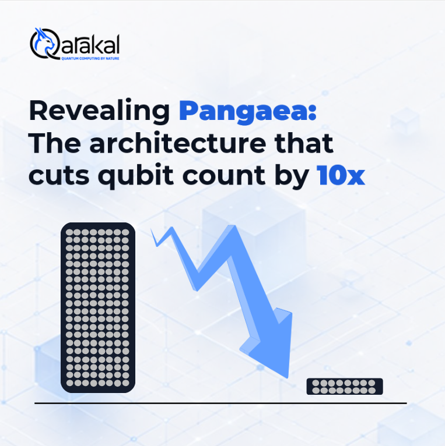
Israeli quantum startup Qarakal Quantum Ltd. has officially launched Pangaea, a modular, three-dimensional superconducting quantum computing architecture engineered to reduce the physical qubit requirements of fault-tolerant systems by an order of magnitude. Published in an arXiv pre-print titled “The Pangaea Architecture: Fault-Tolerant Heterogeneous Topological Codes via a Quantum Bus,” the design resolves the long-standing routing bottleneck of two-dimensional lattice surgery by introducing an IP-protected quantum bus to mediate logical operations between physically separated 2D topological code patches.
Rather than relying on direct physical adjacency, Pangaea uses an auxiliary gauge-code strip as its quantum bus. The bus reconstructs multi-qubit joint Pauli operators and supports native operations between heterogeneous topological code families (such as joint parity measurements between surface codes and color codes) while preserving nearest-neighbor physical connectivity. By replacing traditional planar lattice surgery, the architecture scales multi-qubit interactions using O(dNL) physical qubits for NL distance-d logical qubits—a significant reduction from the O(d2NL) footprint required by standard 2D surface-code layouts.
                      [ Pangaea Modular Bus Architecture ]
                                        │
     ┌──────────────────────────────────┴──────────────────────────────────┐
     ▼                                                                     ▼
  Specialized Code Patches (Memory/Logic)                 Auxiliary Gauge-Code Quantum Bus
  • Surface Codes & Color Codes.                         • Mediates Long-Range Joint Parity Measurements.
  • Dedicated Functional Module Roles.                   • Native 15-to-1 Magic-State Distillation Module.
  • Hardware Specialization per Patch.                   • Scales at O(dNL) vs O(d2NL) Physical Qubits.
In fault-tolerance simulations using pseudo-threshold noise models at a scale of 50 logical qubits, Pangaea achieved a matched logical error rate using 10 times fewer physical qubits than planar surface-code architectures. The architecture also demonstrated measurement-based fault-tolerant CNOT primitives and a native 15-to-1 magic-state distillation module, significantly lowering wiring density, control electronics overhead, and cryogenic cooling requirements.
Qarakal Quantum’s architecture-first approach reflects an industry shift away from monolithic processor scaling toward modular, backplane-connected system design—drawing an analogy to classical bus architectures. By allowing computational, memory, and routing modules to be configured and scaled independently, Pangaea provides a streamlined pathway for enterprises and research institutions to execute large-scale fault-tolerant quantum algorithms on near-term hardware footprints.
Review the official launch announcement on GlobeNewswire here, examine the pre-print research paper on arXiv here, and explore technical details via the Qarakal Quantum Architecture Hub here.
August 5, 2026