
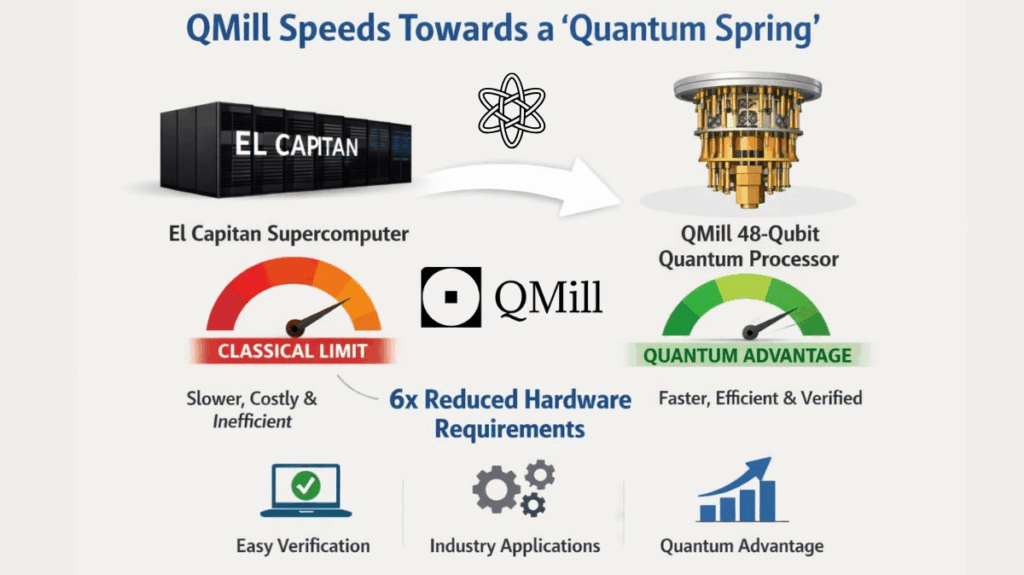
QMill has announced simulation results for a quantum algorithm designed to achieve verifiable quantum advantage on near-term hardware. The architecture requires 48 physical qubits operating at a gate fidelity of 99.94%. This represents a significant reduction in hardware requirements compared to established benchmarks, which traditionally estimate a need for approximately 200 qubits at 99.99% fidelity to achieve a verifiable computational gap over classical exascale systems.
A critical feature of the QMill algorithm is its classical verifiability. While many “quantum supremacy” demonstrations produce results that are exponentially difficult to validate classically, this algorithm is structured to allow verification of the quantum output using standard consumer-grade hardware (e.g., a laptop). This “lightweight” verification protocol addresses the primary bottleneck in cloud-based quantum computing: the ability to authenticate the integrity of a remote QPU’s computation without requiring equivalent classical supercomputing resources for every check.
Numerical modeling conducted by the QMill team indicates that the 48-qubit implementation outperforms El Capitan, currently the world’s most powerful supercomputer (operating at 1.7+ exaFLOPS).
- Noise Resilience: The algorithm achieves a six-fold improvement in error tolerance, functioning at perror = 6 × 10⁻⁴ (99.94%) rather than the 10⁻⁴ (99.99%) baseline typically cited for NISQ utility.
- Instruction Set: The method utilizes a compact, noise-resilient circuit design specifically optimized for the constraints of the Noisy Intermediate-Scale Quantum (NISQ) era, facilitating a more immediate “lab-to-fab” transition for hardware providers like IQM, IBM, and Google.
The QMill team—led by Chief Scientist Mikko Möttönen, CEO Hannu Kauppinen, and CTO Ville Kotovirta—is transitioning the algorithm from simulation to cloud-integrated products. The focus remains on industrial applications with high computational complexity, such as logistics optimization, telecommunications routing, and energy grid simulation. By lowering the qubit-fidelity threshold, the architecture provides a functional bridge for utility-scale computing before the arrival of fully fault-tolerant, error-corrected machines.
Read the technical announcement from QMill here. Note: Claims are currently based on in-house numerical simulations; a technical manuscript is pending experimental validation and scientific peer review.
January 23, 2026

