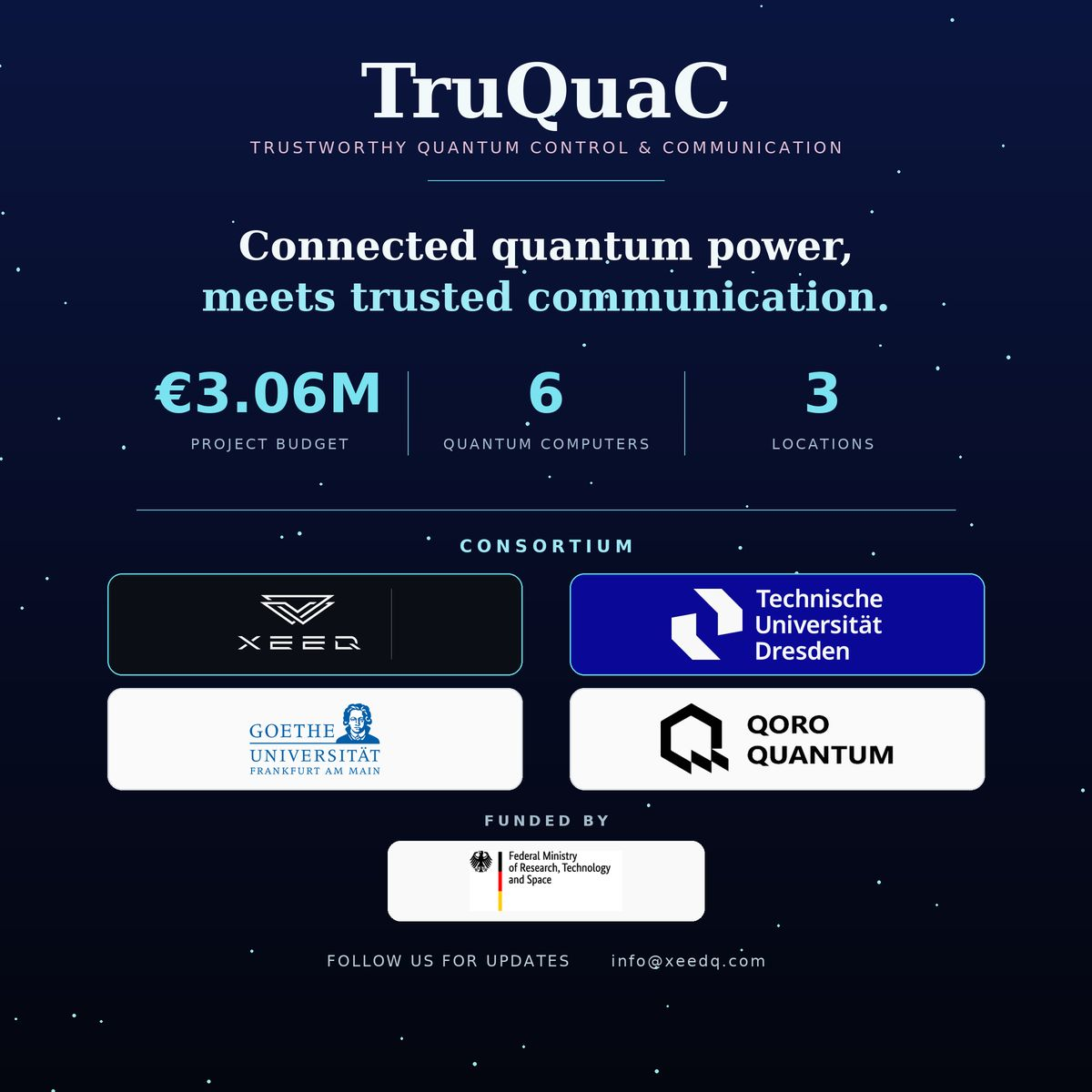
A new German government-backed research consortium named TruQuaC (Trustworthy Quantum Control and Communication) has launched a €3.06 million ($3.5 million USD) project to engineer a secure control-plane and gateway architecture for distributed quantum systems. Funded primarily through a €2.46 million ($2.8 million USD) grant from the German Federal Ministry for Research, Technology, and Space (BMFTR) under its “Transfer and Network Integration of Quantum Communication“ initiative, the 36-month program runs from June 2026 through May 2029. The project addresses a primary structural bottleneck facing the Quantum Internet: the secure orchestration and integration of isolated, multi-archetype quantum nodes into classical communication network fabrics.
                         [ TruQuaC Project Architecture ]
  Total Funding Grant ──► €3.06M total budget (€2.46M direct BMFTR sovereign funding).
  Project Timeline    ──► 36-month operational window spanning June 2026 through May 2029.
  Project Coordinator ──► XeedQ GmbH (Leipzig) — Supplying nitrogen-vacancy (NV) hardware.
  Orchestration Lead  ──► Qoro Quantum — Providing Maestro emulation and Divi Python SDK layers.
  Academic Partners   ──► Dresden University of Technology & Goethe University Frankfurt.
The engineering roadmap focuses on constructing a unified software infrastructure that abstracts network complexities by treating distributed hardware nodes as a resilient, singular system. To safeguard data in transit, TruQuaC will implement secure local gateways capable of managing user authentication, monitoring dynamic node status, distributing computational workloads, and automatically re-routing traffic during localized network drops. By establishing this software-defined infrastructure, the consortium seeks to advance Germany’s long-term technological sovereignty and strengthen regional cryptographic defenses against quantum-enabled network threats.
The technical execution is split across an alliance of commercial pioneers and academic institutions:
- XeedQ GmbH: Operating as the overall project coordinator, the Leipzig-based hardware manufacturer is providing its commercially tested, diamond nitrogen-vacancy (NV) center quantum processors to act as the physical hardware nodes.
- Qoro Quantum: Supervised by co-founder and CTO Dr. Stephen DiAdamo, the software developer is supplying the end-to-end orchestration layer. The platform utilizes its Maestro simulation engine for node emulation, its Composer API for constraint-based task routing, and Divi—the company’s open-source Python software development kit (SDK)—for multi-node program execution.
- Academic Partners: TU Dresden (Dresden University of Technology) and Goethe University Frankfurt are leading the fundamental scientific validation, protocol verification, and academic research compilation.
The official project launch profiles, distributed computing software specifications, and sovereign cybersecurity objectives can be reviewed here, and verified through the institutional project repository registry here, while the real-time consortium updates and kickoff documentation can be audited via the professional network announcements here.
July 9, 2026