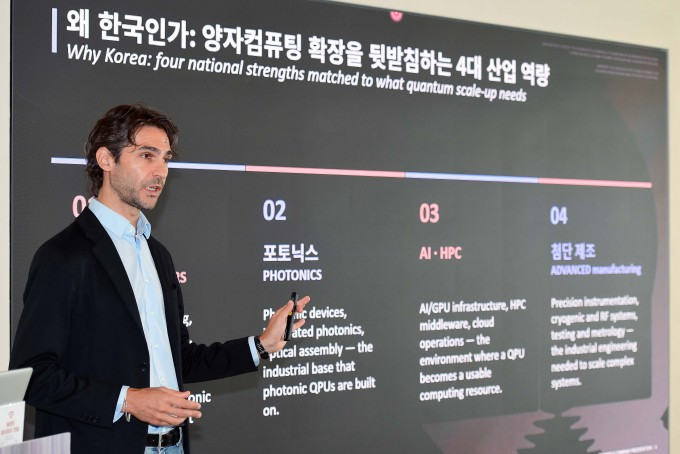
French photonic quantum computing manufacturer Quandela has unveiled a strategic framework establishing South Korea as its primary Asian hub for quantum processor manufacturing, system integration, and collaborative R&D. Announced in Seoul, the initiative targets semiconductor-level fabrication of integrated photonic QPU modules, component co-development, and hybrid high-performance computing (HPC) software integration, complementing the company’s regional operations across Europe and North America (via its Quandela Federal defense subsidiary).
The manufacturing strategy seeks to form an industrial consortium involving South Korean semiconductor foundries (such as Samsung Electronics and SK hynix) and optoelectronic system integrators (including LG Innotek) to scale mass production of photonic control chips and optical component packaging. Under the proposed intellectual property framework, pre-existing IP remains with individual partners, while co-developed manufacturing protocols and integrated optical modules will be shared based on institutional contributions.
| [ Quandela South Korean Ecosystem Partnerships & Technical Scope ] | ||
|---|---|---|
| Partner Entity / Institution | Hardware & Research Domain | Technical Scope & Deployment Roadmap |
| • KAIST (Son Young-ik Research Group) | • Optical component & electronic control co-design | • Integrating Korean-developed electronic control modules directly into Quandela QPU chassis in Paris |
| • KRIBB (Bio-Research Institute) | • Photonic QPU molecular simulation | • Proof-of-concept quantum molecular modeling for drug discovery and algorithmic validation |
| • Seoul Metropolitan Govt (₩80B MOU Alignment) | • Regional QPU cluster & supply chain hub | • Expanding local subsidiary (Quandela Korea) from 3 to 10 systems engineers by 2027 |
| • NVIDIA Collaboration | • Hybrid HPC-QPU interface (NVQLink) | • Reduced GPU-to-QPU communication latency from tens of seconds to the millisecond (ms) scale |
The initiative integrates with ongoing QPU software optimizations. Collaborating with NVIDIA, Quandela reduced GPU-to-QPU communication latency to the millisecond regime, enabling high-speed hybrid error mitigation and job execution across HPC supercomputing clusters (such as the 12-qubit Lucy processor deployed at France’s TGCC facility). Simultaneously, hardware engineering teams from KAIST are deploying to Paris to integrate Korean-fabricated electronic control units into Quandela’s physical QPU chassis, establishing a cross-border supply chain for full-stack fault-tolerant quantum computing (FTQC).
Review the industry disclosure via DongA Science here and inspect regional coverage via BizCrush TechWorld here.
September 29, 2026