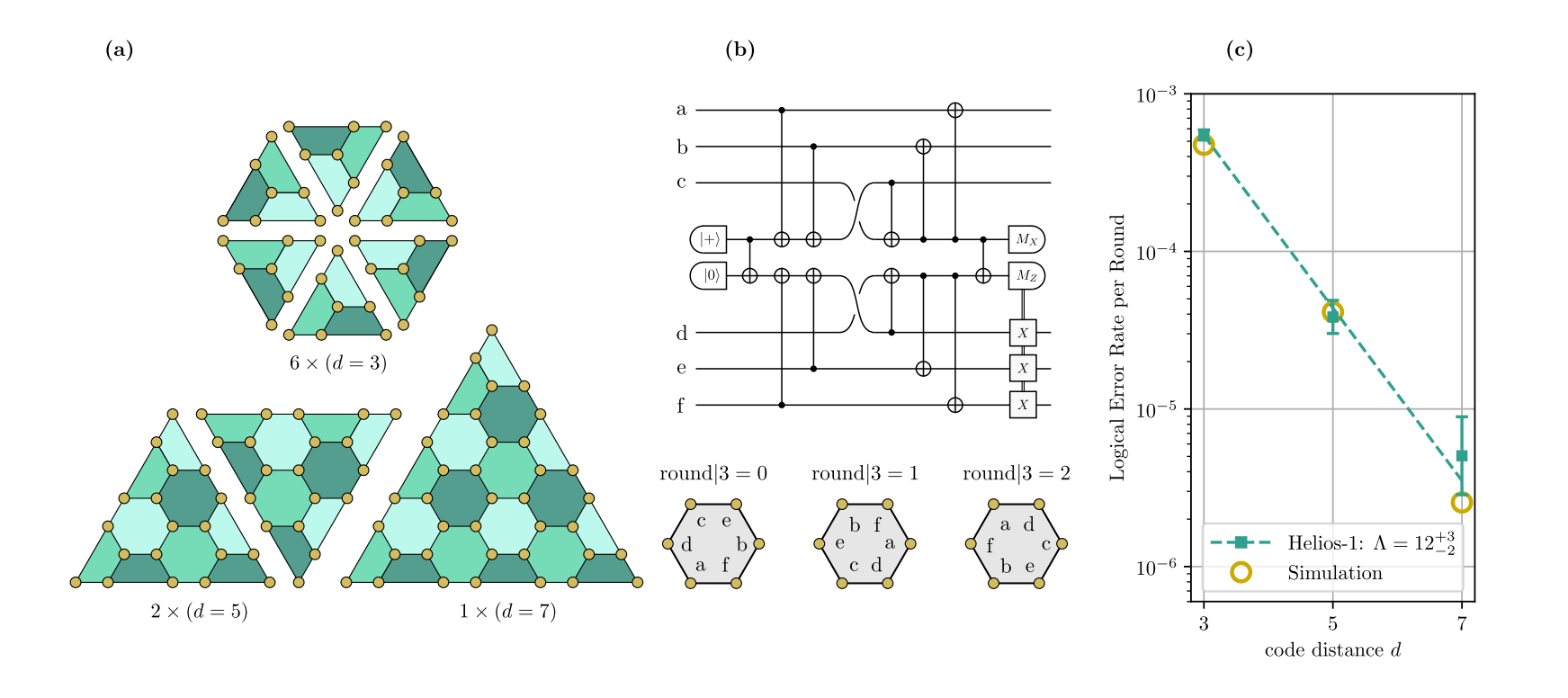
In a technical release and research preprint, full-stack quantum computing provider Quantinuum (NASDAQ: QNT) reported quantum error correction (QEC) performance metrics on its commercial Helios trapped-ion quantum computer, measuring a logical memory fidelity of 99.9995%—equivalent to a logical error rate of 5 × 10⁻⁶ per syndrome-extraction round on a distance-7 code.
Detailed in the technical report (“Quantum error correction well below the color code threshold“), the results evaluate triangular color codes across code distances d = 3, d = 5, and d = 7 on the 137-barium (137Ba+) QCCD processor. The measured logical error rates demonstrate exponential error suppression as code distance increases, following an experimental suppression factor of Λ = 12.
| [ Quantinuum Helios QEC Distance Scaling Benchmarks ] | |||
|---|---|---|---|
| Code Distance / Setup | Physical Qubit Count | Logical Error / Cycle | Suppression Factor (Λ) |
| • Distance 3 Color Code | • 13 Qubits / Memory Block | • 5.5 × 10⁻⁴ | • Baseline (d = 3) |
| • Distance 5 Color Code | • 37 Qubits / Memory Block | • 3.8 × 10⁻⁵ | • Λ = 12 (12x Error Suppression) |
| • Distance 7 Color Code | • 73 Qubits / Memory Block | • 5.0 × 10⁻⁶ | • Λ = 12 (144x total suppression vs d = 3) |
| • Logical 2-Qubit Clifford (d = 5) | • 2-Block Transversal CNOT | • 7.0 × 10⁻⁵ / Gate | • ΛLog = 9 (9x Clifford suppression) |
Key Architectural & Hardware Observations
The study evaluates three core implementation factors within the full-stack architecture:
- Exponential Distance Scaling (Λ = 12): Each step increase in code distance suppressed logical memory errors by a factor of 12. Based on this measured scaling parameter, Quantinuum projects that target logical error rates of 10-12 across 100 logical qubits can be achieved with ~30,000 physical qubits under this architecture, compared to higher qubit counts required under lower Λ regimes.
- Dual-Layer Leakage Reduction: To mitigate state leakage out of the computational clock states into non-computational levels, Helios incorporates 3-cycle mid-circuit 1762 nm optical repumping at the hardware level (reducing leakage by 6.5x) alongside software-driven SWAP-superdense leakage reduction circuits that cycle data and ancilla qubits through QCCD ion transport.
- Sub-Millisecond Neural Network Decoders: In addition to the A*-search Tesseract decoder, Quantinuum trained 3D Convolutional Neural Networks (3D CNN) and Round-Token Transformers (RTT) on emulator data and evaluated them on physical hardware without fine-tuning. Both neural models achieved per-round latencies between 0.2 ms and 0.5 ms on NVIDIA H100 hardware, demonstrating compatibility with real-time streaming decoding.
The empirical results align with the performance targets established for Apollo, Quantinuum’s planned universal fault-tolerant quantum system targeted for 2029.
Review the corporate announcement on Quantinuum Press here, examine the technical blog breakdown on Quantinuum Blog here, and inspect the technical manuscript on Quantinuum Portal here.
October 19, 2026