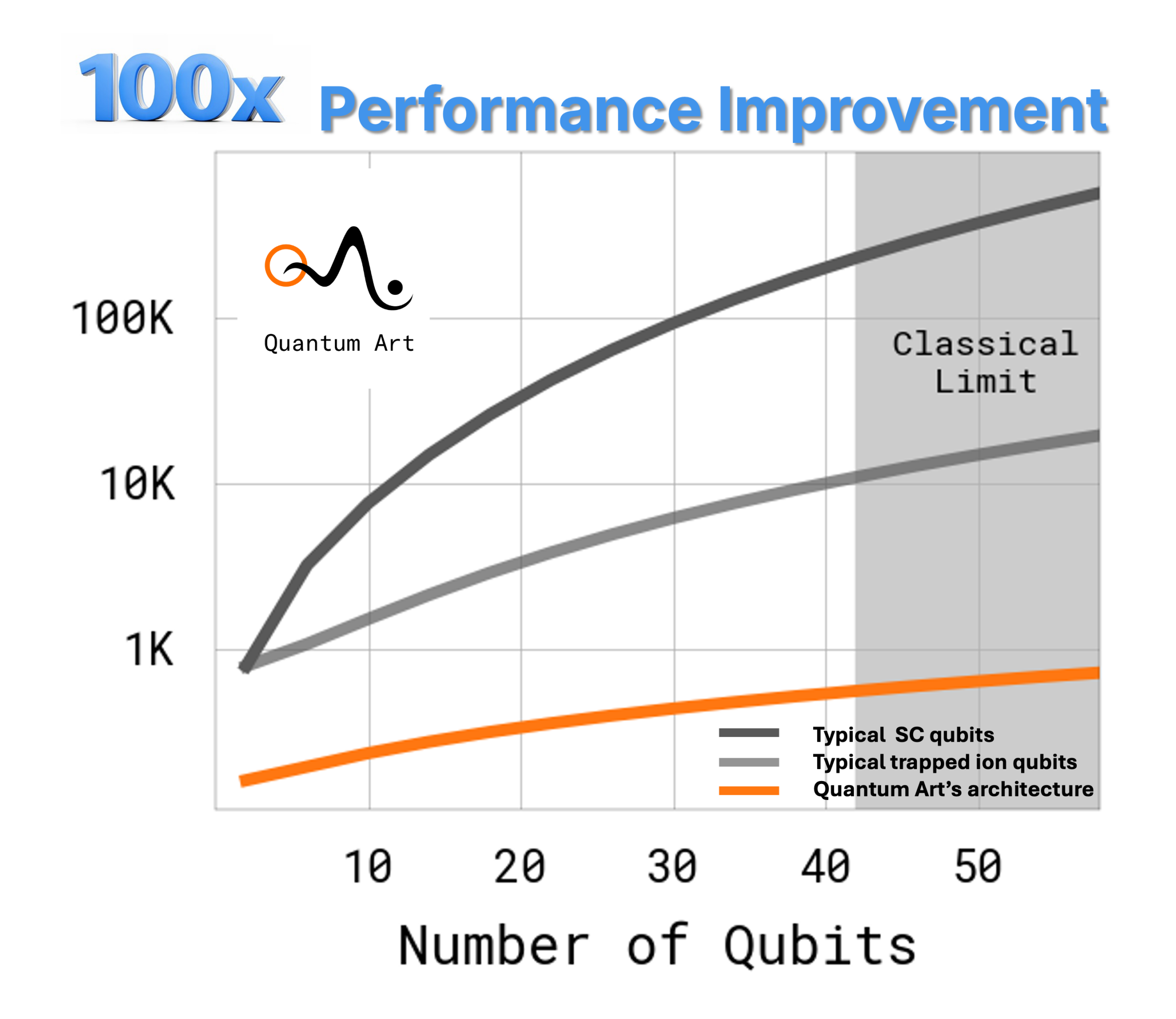
Quantum Art, an Israeli trapped-ion quantum computing company, has announced the successful completion of a joint project with a leading Israeli governmental R&D agency to model electromagnetic wave propagation. The collaboration resulted in a quantum algorithm capable of simulating wave behavior across volumes spanning tens of cubic kilometers at centimeter-level resolution. This level of detail requires approximately 1018 sampling points—a scale that forces classical supercomputers to make significant trade-offs between accuracy, coverage area, and energy consumption.
The algorithm leverages Quantum Art’s unique trapped-ion architecture and its multi-qubit gate capabilities. By compressing complex partial differential equation (PDE) operations into fewer computational steps, the architecture significantly reduces circuit depth. Benchmarking results demonstrated a 100× performance improvement over a leading superconducting platform and a 10× improvement over rival trapped-ion approaches. This efficiency allows the algorithm to represent massive grids using only ~60 qubits, making such high-fidelity simulations achievable on near-term quantum hardware.
Founded in 2022 as a spin-off from the Weizmann Institute of Science, Quantum Art is currently scaling its technology following a $140 million Series A funding round. The company is working toward its 1,000-qubit “Perspective” platform, utilizing a multi-core architecture and linear trapped-ion chains. The success of this wave propagation project highlights the potential for quantum-accelerated solutions in mission-critical communications, wireless coverage planning, and other engineering domains reliant on large-scale PDE modeling.
You can find the official announcement regarding Quantum Art’s wave propagation algorithm here.
May 5, 2026

