Trapped-ion quantum hardware developer Quantum Art has released comprehensive numerical simulations verifying that its proprietary multi-qubit (MQ) gate architecture is fully compatible with large-scale quantum error correction (QEC). Historically, the quantum computing sector has targeted fault-tolerant pathways constructed almost exclusively from dense sequences of isolated single- and two-qubit operations, leaving open questions regarding whether simultaneous, broad entangling operations would cause catastrophic, long-range error propagation. Quantum Art’s validation bridges device-level atomic physics and macroscopic code performance, demonstrating a stable fault-tolerance threshold at the practical 1% level when evaluated against standard rotated surface code topologies.
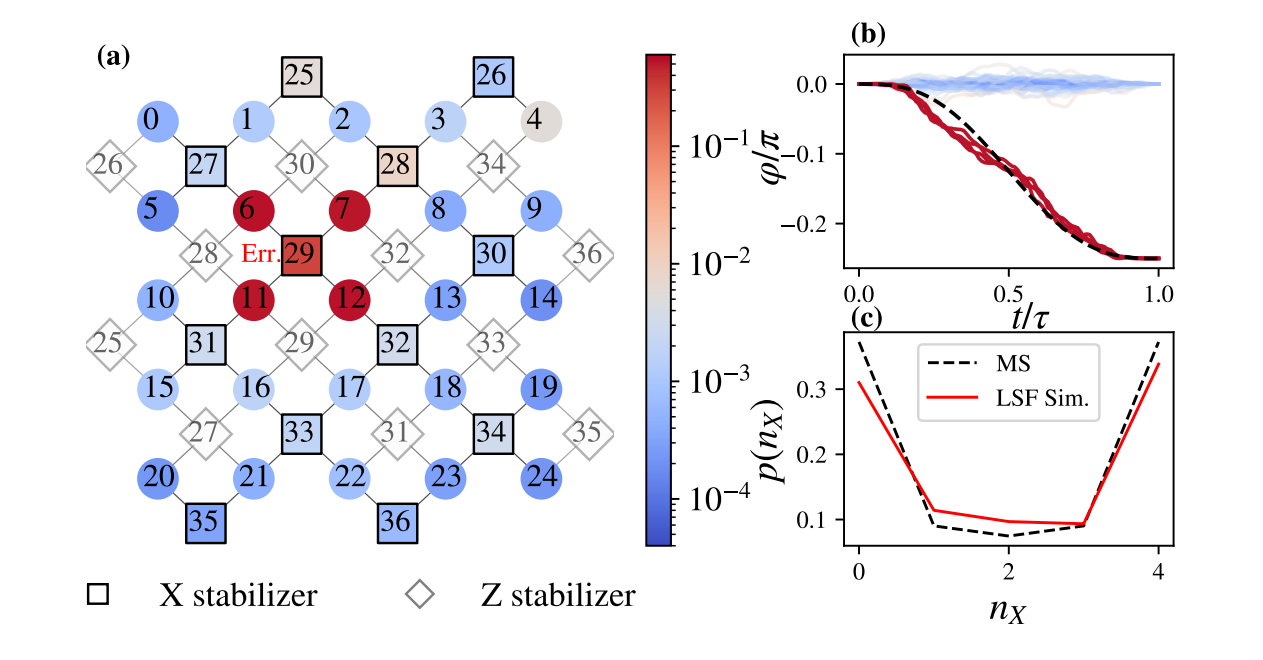
To model physical hardware imperfections accurately, researchers constructed a highly detailed microscopic noise model tracking the core experimental error sources unique to multi-body Mølmer-Sørensen spin-phonon interactions. The simulation profiles revealed that ambient photon-scattering events generate correlated errors exclusively among active ions explicitly tied to the instantaneous MQ gate coupling matrix, avoiding broader leaks. Concurrently, parasitic phonon heating and motional dephasing behaviors were mathematically captured as effective stochastic single- and two-qubit Pauli error channels. Crucially, the median error magnitude between structurally uncoupled ions remained suppressed, proving that error propagation within all-to-all connected ion chains scales predictably and stays localized within the predefined gate connectivity mapping.
The verification solidifies Quantum Art’s engineering roadmap toward constructing multi-core, software-compressed trapped-ion processors capable of running deep quantum circuits. Because global multi-qubit entangling gates allow developers to execute complex parallel processing steps simultaneously, the framework yields massive circuit depth compression and drops overall physical control hardware footprints by orders of magnitude. This validated fault-tolerant framework underpins the development of Quantum Art’s upcoming Perspective platform—a 1,000-qubit multi-core processing system engineered to isolate dozens of highly stable logical qubits for industrial optimization and material simulations—as well as its next-generation, high-density Landscape series QPUs.
The official commercial press release detailing the scaling milestone can be reviewed here. For the comprehensive scientific publication tracking the underlying microscopic noise channels, Mølmer-Sørensen driving field derivations, and rotated surface code threshold crossings, access the peer-reviewed preprint on arXiv here.
June 16, 2026

