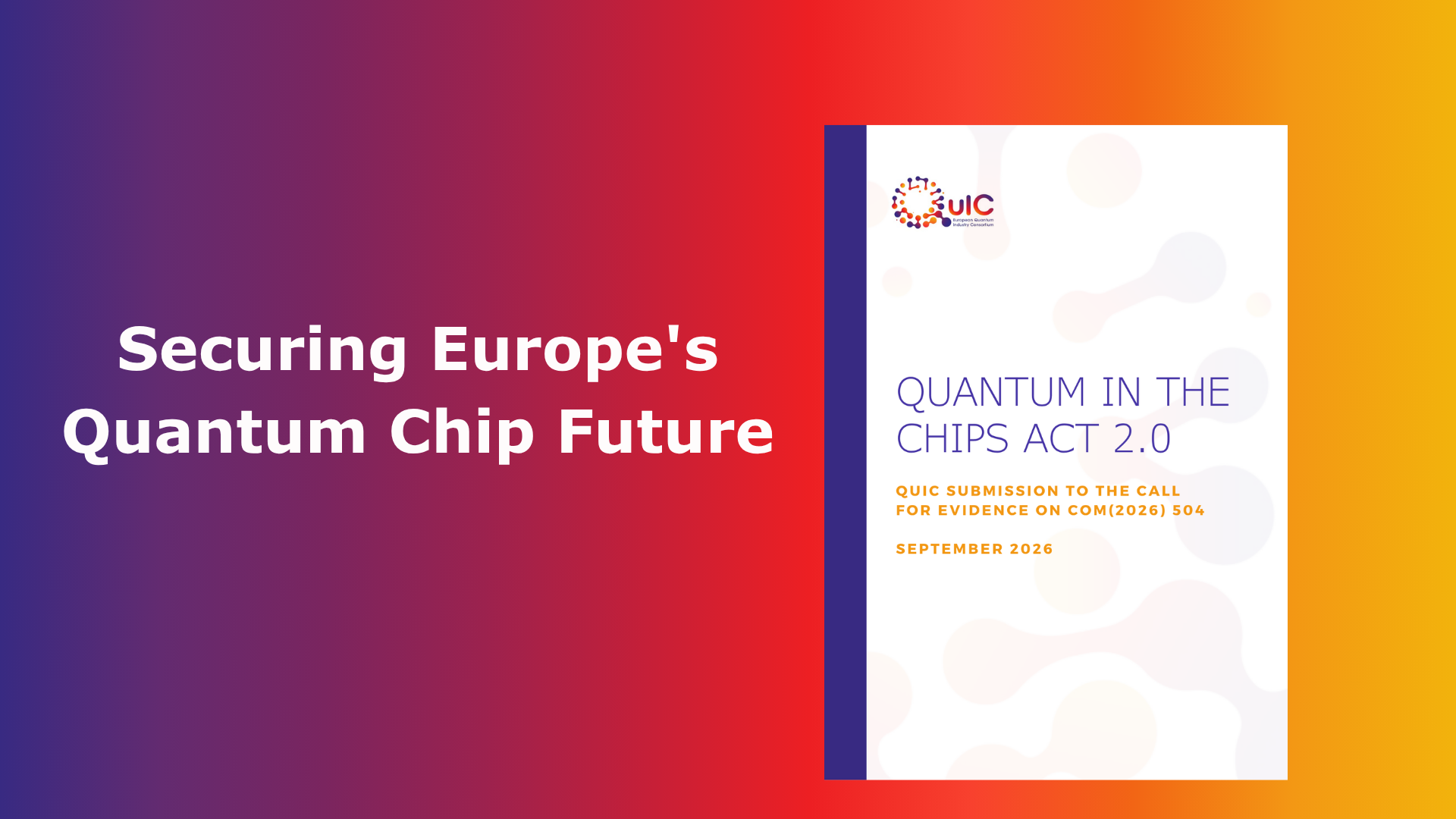
QuIC Whitepaper Calls for Industrial Scale-Up Infrastructure in EU Chips Act 2.0
The European Quantum Industry Consortium (QuIC) has published a whitepaper response to the European Commission’s Chips Act 2.0 proposal (COM(2026) 504), urging EU policymakers to establish concrete industrialization pathways to bridge the gap between quantum chip prototyping and production-grade fabrication.
While QuIC welcomed the continued recognition of quantum chips and six EU quantum pilot lines, covering superconducting (SUPREME), spin (SPINS), photonic (P4Q), diamond (DIREQT), neutral-atom (Q-PLANET), and trapped-ion (CHAMP-ION) modalities, it warned that current proposals lack dedicated mechanisms to deliver industrial-scale manufacturing.
QuIC highlighted recent international transactions that consolidate neutral semiconductor foundries into vertically integrated quantum companies, threatening European supply-chain resilience. These include IBM committing over $10 billion to quantum initiatives, establishing Anderon, a pure-play quantum wafer foundry supported by the U.S. Department of Commerce, and acquiring HRL Laboratories, alongside IonQ completing its acquisition of SkyWater Technology, the largest exclusively U.S.-based semiconductor foundry and an accredited Category 1A Trusted Foundry for U.S. defense programs.
Because most European quantum hardware firms rely on neutral process foundries rather than owning private fabrication plants, QuIC noted that European access to commercial-grade quantum fabrication currently rests on voluntary, revocable terms set outside the Union.
| [ Key Industry Infrastructure Gaps Identified by QuIC ] | |
|---|---|
| Research & Prototyping (Current EU Focus) | Production-Grade Industrialization (Required) |
| • 6 EU Quantum Pilot Lines | • Multi-Project Wafer (MPW) Shuttle Runs |
| • Basic Cleanroom Prototyping Access | • Open-Access Sub-Kelvin Cryo-Testing |
| • Telecom/Datacom Photonic Baselines | • Cryogenic PDKs & Assembly Libraries |
| • Lab-Scale Device Characterization | • Visible & Deep-UV Photonic PDKs |
To build sustainable European fabrication capacity without requiring a multi-billion-euro foundry immediately, QuIC outlined several core recommendations for the European Parliament and Council:
1. Strategic Project Status (Article 19): Extend Article 19 strategic-project status to quantum foundries, ensuring a clear legal framework exists when quantum manufacturing processes reach industrial maturity.
2. Multi-Project Wafer (MPW) Program: Establish a subsidized European MPW shuttle calendar to provide affordable, shared fabrication access for quantum startups and SMEs.
3. Cryogenic & Packaging Infrastructure: Fund shared cryogenic testing, high-volume characterization, and advanced packaging facilities across the 2 K, 4 K, and millikelvin temperature ranges.
4. Visible & Ultraviolet Photonics: Expand the Chips Act photonics objectives beyond telecom wavelengths (near-infrared) to include visible (400 to 800 nm) and deep-UV (295 to 325 nm) photonics required by trapped-ion and neutral-atom architectures.
5. Small-Scale & In-House Production Routes: Provide accessible designations for fast-turnaround, small-scale fabrication facilities that do not meet the strict “first-of-a-kind” requirement.
QuIC also called for structural alignment between the Chips Act 2.0 (governing chip-level fabrication and PDKs) and the upcoming EU Quantum Act (governing systems, software, standards, and public procurement).
Review the full whitepaper on the QuIC Portal here and access the full PDF manuscript via QuIC Whitepaper Downloads here.
October 10, 2026