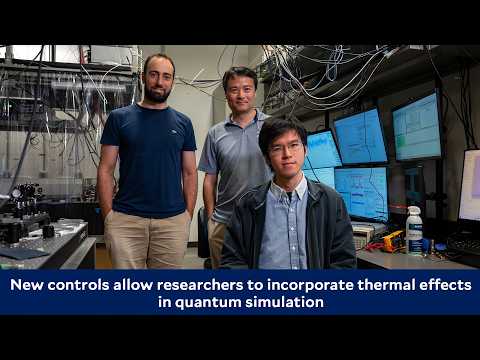
Physicists at Rice University have developed an experimental reservoir-engineering scheme that introduces independently tunable temperatures and dissipation rates to the vibrational modes of a trapped-ion quantum simulator. Published in Physical Review Letters (“Experimental Realization of Thermal Reservoirs with Tunable Temperature in a Trapped-Ion Spin-Boson Simulator“), the technique enables open-system quantum simulations of chemical reactions, charge transfer, and molecular exciton dynamics under realistic thermodynamic conditions.
                [ Rice University Engineered Thermal Reservoir Architecture ]
                                              │
     ┌────────────────────────────────────────┴────────────────────────────────────────┐
     ▼                                                                                 ▼
  Controlled Electric-Field Heating                                 Targeted Laser Cooling
  • Broadcasts RF Signals with Stochastic Phases.                  • Removes Phonon Excitations from Selected Modes.
  • Delivers Random "Kicks" to Phonon Crystal.                     • Controls Dissipation & Equilibration Rates.
  • Induces Motional Heating (Tunable Bath Temp).                 • Stabilizes Finite-Temperature Steady States.
The protocol overcomes a long-standing constraint in trapped-ion quantum simulation: while previous experiments operated either near absolute zero (ground state) or under unconstrained heating (effectively infinite temperature), the Rice framework establishes precise, continuous control across intermediate finite temperatures:
- Dual-Knob Environmental Control: By balancing a laser-cooling beam (which removes phonon excitations) against broadcast electric-field signals with stochastic phases (which inject random vibrational “kicks”), the researchers independently tune both the dissipation rate (γ) and the thermal bath temperature (T / average phonon occupation ⟨n⟩).
- Probing Finite-Temperature Charge Transfer: Using a dual-species trapped-ion chain to simulate Linear Vibronic Coupling (LVC) models, the team observed how finite temperatures alter electron transfer dynamics between donor and acceptor molecular sites. At higher temperatures, thermal population redistribution across hybridized adiabatic energy surfaces broadened the transfer rate spectrum—suppressing rates at small donor-acceptor energy gaps while enhancing them at larger gaps.
- Thermally Activated Exciton Pathways: In a two-mode vibrationally assisted exciton transfer model, local temperature control revealed thermally activated coherent interference pathways, opening new routes for simulating light-harvesting complexes, photosynthesis, and catalysis.
Led by Assistant Professor of Physics and Astronomy Guido Pagano and lead author Visal So, the experimental framework provides a scalable tool for thermal-state preparation, open quantum system modeling, and dissipative quantum state engineering across trapped-ion platforms.
Review the research study in Physical Review Letters here, read the press announcement on Rice University News here.
August 14, 2026