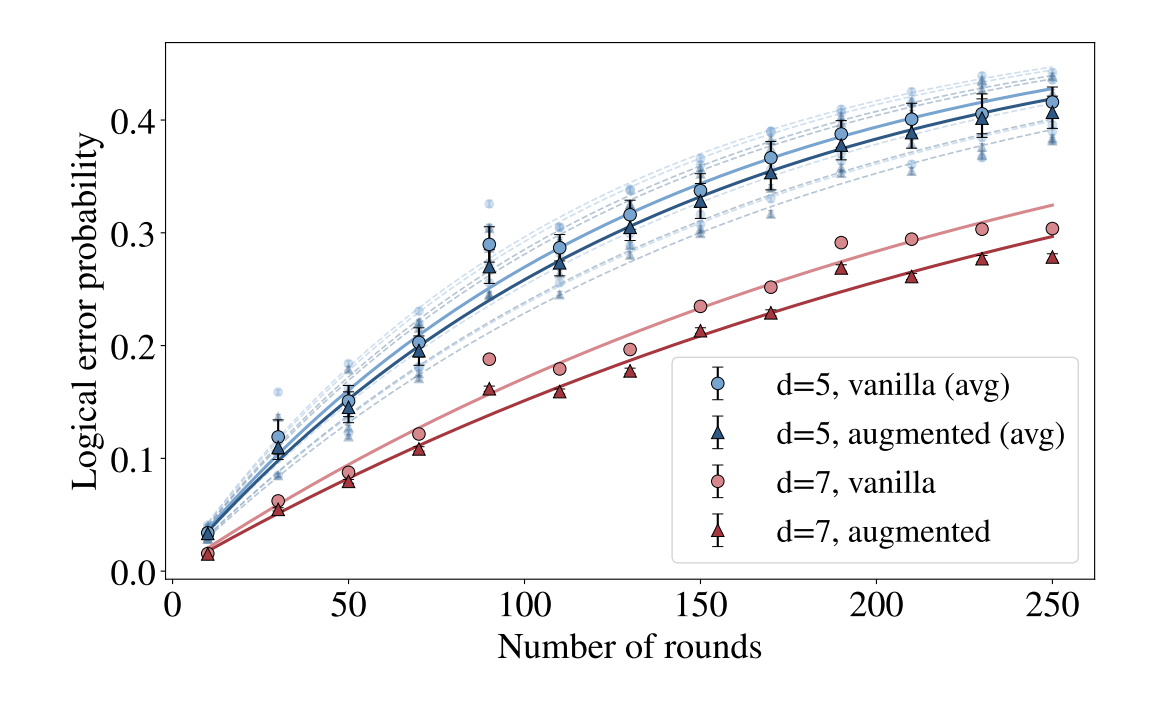
Riverlane has demonstrated a data-driven method to identify unmodeled correlated error mechanisms directly from syndrome measurement data, improving decoding accuracy in surface-code architectures. The technique augments standard Detector Error Models (DEMs) by extracting physical noise correlations omitted from baseline theoretical models, reducing logical error rates by up to 75% in numerical simulations and 14% on physical superconducting hardware.
| Riverlane DEM Augmentation Methodology & Benchmarking Profile | ||
|---|---|---|
| Dimension | Technical Specification | Architectural Significance |
| Core Technique | Pairwise combination of known base mechanisms to discover higher-order hyperedges. | Identifies unmodeled correlated noise mechanisms directly from syndrome firing statistics. |
| Logical Assignment | XOR composition of constituent mechanism logical effects. | Ensures discovered hyperedges correctly update logical observables during decoding. |
| Decoder Compatibility | Hyperedge decomposition into constituent graph edges and singletons. | Preserves compatibility with two-pass correlated graph decoders such as PyMatching. |
| Simulated Benchmark (d=15) | 75% logical error rate reduction; 20% increase in Λ (distances 7–15). | Evaluated under SI1000 noise with correlated two-qubit XX crosstalk terms. |
| Hardware Benchmark (d=7) | 14% logical error rate reduction; 9% increase in Λ (distances 5–7). | Demonstrated using public below-threshold surface-code data from Google Quantum AI. |
Graph-based decoding algorithms depend on accurate decoder priors defining the likelihood and structure of physical error channels. Standard analytical noise models fail to capture multi-qubit physical noise such as crosstalk. Prior mitigation strategies have focused on reweighting known baseline mechanisms, while previous methods attempting to extract new hyperedges from empirical data lacked defined logical operator assignments or decomposed hyperedge structures, preventing their integration into fast graph-based matching solvers.
The pipeline evaluates candidate higher-order mechanisms formed exclusively from combinations of pre-existing elements in the baseline DEM. This bounds the search space and ensures that each discovered hyperedge inherits both an unambiguous logical operator effect and a valid decomposition. Candidate mechanisms undergo pairwise correlation screening, higher-order probability validation via joint detection inversion, and recurrence-edge aggregation to pool identical physical noise mechanisms across operational rounds without inflating parameter overhead.
In planar surface-code simulations combining standard SI1000 circuit noise with correlated two-qubit XX crosstalk (pcorr = 3 × 10⁻⁴), the augmented DEM achieved an error suppression factor of Λ = 2.06 ± 0.01 across distances 7 to 15, compared to Λ = 1.71 ± 0.01 for the unaugmented baseline. At distance 15, the logical error rate decreased by 75%. Applied to Google’s below-threshold superconducting experimental dataset, the augmented priors yielded an error suppression factor of Λ = 2.02 ± 0.06 across distances 5 to 7—a 9% improvement over baseline reinforcement-learning-optimized priors—and lowered the distance-7 logical error rate by 14%.
Full algorithmic derivations and experimental benchmark comparisons are detailed in the arXiv Research Paper here and through Riverlane’s Technical Announcement here.
November 7, 2026