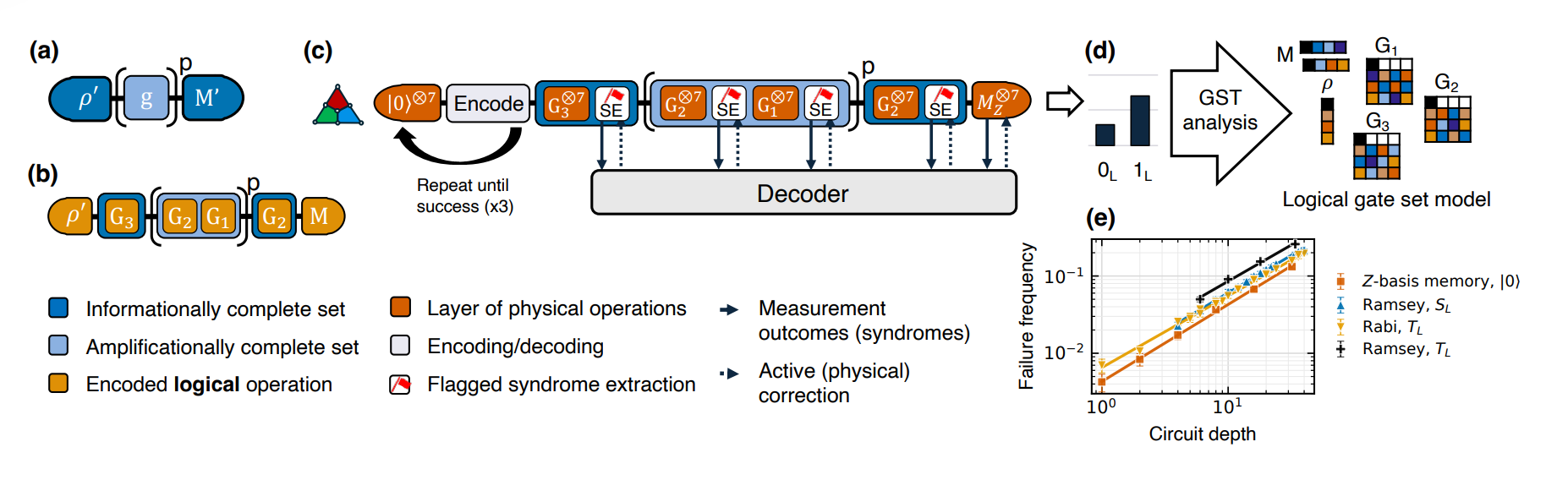
In a joint study published on arXiv under the title Logical Gate Set Tomography, researchers from Sandia National Laboratories and Quantinuum have introduced “Logical GST.” Executed as the final experimental campaign on the 20-qubit trapped-ion Quantinuum System Model H1-1, the work provides the first self-consistent, full tomographic reconstruction of a universal single-qubit logical gate set, extending physical-layer characterization protocols to encoded, fault-tolerant operations.
The protocol was implemented on a single logical qubit encoded in the [[7, 1, 3]] Steane code, using seven data qubits and six syndrome degrees of freedom. While standard logical benchmarking often relies on software-based Pauli-frame tracking—which can artificially twirl and mask coherent phase errors—the team executed active quantum error correction via real-time classical feedforward, applying physical correction pulses directly to the ions inside the gate zones. The characterized gate set comprised logical state initialization (|0⟩L), terminating measurement (MZ,L), transversal Clifford gates (HL, SL, IL), and a non-transversal TL gate implemented via magic-state injection and teleportation (achieving a 95.9% acceptance rate per attempt).
| Quantinuum H1-1 Logical Gate Set Tomography Specifications | ||
|---|---|---|
| Logical Operation | Entanglement Infidelity (εF) | Diamond Distance Error (ε⋄) |
| Hadamard (HL) | 0.7 ± 0.4% | 1.3 ± 1.9% |
| Phase (SL) | 0.2 ± 0.4% | 1.3 ± 2.5% |
| Identity / QEC Cycle (IL) | 1.7 ± 9.2% | 3.2 ± 16.8% |
| Non-Clifford (TL) | 1.2 ± 1.5% | 2.1 ± 3.9% |
| Initialization (|0⟩L) | 0.0 ± 2.3% (State Infidelity) | — |
| Measurement (MZ,L) | 0.1 ± 1.4% | 0.7 ± 2.1% |
Fault-tolerant threshold theorems typically assume that quantum error correction converts complex physical noise into simple, uncorrelated Pauli-stochastic channels (independent bit and phase flips). In the experimental H1-1 dataset (Nshots = 50 across 158 compressed circuits), Logical GST confirmed this assumption: the data aligned with a Pauli-stochastic model (NσS < 1) with no statistically significant non-Markovian memory effects (NσCPTP < 2). However, because low shot counts limit statistical resolution, the authors duplicated the protocol across 14,100-shot simulations using Quantinuum’s high-fidelity H1-1E emulator.
The high-shot emulation revealed small but statistically significant logical non-Markovianity (NσCPTP ≈ 4.9) and definitive evidence of coherent logical over-rotations (Δθ ≈ 0.0015π on SL, IL, and TL). By systematically toggling error channels in the emulator, the researchers proved that physical dephasing accumulated during ion transport and sympathetic cooling serves as the primary mechanism generating coherent logical drift. Furthermore, the analysis demonstrated that non-Markovian dynamics can emerge directly from the syndrome extraction cycles of completely Markovian physical noise. The methodology provides a platform-agnostic framework to verify whether scaling fault-tolerant QPUs conform to the noise models required by modern decoders.
The research paper is accessible on arXiv here, with corporate commentary shared via Quantinuum’s Technical Announcement here.
October 30, 2026