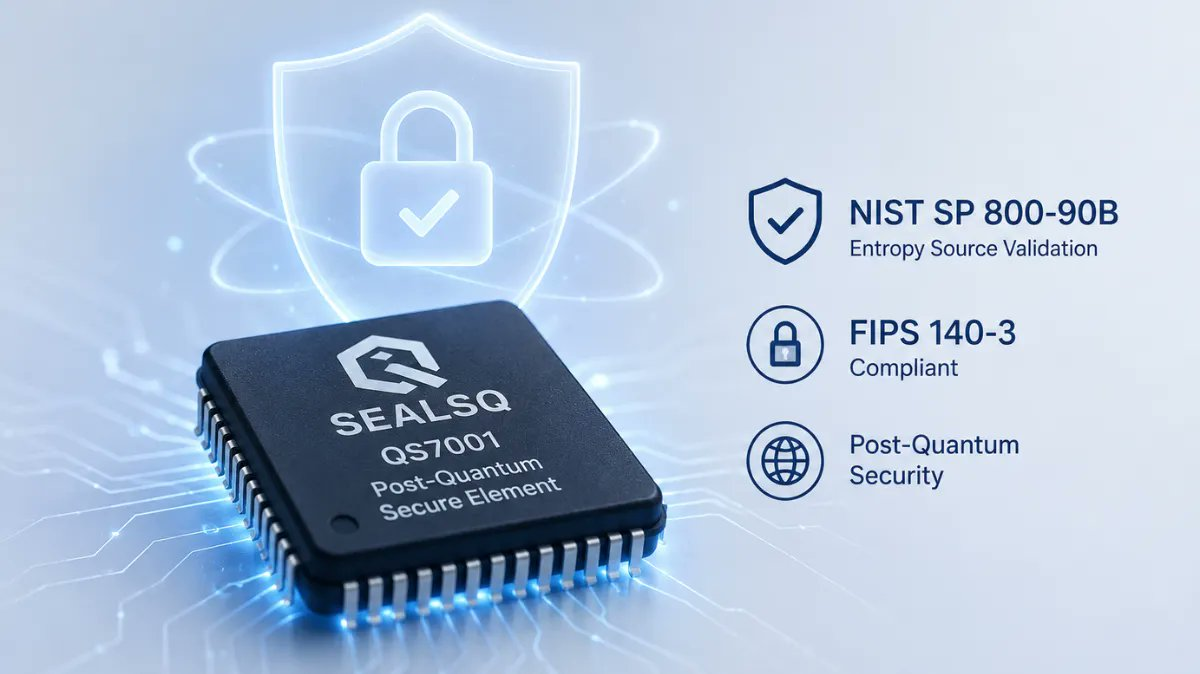
Post-quantum semiconductor provider SEALSQ Corp has secured the National Institute of Standards and Technology (NIST) Entropy Source Validation (ESV) Certificate #E333 for its QS7001 Post-Quantum Secure Element. Evaluated under the NIST SP 800-90B standard by accredited laboratory SERMA Safety and Security, this validation confirms the performance parameters of the chip’s internal random bit generation hardware. Because a verified baseline of physical unpredictability is a mandatory architectural requirement under modern cryptographic assessment frameworks, completing this evaluation serves as a core technical prerequisite for the hardware platform as it advances toward formal FIPS 140-3 and Common Criteria EAL5+ security certifications.
Stochastic Modeling of Ring Oscillator Hardware Entropy
The architectural layer validated inside the QS7001 utilizes a hardware noise mechanism built from a series of interconnected ring oscillators. To translate the raw thermal jitter and phase noise of these silicon components into standardized, bias-free cryptographic keys, engineering teams at SEALSQ’s facility in Meyreuil, France, working alongside their chip design subsidiary IC’ALPS, developed a rigorous mathematical stochastic model to continuously track physical noise source behaviors. This verified design has received an “Open for Reuse” status on the NIST Cryptographic Module Validation Program (CMVP) registry, allowing SEALSQ to port the exact ring-oscillator block into future hardware iterations, custom ASICs, and integrated partner modules without re-executing standalone lower-level entropy evaluations.
Regulatory Procurement and Target Enterprise Deployments
Securing validated physical entropy is an essential step in SEALSQ’s compliance roadmap for the QS7001, which is designed around a secure 32-bit RISC-V microcontroller core optimized to execute lattice-based post-quantum primitives such as ML-KEM and ML-DSA. Achieving standardized certification directly expands the hardware’s addressable envelope within regulated procurement channels across the United States and the European Union, where uncertified cryptographic elements are increasingly restricted by public sector defense mandates like CNSA 2.0. By anchoring its hardware root of trust to an approved entropy source, the platform provides a predictable deployment path for industrial internet-of-things (IoT) gateways, smart grid infrastructure, aerospace electronics, and embedded robotics controllers requiring verified protection against advanced cryptographic intercept threats.
The official validation registry entry can be reviewed directly via the active NIST Computer Security Resource Center database here. For secondary corporate timelines, technical semiconductor layouts, and implementation frameworks for the underlying hardware root of trust, read the primary overviews hosted by SEALSQ here.
June 6, 2026