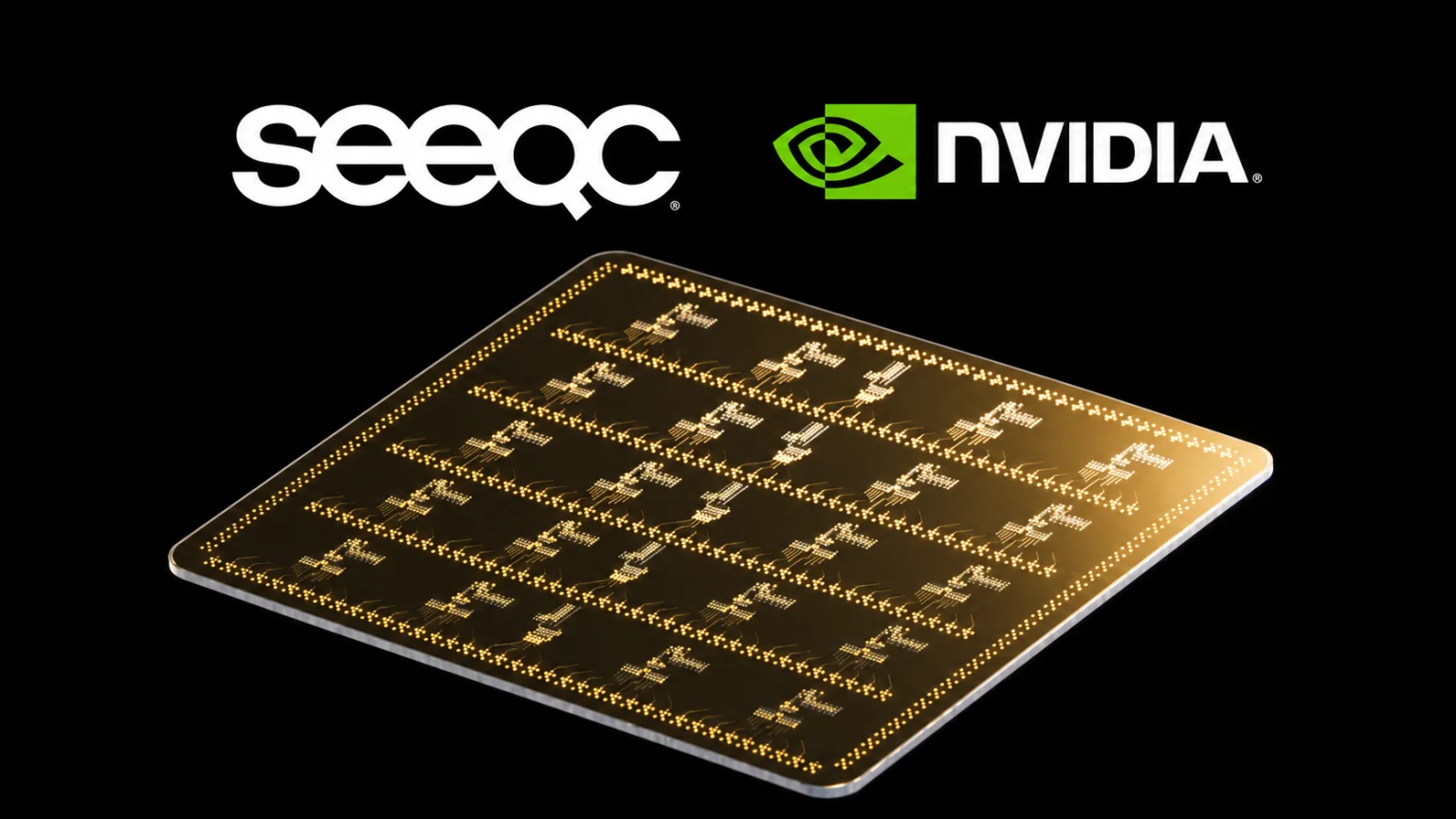
Digital quantum electronics developer SEEQC has announced results demonstrating significant performance improvements in quantum error correction (QEC) decoding by integrating its chip-scale pre-decoder technology with the NVIDIA Ising open AI model family across NVIDIA NVQLink interconnects.
Evaluated on a simulated fault-tolerant quantum processor stack incorporating realistic operational latency, SEEQC’s chip-based pre-decoder operated directly alongside NVIDIA Ising decoding algorithms over the low-latency SEEQC Digital Link and NVQLink frameworks. Compared to operating NVIDIA Ising as a standalone classical pre-decoder, the combined multi-stage architecture achieved an approximate 50% reduction in decoding latency and 50% improvement in logical error rates—two critical operational bottlenecks for real-time quantum error correction.
| [ SEEQC / NVIDIA Multi-Stage QEC Decoding Architecture ] | ||
|---|---|---|
| Architecture Layer | Integrated Technology | Performance & Scaling Functionality |
| • Near-QPU Pre-Decoder | • SEEQC Single-Flux-Quantum (SFQ) Digital Chip | • Filters and compresses syndrome data close to the QPU, reducing classical data transfer overhead. |
| • Low-Latency Interconnect | • SEEQC Digital Link & NVIDIA NVQLink | • Provides high-throughput, low-latency communication between cryo-electronics and GPU nodes. |
| • GPU Acceleration Engine | • NVIDIA Ising AI Decoder Family | • Executes high-level neural/probabilistic decoding workloads on GPU clusters. |
| • System Performance Gains | • Combined Multi-Stage Stack Validation | • 50% latency reduction and 50% logical error rate improvement over standalone pre-decoders. |
By shifting initial syndrome filtering and preliminary decoding tasks to cryogenic SFQ digital chips located adjacent to the quantum processing unit (QPU), SEEQC drastically reduces the bandwidth and data movement required to transmit raw syndrome measurements to room-temperature GPU clusters. The multi-stage design mitigates exponential decoding overheads, paving the way for direct chip-to-chip integration between superconducting QPUs and GPU-accelerated High-Performance Computing (HPC) nodes for quantum AI workloads.
Review the announcement via SEEQC Resources here.
October 22, 2026