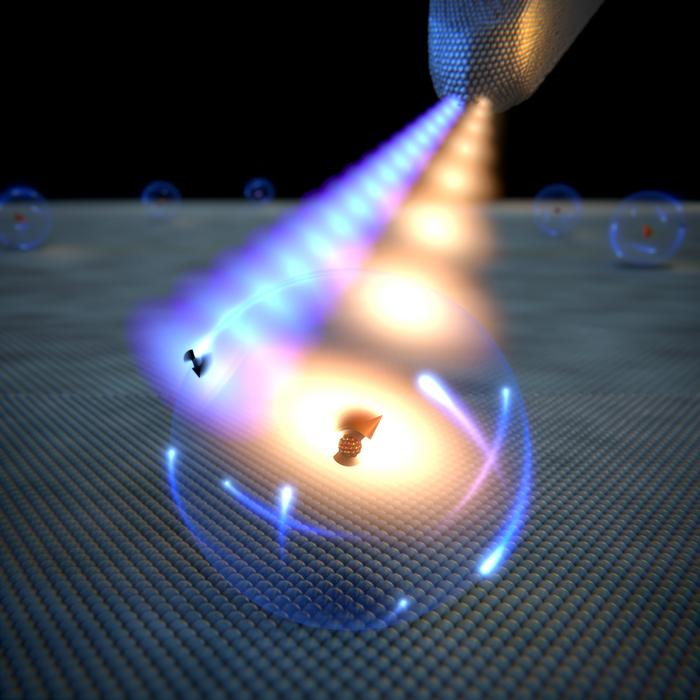
Physicists at Delft University of Technology’s Kavli Institute of Nanoscience have demonstrated direct nuclear magnetic resonance (NMR) control over a single surface-adsorbed atom, achieving coherent nuclear addressing without relying on electron-nuclear spin hybridization. Published in Nature Communications under the title Nuclear magnetic resonance on a single atom with a local probe, the study introduces an Electron-Nuclear Double Resonance (ENDOR) measurement scheme into an ultra-low-temperature (0.4 K) scanning tunneling microscope (STM). The demonstration verifies that an isolated nuclear spin can be driven directly by local radio-frequency fields at high magnetic fields, opening an avenue for atomic-scale quantum memory registers and high-dimensional qudits.
| Single-Atom ENDOR Architecture and Physical Parameters | ||
|---|---|---|
| Parameter | Experimental Specification | Quantum Hardware Significance |
| Physical Platform | Isolated 47Ti atom on bilayer MgO/Ag(100) | Couples an S = 1/2 electronic spin to an I = 5/2 nuclear spin (6-level system). |
| Excitation Scheme | Dual-frequency ENDOR (GHz ESR + MHz NMR) | Separates the electronic readout channel from direct nuclear state manipulation. |
| Decoupled Field Regime | Bz = 200 mT to 1,400 mT (1.4 Tesla) | Suppresses electron-nuclear hybridization by ~10×, preserving intrinsic nuclear lifetimes. |
| State Selectivity | Quadrupole splitting (Q = −2.8 ± 0.8 MHz) | Lifts transition degeneracy, allowing independent addressing of nuclear spin sublevels. |
| Dominant Drive | RF electric-field-induced oscillating magnetic field | Enables transitions without needing system-dependent hyperfine or quadrupole modulation. |
Because atomic nuclei have magnetic moments roughly three orders of magnitude smaller than electrons, they remain well shielded from environmental noise, yielding surface relaxation lifetimes on the order of seconds. Historically, addressing single nuclear spins with an STM required strong hyperfine hybridization at low fields (≤ 100 mT), which mixes the states and collapses that environmental isolation. By scaling magnetic fields up to 1.4 T, the Delft team operated where the electronic Zeeman energy dominates, demonstrating that the 47Ti nucleus can still be driven in the 50–85 MHz range while the GHz electronic channel provides spin-polarized readout. While full coherent quantum gate control will require pulsed-wave sequencing rather than continuous RF driving, the platform proves that atomic-scale nuclear qudits can be integrated into engineered surface lattices.
Technical details and spectroscopy datasets are published in Nature Communications here, with institutional perspectives outlined via the TU Delft News Release here.
October 30, 2026